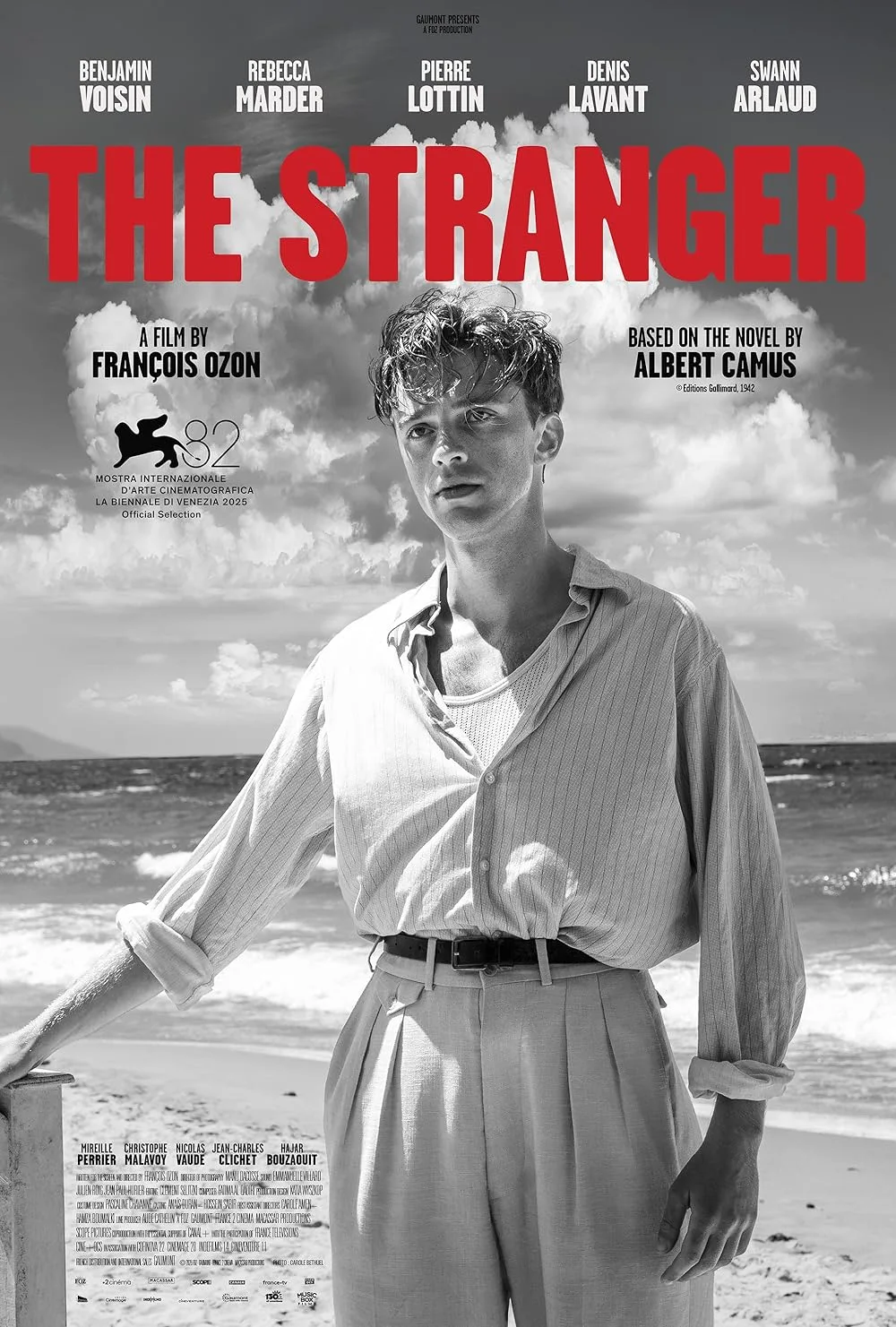
François Ozon’s adaptation of Albert Camus’ 1942 existentialist novel, taken to a horrific extreme, begins with the logo of Gaumont Studio, the French production company, as it would have appeared in an actual 1940s film. Because Ozon is a frequently playful filmmaker who delights in playing with form, a viewer might expect a slightly ironic treatment of the galvanic work.
The story itself, narrated by its main character Mersault in the book, is as simple as death: A French man living in the capital of Algeria, then a French colony, shoots and kills an Arab man—an “indigene,” as he’s called in the current circumstance—for no other reason than his inclination in the moment. And the unfortunate fact that he, of course, happens to have a gun on his person. Later, when he’s convicted of the crime and sentenced to be beheaded, he reflects on what he did. The best he can come up with is that he “upset the balance of the day.” And so he goes to his death. It matters nothing, he believes, whether he lives to be 30, his current age, or 70, which he’s more or less made sure he’ll never see.
The plot details I’m revealing here may be considered spoilers, but if I truly believed they were, I wouldn’t be mentioning them. Camus’ work functions, philosophically, as a kind of mathematical proof. What makes the movie worth experiencing will differ for the viewer conversant with the book and the viewer who isn’t. But I think the experience will be equally rewarding for either, thanks to the movie’s emotional heft and impeccable craft.
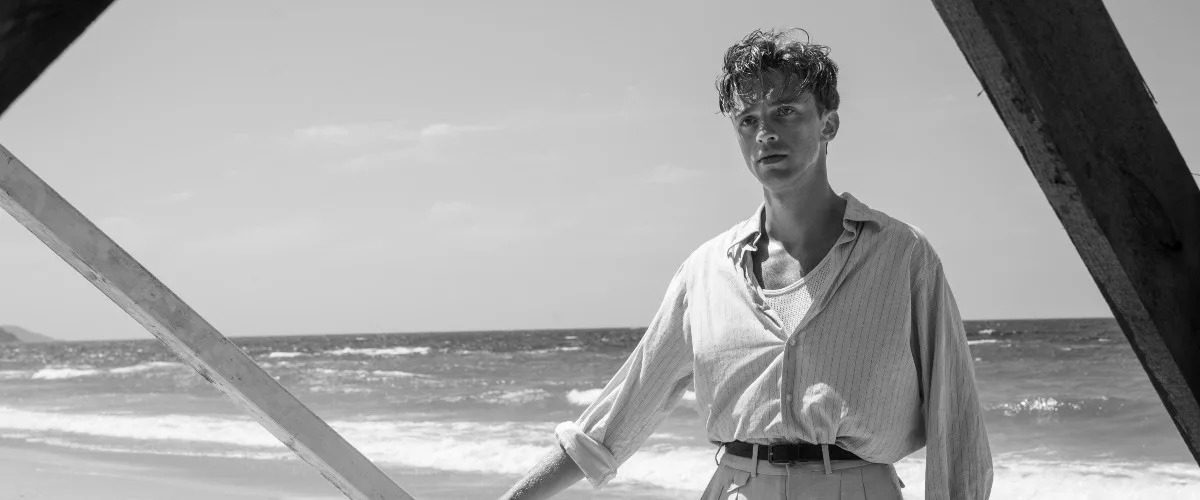
Ozon’s leading man, Benjamin Voisin, has matinee idol looks, and Rebecca Marder, as Marie, his girlfriend who can’t fathom his frankly stated emotional indifference to her, their ardent lovemaking notwithstanding, is equally attractive. They enjoy their time in Algiers, announced in a fake travelogue in the film’s opening as “le premier sourire du Algeria,” “Algeria’s first smile.” They swim, they sunbathe, they see a Marcel Pagnol film starring the immortal French comic actor Fernandel.
Meursault befriends a glib neighbor who may be pimping his Algerian girlfriend, who happens to be the sister Meursault confronts with the aforementioned gun. Another neighbor, played with restraint by the occasionally baroque actor Denis Lavant, admires Meursault for the kindness the young man has shown to his dog. There’s so much about Meursault that’s normal to the point of banality. But that changes as he stares at the sun as it glints off the pocket knife a young Arab toys with while staring back.
While Ozon only occasionally has Meursault narrate his own actions, as happens in the book, when he does, the words are lifted precisely from the text. He understands that he doesn’t need anything else. And while he closes the film with a famous rock song that tells the story of the book, even that, ultimately, doesn’t feel like a wink; rather, it’s an acknowledgement of the way Camus’ vision lives on.
The intensity of “The Stranger” reminds us that Ozon has, in addition to his elaborations of and fantasias on queer themes, like his 2022 Fassbinder riff “Peter von Kant,” directed some of the most credible non-supernatural horror movies of our time, going all the way back to 1997’s “See The Sea.” Make no mistake: this is a horror film; as you stare at the screen, the abyss it represents stares back at you.