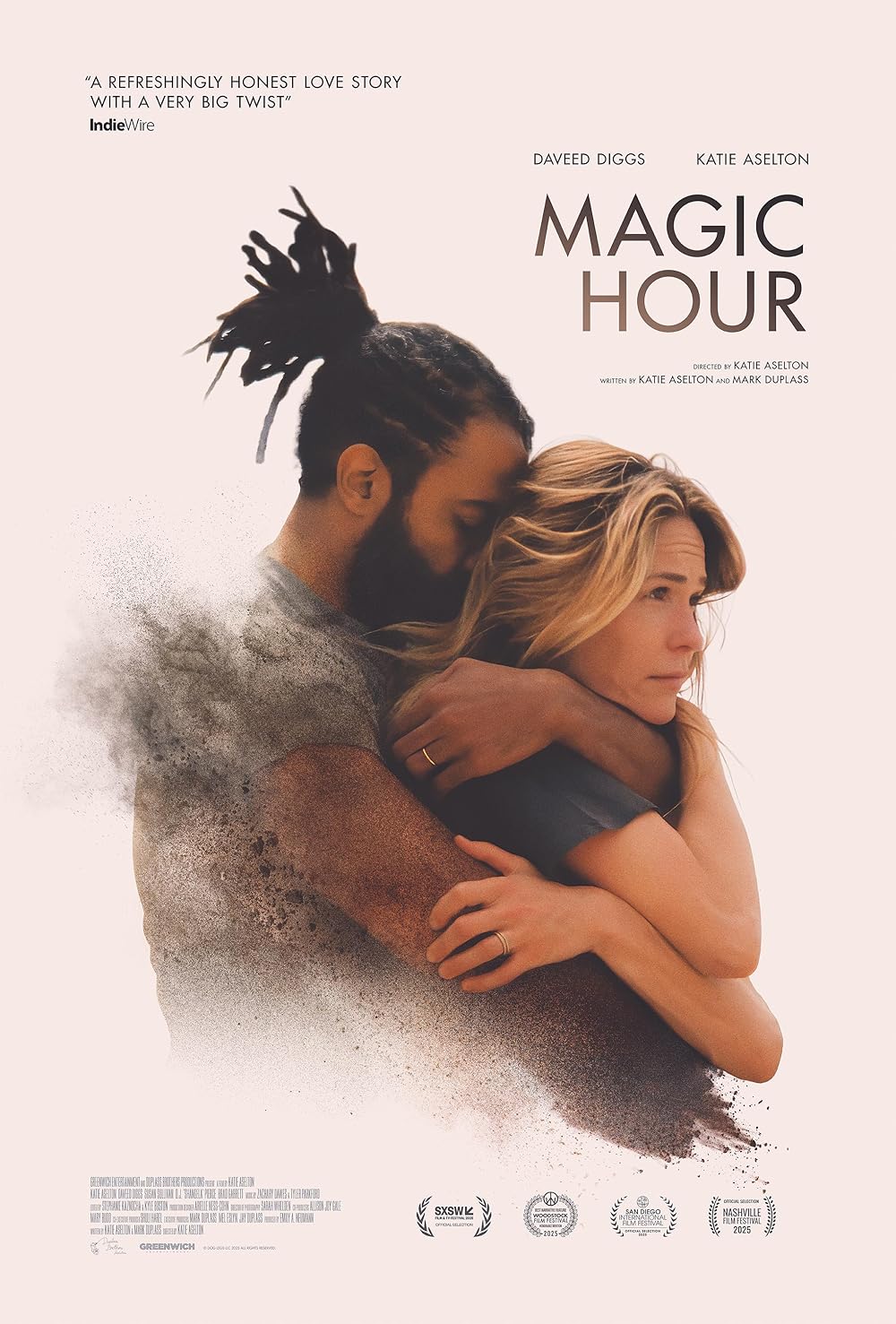
The IMDb synopsis of “Magic Hour,” a drama starring Katie Aselton and Daveed Diggs, reads: “Erin and Charlie escape to the desert to navigate an unexpected and challenging new phase of their relationship.” Well, sure—that’s one way of putting it. There’s another way of putting it that’s an automatic spoiler. So if you think you might want to watch “Magic Hour” at any point in the future, you should bow out of this review when you encounter the period at the end of this paragraph.
As we all know, every meaningful relationship goes through difficult phases, whether it’s a parent and child, a caregiver and the person they watch over, or, in this case, a man and woman who’ve been a couple for a long time, despite severe tests of their bond. Aselton, who also directed and co-wrote “Magic Hour” (with her husband, filmmaker Mark Duplass), plays Erin, the troubled heroine. Erin has booked a cabin in Joshua Tree National Park in southwestern California so she and her guy, Charlie (Diggs), can work through their most recent crisis.
The crisis is that the dude is dead. Deader than disco, Julius Caesar, and that parrot in the Monty Python sketch.
You know those major characters you initially assume are living persons but are revealed to be dead or a figment of someone’s imagination? They seemed to be all over cinema and TV from roughly the late 1990s through about ten years ago. That’s Charlie, who’s handsome and charming and flaky and a bit slippery, ethics-wise, and yup, no longer with us. In a better place. Perished. Departed. Bought the farm. Gone boating on the Styx.
You’ll deduce the twist the first time another character (Brad Garrett, as a longtime friend who owns the house) encounters the couple and addresses Erin warmly while barely acknowledging Charlie’s presence (the acknowledgment is a feint; he was really replying to something Erin said). Or maybe you’ll figure it out a few scenes later, when the couple argues about the event that brought them to Joshua Tree, but never names it.
Thankfully, although “Magic Hour” would’ve been better off not going all “Harvey” on us, at least they dispense with the charade around the twenty-minute mark. But that leaves 50 more minutes to fill somehow. Aselton and Duplass’ solution is to turn those fifty minutes into a showcase for Aselton as a performer, writer, and filmmaker. Aselton has done excellent work in all three disciplines (rent the 2012 survival thriller “Black Rock” if you want to see what she can do as a director). She’s excellent playing Erin, despite scenes of questionable worth concocted by the screenwriters. But it’s not enough to save a collection of ideas that never quite cohere.
In theory, “Magic Hour” has already jumped the broom into magical realism from the moment it begins. But it never feels as if it’s comfortable enough to make the leap into full-bore surrealism—or even a more modest, non-alienating kind of dreaminess—despite such unusual elements as the out-of-nowhere arrival of drag performers who give Erin a makeover and sparkly new dress; some editing (by Stephanie Kaznocha and Kyle Boston) that shuffles between past and present; and a finale that seems like it’s pushing against literalism but is actually stopping a few millimeters shy of obviousness.
The movie does the latter a few other times, notably when Garrett’s character assures Erin she’s gonna love how beautiful it gets when daylight is over, but night hasn’t officially begun. “It isn’t day, but it isn’t night, either, but it’s this beautiful in-between.” That wouldn’t happen to be the magic hour, perchance?
The movie has its strong points, notably Sarah Whelden’s cinematography, which seems to intensify Joshua Tree’s beauty without making it look pretty or slick, and the central performances, which are better overall than the movie itself. Garrett’s long showpiece scene late in the story confirms what a quietly powerful actor he can be. Also noteworthy: Susan Sullivan’s real-as-it-gets supporting performance as Erin’s mom, who is intrusive and smothering in ways she either doesn’t see or refuses to acknowledge. But none of this is enough to sustain a movie that’s short but still feels padded.