One of the most riveting sequences in René Clément’s “Purple Noon,” the 1960 film adaptation of Patricia Highsmith’s The Talented Mr. Ripley, shows Tom Ripley (Alain Delon) attempting to forge his friend’s signature. He tries it over and over and over. In the Ripley book series, Tom goes on to set up an elaborate art forgery scheme. To Highsmith, forgery was never just a plot point. Forgery was instead a powerful metaphor. Making a copy of a photograph or an office memorandum is a neutral act. But copying a signature, a term paper, an artwork, or an identity is the opposite of neutral. Imitation is flattery, but plagiarism is not. Forgery, though, isn’t just a copy. A good forgery requires knowledge and careful study. A good forgery requires love.
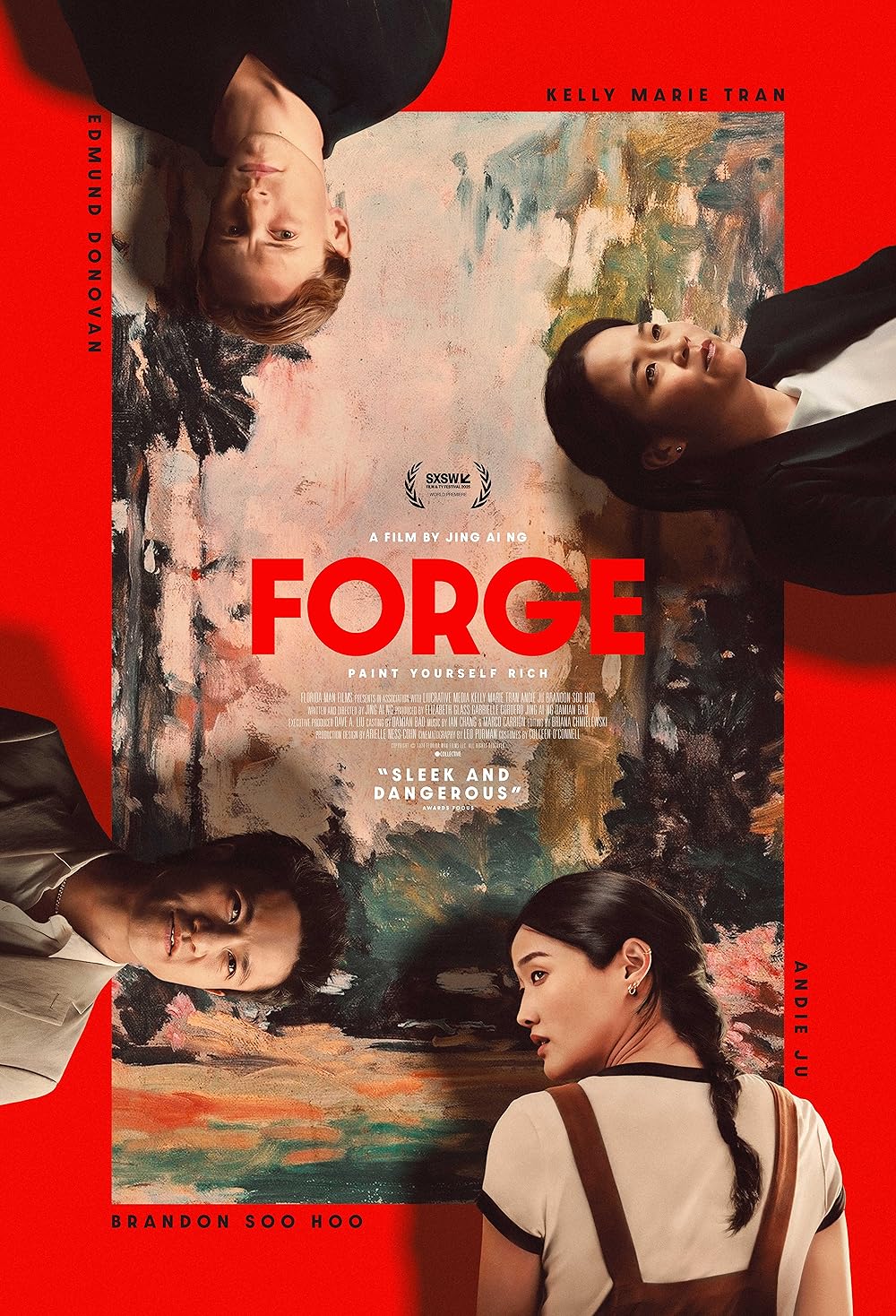
“Forge,” an impressive first feature from Jing Ai Ng, explores all of these interesting ideas while also careening through the art underworld of elite Miami—its late-night clubs, galleries, palatial homes, the dark corners where deals are done. It’s a complicated landscape with isolated moments of silence when all of the different “selves,” erected (forged, you might say) just to make it through the day, are allowed to dissolve.
At the film’s opening, the art scheme of teenage siblings Coco (Andie Ju) and Raymond (Brandon Soo Hoo) is already up and running. Coco is a talented painter. After being forced to drop out of art school, she turned her gifts towards the forgery of fine art paintings, which are sold to the wealthy as “long lost” works of well-known painters (this was Ripley’s scheme, as well). Coco is philosophical about what she is doing. “I’m not faking it,” she says, “These artists are alive inside of me.” A good forger needs to understand the artist intimately: the brushes used, the color palette, how light or heavy the touch, and, on a more ephemeral level, a forger needs to understand the intention behind the work, the love, desire, and anguish in every brush stroke. Not everyone can do what Coco does.
Coco loves the money she’s making, but she’s ambitious in surprising ways. She would love to see one of her forged works hanging in a museum. It would be a coup and, on one level, the ultimate con, but also the ultimate stamp of approval. Her work is good. She is an artist, even if she has to sign her paintings with a name not her own.
Raymond is not an artist or a forger, but he got his start in high school making fake IDs for his classmates. Coco and Raymond’s immigrant parents own a restaurant, and have no idea their children are basically running a criminal operation out of the garage. As second-generation Chinese-Americans, Coco and Raymond feel the pressure to succeed and live up to their parents’ expectations. The irony is that they are successful, albeit criminal, and entrepreneurial, just as their parents want them to be. Too bad none of it can be added to a LinkedIn page.
Coco and Raymond’s lives change when they are hired by Holden (Edmund Donovan), a rich guy whose grandfather’s art collection was destroyed in a hurricane. Holden wants Coco to re-create the entire collection, which will then be sold on the market. The task is overwhelming, the risk massive.
The siblings aren’t aware that they’ve already attracted the FBI’s attention. Miami is awash in forged art, and buyers are complaining. An FBI agent named Emily (Kelly Marie Tran) tracks the pair. Kelly, too, has to negotiate the world using different selves, taking advantage of people’s preconceived notions, “playing in” to a stereotype in order to move past an obstacle. There’s something very fresh about Ng’s handling of the material, the way these different strands weave together in subtle and unexpected ways.
With AI “slop” drenching our algorithms and Large Language Models repurposing original work to “teach” AI, forgery is even more distasteful than usual, beyond the obvious criminal aspect. But there are nuances and subtleties at play. What makes a work original? If you can’t tell the difference between a forged work and the real thing… is there a difference? And if so, what?
“Forge” isn’t perfect, and some of the storylines don’t stick the landing, but Ng has created a space where all of these ideas are at play simultaneously, where we see characters we haven’t seen before, operating in new and surprising contexts.
At one point, FBI Emily corrects her colleagues: “A fake is a replica. A forgery is a new creation.”
“Forge” is a new creation.