“Anniversary,” about a family torn apart by an authoritarian movement within the United States of America, is ripe for nitpicking and perhaps outright rejection, on the basis that it’s too on-the-nose, too opportunistically topical, too muddled in its message, or just too inconsistent. As always, your mileage will vary. Be warned that the first act is a bit of a slog, with exposition that goes down as smoothly as broken glass in a garbage disposal, and that the powerful climax hinges on an event that you have to decide to believe could happen. Nevertheless, it stays with you—and if you take a macro rather than micro view, its ambition is easy to see, and its timing is perfect.
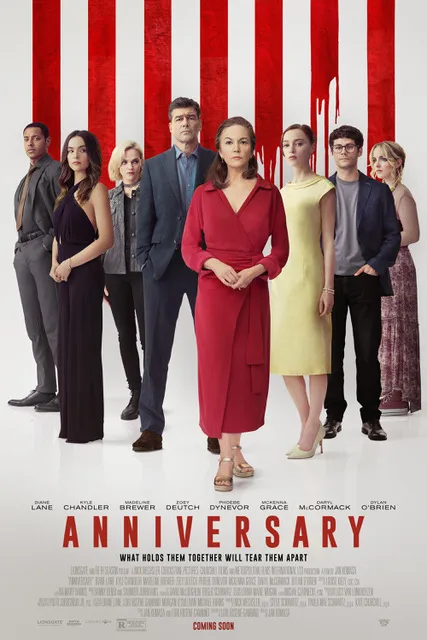
“Anniversary” is directed by Polish filmmaker Jan Komasa (“Suicide Room,” “Corpus Christi”) and written by Lori Rosene-Gambino, who partnered with Komasa on the story. Komasa sees America more clearly than most American filmmakers might, having grown up in a country that’s been occupied by Nazi Germany and the former U.S.S.R, and having directed other films about life under authoritarianism, including the hybrid documentary-drama “Warsaw 44.” At first, this film’s title appears to refer only to a familial event that opens the story: The 25th wedding anniversary of Ellen (Diane Lane), a political science professor with progressive views who teaches at Georgetown University; and her husband Paul (Kyle Chandler), a chef turned restaurateur whose Washington, D.C. eatery is a magnet for the city’s power players, and profitable enough to fund elite educations for the couple’s four children, three of whom have left the nest.
But the movie is built around many gatherings occurring over a five-year timespan, ending with the couple’s 30th anniversary. We watch the family grow in size, shift in power dynamics, and break apart as an authoritarian movement spreads across society. In retrospect, the most important anniversary of all marks the day the agent of the family’s downfall entered their home: a young woman named Liz (Phoebe Dynevor), a former student of Ellen’s with outspoken right-wing politics who felt rejected and humiliated by her professor, but is now on the verge of becoming a conservative media star. Liz’s first book, The Change: A New Social Compact–a manifesto as thick as a shoebox—is about to be published. She is dating the couple’s only son, Josh (Dylan O’Brien), a wannabe novelist whose first effort was rejected by publishers. This made Josh feel like a failure in relation to his mom, a public intellectual who’s drafted by her department head to appear on a national news show and defend the Ivy League system against accusations that they’re “bastions for organized liberalism.”
Liz is phonier than a televangelist’s tears, but not everyone at the party recognizes it because she’s mastered a compassionate gaze and a warm tone. Exhibit A is Paul, who insists that anyone taking part in a family gathering leave their personal politics at the door. Initially, we have no idea where Paul stands on the issues of the day. Is he also a progressive, albeit less outspoken than Ellen, or a conservative who loves his wife more than he loathes her politics? We’re also not sure about their youngest daughter, Birdie (McKenna Grace), a budding scientist who seems focused on the mechanics of viral infection and is politically very much a work-in-progress.
There’s no doubt about the other sisters, though. Anna (Madeline Brewer) is a lesbian shock-comic fueled by left-wing politics and feminist solidarity. Cynthia (Zoey Deutch) is a lawyer working on environmental cases with her boyfriend Rob (Daryl McCormick), one of the only nonwhite characters in the core group, though one whose identity is less a factor in his decisions than a desire for acceptance and material comfort. You see where things are headed. Some of these characters are more secure in their identities and choices than others. The promise of money, influence, or both can go a long way towards convincing people to jump the fence, unless they have rock-solid morals and an ability to withstand suffering.
The movie isn’t shy about offering disease as a metaphor for how fascistic ideologies spread. Liz’s manifesto becomes a surprise bestseller, igniting a “common sense” movement that claims it’s about uniting a divided populace and putting people at the center of American life again. The Change presents itself as centrist or somehow “above politics” even as it embraces right-wing signifiers, such a redesigned national flag, a desire for one-party rule (though a third party created and blessed by them), and a partnership with a huge corporation that funds a right-wing think tank in the vein of The Heritage Foundation (the architects of Project 2025, the blueprint for Trump’s second term). The violence and chaos that accrue when right-wing populists unite around Liz’s book are mirrored inside the home, where people who want to get along end up clawing at each other, even selling one another out for self-interested reasons.
In movies, every family gathering has a bombshell revelation. At Ellen and Paul’s anniversary party, It’s Liz revealing that she and Josh are engaged. This is the first of many power moves that seem intended to avenge past injuries by Ellen, who treated Liz the student as an adversary, and will treat Liz the political figurehead as a menace to democracy. The justifiably paranoid Ellen thinks Liz hooked up with her son to roll out a long-term vendetta that will punish Ellen by infiltrating her family, converting its members, and absorbing it, as the new movement hopes to do to the U.S. population. There’s no doubt that Liz is the main villain of the movie, unless you’re the kind of viewer who argues that “Star Trek” only recently began endorsing progressive messages, or that the Galactic Empire was the good guys in “Star Wars.” But there are others, and the movie shows that even the worst people are complicated. They don’t always understand why they do things, much less anticipate every consequence.
Liz’s desire to dominate Ellen is the first appearance in “Anniversary” of a motif that is true to what we know of human nature: the origin story of many authoritarian figureheads begins with a moment of failure or humiliation, whether it’s a future German despot being labeled a bad painter or a future American president getting slagged by his predecessor at a White House Correspondents Dinner. Private citizens do this as well, and we see it happening throughout this movie. After Ellen slights Liz by brushing her off at the party, Liz weaponizes her anniversary gift, an advance copy of The Change, by handing it gift-wrapped to Ellen as she and Josh are heading out the front door to drive home. It’s another (metaphorical) explosive device that’s on time-delay. It injures Ellen’s ego by saying, in essence, “You shouldn’t have underestimated me. Now I have your son, and will soon have the important bestseller you’ve always dreamed of.”
Future attacks include announcements of Liz’s pregnancy (twins!) and a coveted slot at Georgetown, which dethrones Ellen as the department’s star. Both Josh and Liz revel in the sight of Ellen and Paul stifling their discomfort and watching their words for fear of making a scene. The New Josh verbally torments family members who either didn’t validate his ambition before he met Liz or consider him a menace now that Liz’s success lets him buy fancy cars, hire a multilingual au pair to raise the twins, and carry on like a smug young Nazi functionary in a World War II thriller without fear of being shunned.
Allegiances and tactics shift over time. The conflicts, sudden tragedies, and moments of distilled rage and fear within the household reflect events happening in the broader world. We see how easily political power can be weaponized to punish those whose only crime is to criticize or oppose their leaders. We see how certain words—such as “sedition” in this movie, and “terrorist” in modern America—can be twisted into all-purpose rubber stamps justifying inhumane policies. Most of all, we see how power can seem like a life force unto itself, a ravenous, feral beast that ruthlessly ambitious people mistakenly think they can train and control like a house pet. There’s even a subplot that’s the political thriller version of the classic 2015 Twitter post “‘I never thought leopards would eat MY face,’ sobs woman who voted for the Leopards Eating People’s Faces Party.”
By the end, people are considering selling each other out for for all kinds of reasons, including the lure of a cushy job, even as they’re staying indoors and whispering about whether a disappeared person should be presumed dead. Scene after scene of “Anniversary” underlines a fact that survivors of dictatorships carry in their DNA: the oppressors’ power trip isn’t just the transgressive turn-on of ignoring laws and personal consent and taking what they want through violence; it’s also the aftermath, in which the victims are forced to act grateful to the people who ruined them.
Some of the scenarios that “Anniversary” envisions are already unfolding across the United States. The supermajority of voters that prefers an imperfect democracy to a perfect engine of cruelty is resisting the government’s violence against its own citizens and organizing to stave off worse scenarios, versions of which dominate the movie’s wrenchingly melodramatic second half. “Anniversary” did not predict the future: shot in 2023, during a liberal interregnum between Trump administrations, its makers appear to have gamed out where things could have gone if authoritarians retook the federal government. Unfortunately, they nailed it.
The result feels evokes one of the many thoughtful films made about life under dictatorship, but with a unique twist: This one isn’t critiquing past events in Argentina, Chile, or Uganda from a safe historical distance, but events happening here and now, from behind a scrim of metaphor as thin as tissue paper. You may feel as if you’re watching a movie about the Argentine Revolution of 1966 or the Tonton Macoutes era in Haiti transplanted to North America. It’s not a cautionary tale, but a projection of what the U.S. will become if present trends continue. Imagine if 2024’s “I’m Still Here,” about life in Brazil following the military dictatorship of 1964-85 , had been released in the mid-1970s, in Brazil.
The movie was funded indie-movie style, through a patchwork of sources, and shot in Ireland, where hanging up mutant Stars and Stripes flags wouldn’t result in a social media firestorm and “how dare they” editorials. But things are changing so quickly on the home front that it’s hard to imagine “Anniversary” getting funding had it been written this year, no matter where the producers planned on shooting it. If the movie did find its way to the starting line, some of its participants might have dropped out for their family’s sake, after months of seeing Americans assaulted, detained, and disappeared by masked men for criticizing the president or having the wrong color skin. That “Anniversary” depicts oppressed and terrorized Americans doing much riskier things under far bleaker circumstances saves it from doomerism, leaving viewers with shreds of hope.