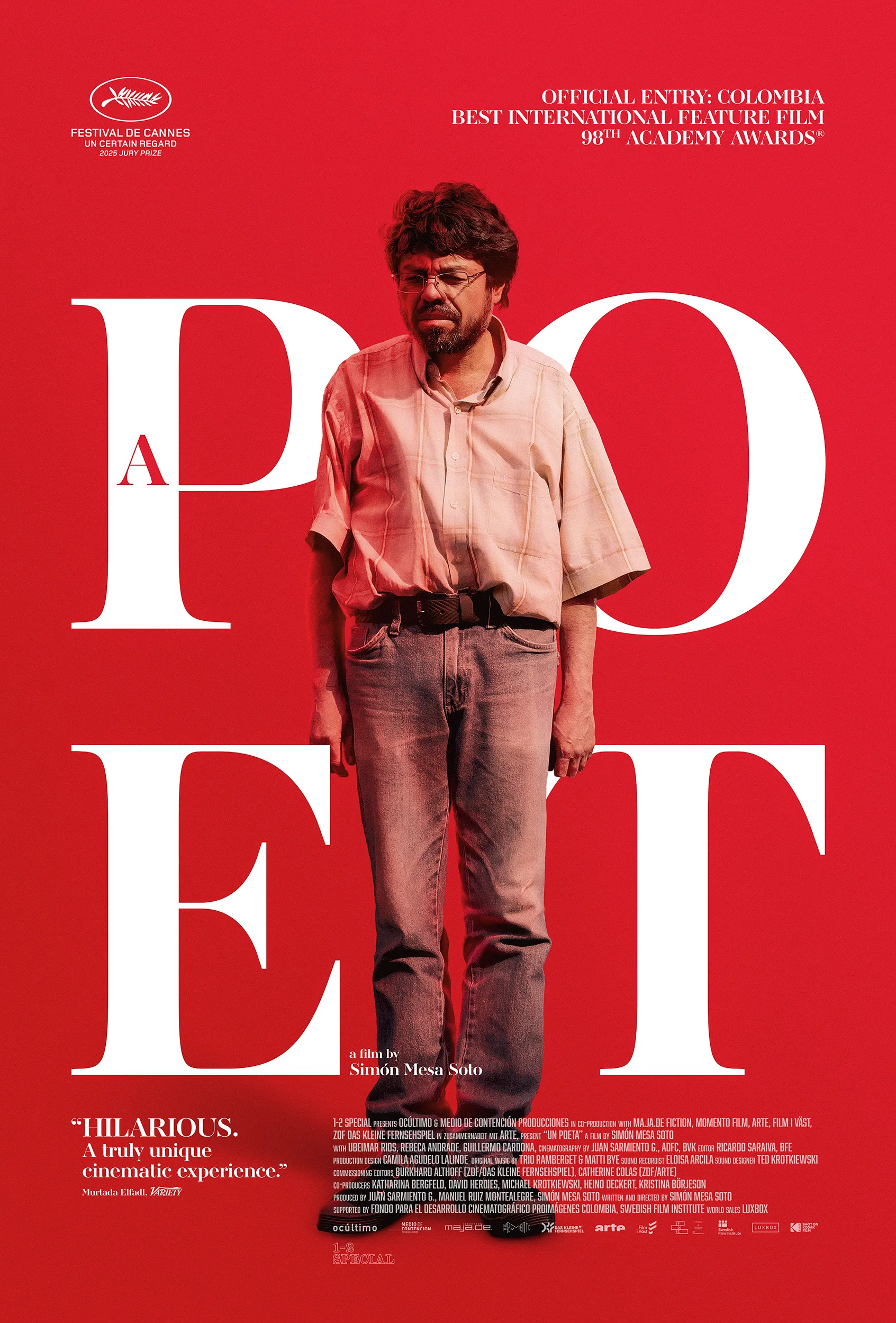

Last year, writer/director Simón Mesa Soto’s absurd tragicomedy “A Poet” premiered at Cannes in its Un Certain Regard section. Since then, it’s earned a nomination for Best International Film from the Spirit Awards and become Colombia’s Academy Award submission. The film is about a washed-up loser whose inability to get even the simplest task right makes him a far more relatable character than he’d be in real life.
“Do you also live in profound sadness?” he forlornly asks. Oscar Restrepo (Ubeimar Rios) is an alcoholic poet living with his sick but supportive mother in Medellín. He has no money. In fact, he begs his mother for a loan to participate in a “promising” investment that includes questionable bonds and support from Zimbabwe. He’s also unemployed. When his sister Yolanda offers him a teaching position, however, he so fervently rejects the prospect that it literally makes him physically ill. Nevertheless, Oscar’s estranged daughter Daniela (Allison Correa) is preparing for her college entrance exams. Because he wants to reconnect with her by giving some financial support, he takes the teaching job anyway, where he often drunkenly educates teenagers. Among them is Yurlady (Rebeca Andrade), whose verses are so promising that Oscar envisions a future for her that she doesn’t share.
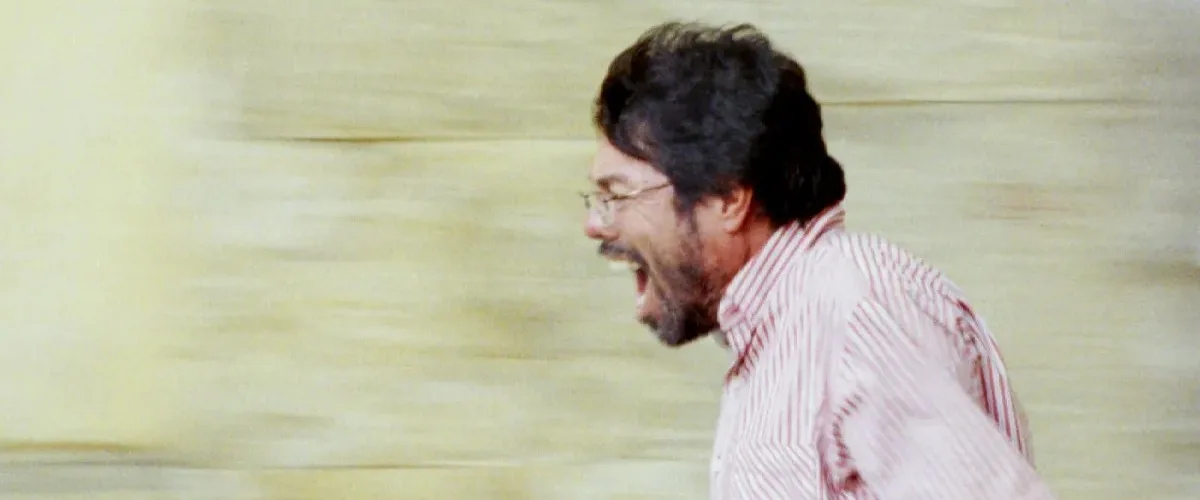
Like many poets, Oscar sees the profession as a higher calling. It’s not something you simply do. You must live it. But Oscar isn’t really living. This bent, disheveled man with ill-fitting clothes, dandruff sprinkled over his greasy hair, and a hangdog expression spends his many nights getting drunk at the local bar where he converses about the virtues of the tragic poet José Asunción Silva—who went unnoticed during his brief life—and denounces the popularity of One Hundred Years of Solitude author Gabriel García Márquez.
As you can guess, Oscar, who hasn’t published since his second book at the age of twenty-five, sees himself in the former figure. He even has Silva’s portrait hanging prominently in his bedroom. So when he comes across Yurlady, he not only recognizes a chance to help a young poet in a way he couldn’t help himself. But he also sees her as a version of his daughter.
In that sense, “A Poet,” which is split into four chapters, is a film about the difficulties and fears of fatherhood. It’s telling, for instance, that Oscar has struggled to write since Daniela’s birth. Consequently, he’s a pathetic absentee father who’s taken that failure into his poetry. His futility, therefore, transfers to his relationship with Yurlady. Rather than believing that Yurlady isn’t particularly interested in poetry—she just writes what’s in her head—he sells her as a prodigy worthy of support from a young poets’ collective run by the far more successful writer Efrain (Guillermo Cardona), who immediately sees the impoverished Yurlady as an avenue toward bilking money from an exoticizing Danish donor.
Thankfully, the film doesn’t exploit Yurlady. Part of that is due to Juan Sarmiento G.’s soft, lyrical photography, which bathes her in an ethereal light that contrasts with the jittery crash-zooms and stark brightness used to film Oscar. Her poetry narrates these moments. And while plenty of films use verse to reveal the inner life of a young woman, to the point of being cliché, this instance doesn’t feel cloying. It’s visually eloquent and linguistically engaging.
Andrade’s incredible performance furthers Yurlady’s humanity by granting her a rich inner life. When Oscar belittles her by saying “people like you…,” in relation to impoverished folks only having the prospects of children and menial jobs, Andrade jolts away from him. As she is pushed, first by Oscar and then, more egregiously, by Efrain, to become a poet of note, she rolls past their othering in hopes of gaining food for her family and beauty supplies for herself. Andrade plays Yurlady as a knowing teenager, as someone far more comfortable with her and her family situation (she shares an apartment with many kin) than a grown-up like Oscar espouses for his own life.
That self-awareness partially keeps “A Poet” from being a nauseating watch. It’s very easy to dismiss a film about a hapless loser. But it’s nearly as difficult to ignore a performance like the one Rios gives. Through his anguished facial expressions and physical rigidity, he gives this dark, absurd picture its riotous streak. The way he desperately elongates “no,” reaching an upper register with a twisted visage, would make Chuck Jones elated at its cartoonishness. Nevertheless, Rios never treats Oscar like a joke. Oscar is misguided, and, to be honest, probably a bit pervy, but he also truly wants to be better—if not for himself, then for his daughter.
Soto, for his part, walks a fine line. He doesn’t allow Oscar off the hook. Often with these movies about terrible artistic dads, their art is powerful enough to elicit sympathy and forgiveness from their aggrieved child. Daniela, however, isn’t so easily pliable. Conversely, Soto does offer Oscar a glimmer of hope. Toward the end, there’s a scene where Oscar becomes soaked in the same ethereal lighting and soft lens reserved for Yurlady. Is Oscar capable of growth? We aren’t told. But by the end, we can figure out that his greatest poem (which could be fatherhood itself) is yet to be written.