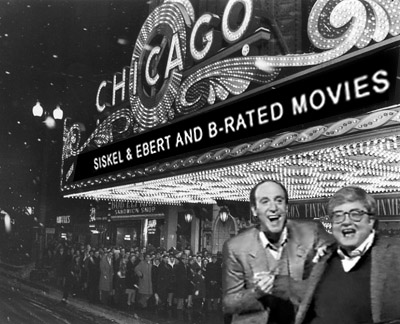
Siskel & Ebert review B-Rated movies. And C. And D…

Marie writes: It’s no secret how we feel about B-rated movie trailers inside the Ebert Club; there’s nothing like a steaming pile of crap to inspire a good laugh. And it seems we’re not alone. For behold: Siskel & Ebert and “The Stinkers of 1983”. To enjoy even more amusing discoveries join the Club and explore a truly eclectic assortment of finds. Your subscription helps support the Newsletter, the Far-Flung Correspondents and the On-Demanders.

Go here to join the Ebert Club. Your subscription helps support the Ebert Club Newsletter, the Far-Flung Correspondents and The Demanders.

April 9, 2013

For Sylvia Plath on her birthday

Sylvia Plath, October 27, 1932 – February 11, 1963
These poems are read by Tom O’Bedlam (seen below), on his website Spoken Verse, one of the web’s most impressive treasures. You can spend hours on a visit.

April 9, 2013

My video tours of London, Cambridge and York

I was so surprised to find this on You Tube. I hosted several segments of the “Focus on Britain” series in the 1980s. It was produced by the British Tourist Authority. I haven’t seen this in more than 25 years.

…and then, a month later, this turned up! It was found by my reader David Wenk. I’d never seen it. I take the reader on the route traced by my book The Perfect London Walk. With an introduction by Sir MIchael Caine, no less. When David found this and told me about it, it had less than 100 hits, perhaps because the title didn’t tempt Google.

Above: My self-portrait while walking from Cambridge to Grantchester. Below: My point of view in a London cab.

April 9, 2013

The 1982 Tron Holiday Special

The 1982 Tron Holiday Special from Rip Taylor

My TwitterPages are linked at the right.
var a2a_config = a2a_config || {};
a2a_config.linkname = “Roger Ebert’s Journal”;
a2a_config.linkurl = “http://blogs.suntimes.com/ebert/”;
a2a_config.num_services = 8;

April 9, 2013

Oscar-worthy B-rated trailers

Marie writes: In the wake of the 84th Academy Awards, I couldn’t help but reflect upon all the films that have been deemed unworthy of recognition over the years, and with a measure of empathy – especially for the really bad ones – as even those filming a piece of unwatchable crap secretly dream of winning an Oscar for it. Indeed; many a bottle of cheap shampoo has undoubtedly been raised and tearfully clutched before a bathroom mirror, whilst in a drug-induced fantasy of receiving one amidst the deafening roar of applause.And so on behalf of delusional dreamers everywhere, the Ebert Club would like to present the following nominees for BEST b-rated trailer!  The winner will be determined by reader votes and announced on Wed 14, 2012; so vote early, vote often and don’t be afraid to change your mind at the last minute.  And to explore an even more eclectic assortment of discoveries, please join the Ebert Club. Your subscription helps support the Newsletter, the Far-Flung Correspondents and the On-Demanders on Roger’s site.

April 9, 2013

Jeni le Gon: The first black woman signed by Hollywood was livin’ and dancin’ in great big way

My good Sun-Times pal from the 1970s at the Chicago Sun-Times, Cynthia Dagnal, wrote me today:

“A friend in London sent me this, obituary from the London indpendent and I was stunned to see that Jeni Le Gon attended the same Southside dancing school in Chicago that I did. It was probably the most reputable one on that side of the “color line,” and not very far from my house. So I studied with the younger “protégés” of Mary Bruce, and all those cute pics of me in little but EXPENSIVE tutus and whatnot that I sometimes use on my blogs are reminders of those days! I took tap, jazz and ballet as a wee one, and loved to walk around en pointe all day long in those danged–and also expensive–toe shoes!”

Le Gon (born in Georgia Aug. 24,1916; died December 7, 2012) was the first African-American women to sign with a major studio, but there was more to it that that. From the loving obit by Stephen Bourne in the Independent:

“Following her screen debut, the vivacious Le Gon was signed by MGM and paid the huge sum of $1,250 a week. They gave her a role in Broadway Melody of 1936 but, she said, “MGM hosted a party for the mayors of various cities and the cast of Broadway Melody of 1936 entertained them. Eleanor Powell, the famous tap dancer from Broadway, had also been signed for the movie and after I stopped the show on performance night at the mayors’ party, MGM decided they couldn’t have two tap dancers in the picture and I was dropped from the studio. If I had been white, they would have kept me because I could have developed into something, but they let me go. While I was at MGM I was told I wasn’t allowed to eat in the main dining room. Here, they were paying me $1,250 a week and telling me I wasn’t good enough to eat in their dining room. But Hollywood was no different to the rest of the country in that respect.”

Also from the obit:

” She played maids to Maria Montez in Arabian Nights (1942), Ann Miller in Easter Parade (1948) and Betty Hutton in Somebody Loves Me (1952). Tiring of maid roles, Le Gon faced humiliation in 1950 when she joined a group of black actors to call on Ronald Reagan, then president of the Screen Actors Guild. They raised their concerns about the stereotyping of black actors, but Reagan showed no interest: “We tried to get him to intervene for us, but he wasn’t the least bit sympathetic. He didn’t even lie about it.”

After moving with her family to Chicago, Le Gon attended Mary Bruce’s School of Dancing. At the age of 16, she embarked on a professional career after successfully auditioning for the chorus of the Count Basie Orchestra. After arriving in California in the mid-1930s, Le Gon’s energetic and expert dancing skills were noticed by Earl Dancer, a black producer and talent scout. Dancer took Le Gon under his wing and he was instrumental in bringing her to the attention of various Hollywood studios.

She made her film debut in RKO Radio’s Hooray for Love (1935), in a lively musical sequence in which she was teamed with Bill “Bojangles” Robinson and Fats Waller. The trio’s rendition of “I’m Livin’ in a Great Big Way” was sensational and, after Hooray for Love, Fats Waller employed Le Gon as a vocalist and dancer with his band. Le Gon explained to his biographer, Alyn Shipton, how Waller helped to shape her stage act: “I danced like a boy – I did flips and knee drops and toe stands and all that sort of business so, when I had to sing after I’d danced, he gave me these cute little numbers so that I could talk-sing.” In 1984, referring to her toe stands, and to Michael Jackson, Le Gon commented: “That Michael fella, they say he invented it. All the girls from my era did that.”

Le Gon was warmly received in Britain when she opened at London’s Adelphi Theatre on 4 February 1936 in CB Cochran’s revue Follow the Sun. Later that year, she was featured as a cabaret dancer in the British film Dishonour Bright. She said: “I experienced being a real person for the first time. On board the ship and in Europe I was referred to as Miss Le Gon and that had never happened to me before.”

“On a tour of Canada in 1969 she found herself in Vancouver and agreed to hold a few workshops during the two days she was there, “but the students began lining up before we had even rented space. In Vancouver, I found out I was a person. Period. I didn’t have to worry about going somewhere and hearing somebody say, ‘No, you can’t come in.’ That’s one of the reasons I stayed in Canada.”

Jeni Le Gon with Biill (Bojangles) Robinson and Fats Waller in “I’m Living in a Great Big Way” (1935).

“Swing is Here to Stay” (1937), co starring the zoftig Dixon Sisters. When she leans at the end, they nailed her shoes to the floor.

In “Getting It Right With You” (1939)

Full-length film: “Double Deal” (1939), with Monte Hawley and Edward Thompson

With Cab Calloway in “HI De Ho” (1947)

Jeni performs in “I’m Living in a Great Big Way” in 2007 in the Century Ball Room in Seattle.

Jeni performs her last dance, it says, at the 2008 Masters of Lindy and Tap. Somehow I don’t believe this was her last dance.

Jeni at 90

A December 2012 tribute to Dr. Jeni Legon

Photo at top from the London Independent, autographed to Stephen Bourne, the author of the obituary.

…and above is my friend Cynthia Dagnal herself, when she was attending the same dance studio, about 10 and dolled up to look 30.

She writes: “Distinctive “Chicago style” just makes my eyes tear up. Whenever I hear Gene Kelly say, “Le time step,” in An American in Paris, I think of that step–everyone does it, but we did it with Chicago swag. Here’s a shot of me all dolled up and looking about 30-years-old.
“Here’s a little blurb piece on both Sadie and Mary Bruce’s dance schools from the Chicago Public Library. Both schools were amazing–in fact, when I read this, I thought, “Okay…which one WAS it?” I think I had to go to Sadie’s for a while because there wasn’t room at Mary’s for a wee one, but it was sooooooo long ago, I don’t even remember all that very well.
http://bit.ly/WUiaOJ
“Doesn’t matter, they were both amazing women and both schools were a VERY big deal on the Southside. Every parent wanted to get their kids into a class at either one, and I felt so lucky to be able to dance there. We had huge recitals all the time, and I loved every minute of those very serious shows.

April 9, 2013

The Lady from Shanghai

The Ebert Club would like to present the noir film “The Lady from Shanghai” by director Orson Welles, streaming free. And to explore an even greater assortment of finds and discoveries, please join the Ebert Club. Your subscription helps support the Newsletter, the Far-Flung Correspondents and the On-Demanders on Roger’s site.

“Although The Lady From Shanghai was acclaimed in Europe, it was not embraced in the U.S. until several decades later. Influential modern critics including David Kehr have subsequently declared it a masterpiece, calling it “the weirdest great movie ever made.” – wikipedia

The Lady from Shanghai (1947) Directed by Orson Welles. Screenplay by Orson Welles. Based on the novel by author Sherwood King. Uncredited writers: William Castle, Charles Lederer and Fletcher Markle. Starring Rita Hayworth, Orson Welles, Everett Sloane, Ted de Corsica, Erskine Sanford, Glenn Anders, Gus Schilling and Carl Frank. With Cinematography by Charles Lawton Jr.Synopsis: Against his better judgment, Michael O’Hara signs on as a crew member of Arthur Bannister’s yacht which is sailing to San Francisco. En route, they pick up a man named Grisby; Bannister’s law partner. Bannister also has a wife, Rosalie, and who appears to like Michael more than her husband.After they dock in Sausalito, a strange plan is proposed by the law partner: namely; Grisby wants to fake his own murder so he can disappear without anyone trying to find him. Michael agrees to the scheme because he wants the $5000 Grisby has offered him – so he can run off with Rosalie. But when Grisby actually turns up murdered, Michael gets blamed for it. Somebody set him up, but it is not clear who or how… Note: The yacht Zaca (used in the film) was owned by actor Errol Flynn, who skippered the yacht in between takes, and who can be glimpsed in the background during a scene filmed at a cantina in Acapulco.Twelve years later, in need of money, Errol Flynn (accompanied by 17-year-old starlet Beverly Aadland) flew to Canada in order to sell his yacht to a millionaire friend; stock promoter George Caldough. Flynn suffered a heart attack and died in a West End apartment on October 9, 1959 in Vancouver. He was 50 years old.

Go here to watch “The Lady from Shanghai” on Crackle.com

April 9, 2013

The Kennel Murder Case

The Ebert Club invites you to enjoy “The Kennel Murder Case” (1933) streaming free. And please join the Club to explore an eclectic assortment of discoveries. Your subscription helps support the Newsletter, the Far-Flung Correspondents and the On-Demanders on my site. – Roger Ebert

The Kennel Murder Case (1933) Directed by Michael Curtiz. Screenplay by Robert N. Lee, Robert Presnell Sr. and Peter Milne. Based on the novel “The Kennel Murder Case” by S.S. Van Dine. Starring William Powell, Mary Astor, Eugene Pallette, Ralph Morgan, Robert McWade, Robert Barrat, Frank Conroy, Etienne Girardot, James Lee, Paul Cavanagh, Arthur Hohl and Helen Vinson.Synopsis: “Archer Coe has been found dead in his locked bedroom. The cops consider it suicide, but Philo believes otherwise. When the Coroner shows up, he finds that Archer had been hit with a blunt object, stabbed and shot – making suicide unlikely. When the evidence points to his brother, Brisbane is found stabbed to death in the closet. Archer had a number of enemies, any one of which would have been glad to knock him off, but which one did and how did the murder occur in a room looked from the inside. Only one man, the keen, fascinating, debonair detective Philo Vance, would be able to figure out who is the killer…”Note: Film historians such as William K. Everson, who pronounced The Kennel Murder Case a “masterpiece” (in the August 1984 issue of Films in Review) consider it one of the greatest screen adaptations of a Golden Age mystery novel; ranking it with the 1946 film Green for Danger. – Wikipedia

The Ebert Club: A weekly newsletter of discoveries, news, trailers, free streamers and eccentric miscellany, celebrating its 102th issue!  Join the Club here.  A member’s link allows you to browse previous issues.

April 9, 2013

Que sera, sera

var a2a_config = a2a_config || {};
a2a_config.linkname = “Roger Ebert’s Journal”;
a2a_config.linkurl = “http://blogs.suntimes.com/ebert/”;
a2a_config.num_services = 8;

April 9, 2013

The enigmatic case of the oddly persistent mystery writer


Harry Stephen Keeler was the most prolific Chicago novelist of all time — and perhaps the most forgotten, although perhaps we may have forgotten an even more forgotten novelist. Not even the devoted, even fanatical, members of the Harry Stephen Keeler Society
claim significant fame for him.

Yet perhaps no published author in history has produced more convoluted, bizarre plots, one of them related entirely in dialog between two men stranded on a small river island, another concealing its denouement within a Sealed Page at the end.

I came upon Keeler by way of a mysterious e-mail advising me that he had started to Tweet from beyond the grave. I went to @HarrySKeeler. There I found such masterpieces of the Tweet form as these:

• “Cube steak so good,” said the idiot blankly. “Like eat fat baby with juice.”

• It was like trying to think about the square root of
minus zero, or something.

• There is no paternal authority in a family where a woman is running it according to precepts laid down by quack Yogis.

• “He’s not called ‘Habeas Corpus Gottselig’ for nothing,”
said Bob Landell grimly.

• Socko. Sqush. Right through the back of John’s coco. He gurgles
on his brew–and he’s dead.

• And so–my poor son’s head came forth out of the unknown–and then went, again, like–like a butterfly pausing on a mulberry leaf.

• “Guggle-oo–guggle-oo!” he choked gleefully, on his own saliva.

• And comparisons–comparisons odious!–were rearing themselves like impenetrable granite ghosts lined starkly along the fence of reason.

• My forehead was so corrugated that an Eskimo’s fur coat, sprinkled with nothing but Lux, could have been washed on it.

There are many more gems, all mined from Keeler’s vast lifework.

The go-to man on Harry Stephen Keeler is Richard Polt,
whose admirable website offers
a biography of the man, insights into the 75 worldwide members of the Society, downloadable texts of some of his novels, and a vast vault of his book jackets, of which I append only a few below. There are also coffee mugs, T-shirts, clocks, and even a Henry Stephen Keeler garment for your dog (S, M, L, XL, and 2XL).

Mr. Keeler exhausted the resources of two or three English language publishers, before continuing to publish in Spanish and Portuguese. When those outlets also dried up, he continued to write anyway.
As the New York Times observed:

“We are drawn to the unescapable conclusion that Mr. Keeler writes his peculiar novels merely to satisfy his own
undisciplined urge for creative joy.”

Keeler received the distinction in 1995 of having one of his novels republished by McSweeney’s magazine. Since then, several of his novels have been reprinted by Ramble House, as you can see by the
Amazon links at the bottom.


I know of two admirable websites that may satisfy your curiosity about this author:

Richard Polt maintains an extensive site for the The Harry Stephen Keeler Society, where I found the dust jackets below.

Here is a discussion of the Keeler archives. There is a large gallery of photographs, wherein I found the photo above of Keeler
and his first wife, Hazel.

Please visit the YouTube link at the bottom for a short film
based on a Keeler short story.


• Amazon.com Widgets


•Three scans kindly sent to me by Guy Maddin: A key to the characters
in Keeler’s novel “The Iron Ring”


April 9, 2013
subscribe icon

The best movie reviews, in your inbox