King of the mash-ups

“Life’s a laugh and death’s a joke it’s true. / You’ll see it’s all a show, / Keep ’em laughing as you go. / Just remember that the last laugh is on you…”

“For life is quite absurd / And death’s the final word. / You must always face the curtain with a bow. / Forget about your sin. / Give the audience a grin. / Enjoy it. It’s your last chance, anyhow…”

Over at a film odyssey (check out that beautiful logo!), movie blogger and “Fight Club” Opening Shots contributor Robert Humanick mashes up two movie mash-ups from YouTube, both set to Eric Idle’s uplifting, send-’em-out-whistling curtain number from the great “Monty Python’s Life of Brian”: “Always Look on the Bright Side of Life.” The first cuts footage from Mike Judge’s “Office Space” to the tune, providing encouragement to disheartened cubicle gnomes with martyr complexes the world over.

The other uses footage of Idle singing the song in “Life of Brian,” intercut with gruesome footage from Mel Gibson’s “The Passion of the Christ.” Either way, it’s a revelation.

December 14, 2012

An unforgivable lapse into tabloid sensationalism (in song)

View image Mug shot: July 24, 2007.

HEADLINE; “Lohan defends herself after arrest

AP, LOS ANGELES (July 24, 2007) — Lindsay Lohan says she’s innocent.

The 21-year-old actress was arrested and released on bail for investigation of misdemeanor driving under the influence and with a suspended license, and felony cocaine possession, early Tuesday in Santa Monica, less than two weeks after completing her second trip to rehab.

“I am innocent … did not do drugs they’re not mine. I was almost hit by my assistant Tarin’s mom I appreciate everyone giving me my privacy,” Lohan wrote in an e-mail to “Access Hollywood” host Billy Bush, the show reported on its Web site Tuesday night.

Police found cocaine in one of Lohan’s pockets during a pre-booking search, Sgt. Shane Talbot said. Police initially said Lohan was also being booked for investigation of transporting a narcotic but later said she was not.

Police received a 911 call from the mother of Lohan’s former personal assistant saying that Lohan was chasing her in an SUV, said Lt. Alex Padilla. The assistant had quit hours before, he said.

Authorities found Lohan and the woman in a “heated debate” in the parking lot of Santa Monica’s Civic Auditorium at about 1:30 a.m.

Lohan’s arrest comes as she still faces DUI allegations connected to a Memorial Day weekend hit-and-run crash in Beverly Hills. The actress completed more than six weeks in rehab less than two weeks ago, and had checked into a recovery clinic in January.

She had worn an alcohol-monitoring ankle bracelet since her July 13 release from rehab and was tested daily to support her sobriety, her attorney, Blair Berk, said. She said Lohan had relapsed and was receiving medical care at an undisclosed location. Lohan’s publicist, Leslie Sloane Zelnik, had no comment.

This story moved me to write a song, to the tune of “Unforgettable”:

Uninsurable, that’s what you are

Always crashing in your fancy car

Tabloid photos, so embarrassing

Flash your breasts when you’re out Paris-ing

Media whore is a role you adore, but you’re

Unemployable for picture work

Unprofessional, and quite a jerk

Keep the cast and crew awaiting you

And you wonder why they’re hating you

Fear next year, you’re carbon-dating your career

Unreliable, and more each day

Less than “adequite” in every way

Stanwyck wore an anklet to seduce

Not to monitor her booze abuse

You’re a boor, a poor excuse for loose, too

Uninsurable, in Calvin Klein

Unendurable, no sign of spine

Famous for your notoriety

Not ability, insobriety

Pie-eyed claims of future piety, pooh!

Uninsurable, such a cliché

Scourge of SAG, Double-, and Triple-A

Liquored-up but not Anonymous

“Lindsay” has become synonymous

With pathetic DUI arrests, eeww…

See also: Seattle Post-Intelligencer: Denials Go Better Without Coke

December 14, 2012

Cinema isn’t dead, it’s just different

Commenting on Jonathan Rosenbaum’s article in Cineaste (“DVDs: A New Form of Collective Cinephilia,” Michael Althen wrote that, for him, cinema is not what it used to be:

It only exists in festivals — and on DVD. That’s a long way from my/our former belief that cinema can only exist if it follows the well-known liturgy of an anonymous mass staring at a screen. On the other hand, this was a somehow romantic construct fueled by Truffaut’s “Day by Night” and other cinephile movies. To be honest, that was not how I discovered the Movies. Born in [the] Sixties, growing up in a suburb, I saw most of the influential movies of my life on TV: “Le samourai”, “The Party,” “Jules et Jim”, “Citizen Kane”, “Le scandale”… Did these less-than-ideal-viewing-circumstances diminish in any way the experience? Maybe…. [Maybe] Cinema is not dead — but it’s different. Its future will be defined by those who grow up having the possibility to choose between Blu-ray at home and 35mm somewhere in the dark.

It seems that cinema, like criticism, is forever dying and never quite dead. (See my recent post, “It’s the End of the Cinema as we know it (then and now).”) Movie formats and formulas are always being tinkered with — which is not to say you have to like the new recipes, any more than you were obliged to savor the flavor of New Coke back in the 1980s.

December 14, 2012

Brian De Palma and The Pink Dahlia

An attempted “Chinatown” shot from “The Black Dahlia.”

I’ve been holding back my thoughts about Brian De Palma’s “The Black Dahlia” since I saw it at the end of July, and now (especially after ten days at the Toronto Film Festival) those thoughts are more distant and disorganized than ever. I had intended to review the movie for RogerEbert.com, but that proved to be nigh impossible — I’ve just been too busy with Toronto and other stuff, and I found the movie rather flat and ininspiring, so I didn’t feel passionately motivated to write about it. (I’m still in Toronto as I write this.)

So, I’m going to offer just a few general comments (including some mild spoilers about particular shots and sequences), and then I’d very much like to hear your comments about the movie.

As I think back on the film, I’m surprised to find that the predominant color I associate with it is a rosy pink. Not black. Not blood red. But a mild color that Vilmos Zsigmond has used in his peculiar pastel palette for the film. That’s not what I expected of a De Palma film of James Ellroy’s “The Black Dahlia,” but there it is. And somehow that characterizes what I think is wrong with the movie: After the first hour or so, which seems like a good set-up for a De Palma extravaganza, it grows pale and indistinct. From the start it’s too controlled, rarely risky or dangerous. By the end, lots of people are getting shot (in pretty unimaginative ways for De Palma), just so it seems the filmmaker can hurry up and get the movie over with. Things fall apart. I didn’t feel like De Palma cared about the picture anymore at this point, and so neither did I. You can feel the filmmaker losing interest in his own movie.

December 14, 2012

Replies to Walter Murch on the end of 3D as we know it

This is the end… Oh. No. It isn’t…

Walter Murch rekindled a discussion about 3D, a hot-and-cold topic since “Avatar,” with a letter to Roger Ebert, published on Roger’s blog under the headline “Why 3D doesn’t work and never will. Case closed.” Ebert introduced Murch’s correspondence with this, accompanied by a recitation of Murch’s credits:

I received a letter that ends, as far as I am concerned, the discussion about 3D. It doesn’t work with our brains and it never will.

The notion that we are asked to pay a premium to witness an inferior and inherently brain-confusing image is outrageous. The case is closed.

This, of course, generated more discussion — much of it with an ad hominem slant, signaled by the headlines in Slate (“Two Thumbs, Two Dimensions: Roger Ebert is done talking about 3-D movies. Thank goodness.”) and Boxoffice Magazine (“This Week in Cranky: Walter Murch Declares War on 3D”). At the same time, Kristin Thompson published two sequels (produced concurrently, in the modern Hollywood style!) to her August 2009 piece, “Has 3-D already failed?,” assessing the argument for the commercial viability of the format, pro (“Part 1: RealDlighted”) and con (“Part 2: RealDsgusted”).

What Murch contributes to the debate is not substantially different from what I, Kirstin Thompson and many others have been writing about since the release of “Avatar” (see my posts, “Avatar 3D headaches: Look at this! Don’t look at this!” and “Avatar, the French New Wave and the morality of deep-focus (in 3D)”). The one thing he does bring to the table is that he’s Walter Murch, famous sound designer and editor, who edited the Francis Ford Coppola/Michael Jackson Disneyland 3D movie attraction “Captain Eo” back in the 1980s. (That use of the technology as a theme park-style attraction is, in my view, a stage the technology still has not moved beyond. Even those who don’t personally like the hallmarks of the current 3D processes — the glasses, the flat-planed illusion of “depth,” the dim picture — admit it works just fine for animation and cartoony or CGI-enhanced live-action, where the 3D isn’t meant to be “realistic.”)

December 14, 2012

Opening Shots: ‘Slacker’

View image: To sleep, perchance to dream…

View image: The dreamer awakes.

View image: Meanwhile, on the other side of the world… (From the opening shot of “Lost in Translation.”)

Does this shot look uncannily familiar? A man asleep, or almost asleep, with his head against a window as the twilight world outside floats by. This one’s from Richard Linklater’s “Slacker,” but we’ve also featured a similar opening shot from Sophia Coppola’s “Lost in Translation.”

I love the way the window, besides being a frame within a frame (suggesting a slightly fuzzy, abstracted reality in the background that’s distinct from, but related to, what we’re seeing in the foreground), is almost like a cartoon dialogue bubble, but instead of words it’s filled with images. A dream, perhaps? It certainly has a dreamlike quality. And, of course, the sleeper/dreamer in this shot is the filmmaker himself, Richard Linklater. And the movie we’re about to see is filled with stream-of-consciousness monologues and long, winding shots that drift from one character to another until the very end when some kids throw the camera itself off a cliff. Linklater (unlike Bill Murray in Coppola’s movie) is on the right of the frame, with the window images moving from left to right. Linklater’s face is on the strong axis, in terms of traditional composition, and the flow of motion seems natural and unforced, kind of like the path-of-least-resistance flow of the whole movie. Murray, on the left with the images moving right to left (against the way we Westerners read) seems to be swimming upstream in an Eastern world. (Speaking of upstream: You rarely see images of spawning salmon leaping left to right; upstream always seems to be right to left. See “My Own Private Idaho.”)

December 14, 2012

12 writers, 12 films: MSN’s Best Movies of the Decade

MSN’s Dave McCoy writes:

Saying that we’ve come up with the 12 best films of the decade is pretty hilarious when you get right down to it. You can’t take the thousands of films released in the past 10 years and say, “Yes, these by far represent the greatest cinema had to offer!” Hell, if you quizzed the 12 of us right now, we’d probably give you completely different lists than the ones we delivered in early December 2009. But, you can’t say it isn’t fun, right?

This reminds me: How the hell did I manage to omit Laurent Cantet’s 2001 “Time Out”? You can find the aggregate ballot results here, individual contributors’ lists here.

After the jump: The composite list, my list, and my capsule appreciation of “Caché”:

December 14, 2012

3-D, QT & “DP”

QT: Back in flack mode.

Dave Kehr points out errors in the New York Times story about the future of 3-D by Sharon Waxman (the Judy Miller of showbiz reporting), which Kehr describes as “riddled with errors and misperceptions, to the point where it is actively misleading.” Not the first time for Waxman, and it won’t be the last. (I had to stop reading her “Rebels on the Backlot” book because it was likewise riddled with factual errors and such gross misunderstandings of how the movie business works that it led her to draw preposterous conclusions about what she witnessed or was told.)

There’s a classic line in the Waxman article from Springsteen/”Titanic” producer Jon Landau: “The screen has always been an emotional barrier for audiences. Good 3-D makes the screen go away. It disappears, and you’re looking at a window into a world.”

Yeah, that damned screen. If only it weren’t there to present an emotional barrier for us. (Maybe if we removed it — and the back wall of the theater — the projector could just show the movie into 3-D “reality” and allow us to really feel the emotions the movie is trying to convey!) It’s like the way those blasted audio speakers get in the way of our emotional involvement in recorded music. Gotta get past that…

DK also refers us to a hilariously profane (i.e., Tarantinoesque) account of the “Death Proof” press conference in Cannes by Rob Nelson of the Minneapolis/St. Paul City Pages. Excerpt:

Not that I don’t appreciate the privilege of seeing a longer “Death Proof”—I positively adored it at 87 minutes on the bottom-half of the ill-fated “Grindhouse” double bill. But whoever encouraged the Cannes Film Festival to advertise its new cut at “2h07” (i.e., 127 minutes)—director Quentin Tarantino, perhaps, or (more likely) the Weinstein Co.’s Stuntman Harv—is practically begging for a long ride on the fuckin’ roof of the white Dodge Challenger, sans straps. I mean, the goddamn thing is no fuckin’ longer than 113 tops—I fuckin’ timed it—but that didn’t stop Stuntman Harv from bum-rushing the Death Proof press conference yesterday to say that “you’re missing the essence of Tarantino” at 87 (pffff…), and that the new cut, when it’s released internationally, “will dwarf Grindhouse—trust me.” Fuck, man. Does anyone, even Tarantino, trust Harvey Weinstein at this point?

Near the end of the press conference, which had QT literally sweating with enthusiasm for his movie and its many sources, a journalist asks Monsieur Grindhouse how he feels about writers having been requested by Harvey’s crew to pay $1,500 apiece for a seat at the Cannes “Death Proof” junket. […]

… As you might’ve guessed, gorgeous Butterfly (Vanessa Ferlito) finally does her big Texas Chili Parlor lapdance for Kurt Russell’s icy-hot villain in a scene that QT invests with as much meta-movie passion as a fuckin’ car chase or shootout or samurai showdown. Butterfly’s tailfeather-shakin’ shit is ridiculously, hilariously hot—even, it seems, for the lady from Uzbekistan who pipes up during the press conference to thank QT for his kick-ass female-empowerment movie on behalf of “all the women of Central Asia.”…

December 14, 2012

Walking down to The Wire

If, like me, you were spellbound by each season’s opening credits for “The Wire,” you must see the short film analyses of them by critics Andrew Dignan, Kevin B. Lee and Matt Zoller Seitz at Moving Image Source (published by the Museum of the Moving Image). Using the actual footage, along with still frames and zooms (aka “the Ken Burns effect”), these short films examine the credits in critical detail, treating them as short movies unto themselves. Which is exactly what they are. Each season of “The Wire” introduced a new opening montage (cut to various recordings of Tom Waits’ “Way Down in the Hole”) to set the scene. (Also see the Opening Shot essay for “The Wire.”)

December 14, 2012

Nothing is real(ism), and nothing to get hung about

Australian film critic Adrian Martin has sparked a discussion about the term “realism” with a short piece he wrote for the Dutch publication “Filmkrant,” titled “Make Me Feel Mighty Real.” Martin contends that the critical success of David Fincher’s “Zodiac” (though it was a commercial disappointment) “kick-started a minor trend” — he includes Steven Soderberg’s “Che,” Olivier Assayas’s “Carlos” and Fincher’s own “The Social Network” — toward a kind of historical realism he describes as “a low-key realistic soap-opera of guns, sex, death, wealth, power… sticking as far as possible to the exact, wayward contours of the original events.”

The term “realism” is one I’ve always had trouble with, because it’s so vague and relative. Is cinéma vérité (or, for that matter, a surveillance camera recording) any more “real” than a Stanley Kubrick film? Not necessarily — all show the results of decisions that have to do with photography: camera placement, lighting, sound recording, editing, etc. How much of the action is taking place because of the presence of the camera(s)? How aware of the camera(s) are the subjects, or the audience? Timestamps, black-and-white video, handheld camerawork — they’re all storytelling devices available to filmmakers. So, isn’t so-called “realism” really more a choice of technology, functionality, technique, style?

December 14, 2012

Shoot the paparazzo

View image Writer-director Tom DiCillo in the limelight. (photo by Thompson McClellan)

After the Ebertfest screening of “Delirious” Thursday afternoon, writer-director Tom DiCillo (“Johnny Suede,” “Living in Oblivion,” “Box of Moonlight,” “The Real Blonde” (1998)) recalled sending Roger Ebert an e-mail. He was in despair over the distributor’s treatment of his latest film, which Ebert had reviewed quite favorably. Out of frustration, and although he’d never written to a critic before, DiCillo posed five pained (and semi-rhetorical) questions about the injustice of the movie business, the last of which was: “Is this all a Kafkaesque nightmare that will never end?”

Ebert wrote back and answered every question. To the final one, he said yes.

December 14, 2012

Super 8: Spielberg Lite

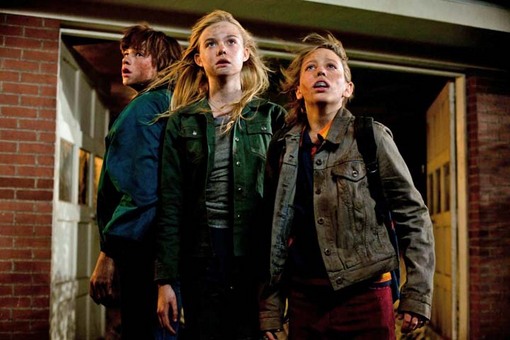
If you’ve recently re-watched, as I have, Steven Spielberg’s “Jaws” (1975), “Close Encounters of the Third Kind” (1977), ” “E.T. The Extra-Terrestrial” (1982), or any of his kid-friendly fantasy/adventure/science-fiction pictures — or the later, harsher “A.I. Artificial Intelligence” (2001) and “War of the Worlds” (2005) — you’ll quickly recognize that J.J. Abrams’ Spielberg-homage “Super 8” (co-produced by Spielberg himself) is a mere shadow of the work that inspired it. The aforementioned Spielberg movies still dazzle, shock and inspire awe — not only in their justly famous set pieces, but in the richness and sophistication of their shot-by-shot inventiveness. They’re spellbinding because they always show you more than you realize you’ve seen.

Spielberg is a prodigiously adroit filmmaker; Abrams is a guy who has a lot of genuine affection for Spielberg’s movies. And, for me, that at least makes “Super 8” far more watchable than, say, Richard Donner’s desultory 1985 Spielberg clone “The Goonies,” though it’s nothing as lively or inventive as Joe Dante’s 1984 “Gremlins,” either (and, yes, Spielberg is listed as a producer on all three of these pictues).

Spielberg’s popular entertainments do tend to feature suburban kids, fractured families, monsters, and such — but that’s not what the movies are about. Beneath the surface (and what gorgeous surfaces they are), these are sophisticated cinematic works. (I long ago made the case that “E.T.” and “Close Encounters” are daring abstract experimental films that just happened to be thrilling and moving narrative movies, too.)

December 14, 2012

I, the Fury: Mickey Spillane, R.I.P.

View image: Mickey Spillane Strips Down to Naked Fury!

Mickey Spillane, the creator of hard-fisted private eye Mike Hammer, has died at the age of 88. Several of his kiss-kiss, bang-bang pulp novels — including “I, the Jury,” “The Long Wait” and “My Gun is Quick” — were made into movies, and Spillane himself played Mike Hammer in the 1963 picture, “The Girl Hunters” (“Trapped in a Quicksand of Love…”).

But the Spillane movie masterpiece is, of course, “Kiss Me Deadly” (1955), directed by Robert Aldrich and scripted by A.I. Bezzerides. It is considered one of the bookend landmarks of the age of full-blown film noir, beginning (roughly) with Billy Wilder’s “Double Indemnity” (1944), and one of the most florid examples of that post-war style.

Recently, we featured Kim Morgan’s appreciation of the opening shot of “Kiss Me Deadly,” which is worth re-visiting. As Kim describes this crazy Pandora’s Box of a movie (the inspiration for the glowing MacGuffin/Great Whatzit suitcase in “Pulp Fiction”), it’s filled to bursting with “stark, hard-boiled cruelty, paranoia, insanity and psycho-sexual angst.” That’s a great capsule description, not only of this particular film, but of the Spillane sensibility in general.

View image

Likewise, Roger Ebert summed up essential qualities of the world created by Spillane and his chain-smoking, wise-cracking partners in crime in his brief “Guide to Film Noir”:

Film noir is . . .

1. A French term meaning “black film,” or film of the night, inspired by the Series Noir, a line of cheap paperbacks that translated hard-boiled American crime authors and found a popular audience in France.

2. A movie which at no time misleads you into thinking there is going to be a happy ending.

3. Locations that reek of the night, of shadows, of alleys, of the back doors of fancy places, of apartment buildings with a high turnover rate, of taxi drivers and bartenders who have seen it all….

December 14, 2012

Mr. Lynch Comes to Washington

If you have to ask what “Inland Empire” is about, you haven’t read the poster.

David Lynch returned to the Great Pacific Northwest Wednesday night for two screenings of his three-hour “Inland Empire” (at 7:30 and midnight), bringing with him to Seattle a fresh, hot shipment of David Lynch Coffee. That’s good coffee! (Packaging tagline — from “Inland Empire,” it turns out: “It’s all in the beans, and I’m just full of beans.”) Just a few blocks away, in the Pike Place Market, was a little shop where I used to get my beans, when I first became a serious coffee-drinker in college. It’s still there, and it’s still called Starbuck’s, but I hear there are more of them now.

I went to the early show. (When it was 9:45 I probably thought it was after midnight.) Lynch began by introducing a cellist who performed a brief improvisational piece “to set a mood.” Then Lynch read a short verse:

We are like the spider.

We weave our life and then move along in it.

We are like the dreamer who dreams and then lives in the dream.

This is true for the entire universe.

— Upanishads

And then “Inland Empire” hit the big Cinerama screen (in the theater where I saw “2001: A Space Odyssey” in its original release, when I was 10). I won’t say much more about the movie now (I just finished a longer piece that will run next week), but the local crowd went wild when a lumberjack appeared. We live in the land of “Twin Peaks” here, you know. Lynch spent some of his formative years growing up in Spokane, on the other side of the Cascades, in what Washingtonians refer to as the Inland Empire (though most people associate the term with California).

After the movie, Lynch took questions from the audience. Most of them were pretty lame (as is usually the case at these sorts of events), but nothing fazed Lynch, who was gentle, gracious and folksy. He was most passionate when talking about finding “the idea” for whatever he was trying to create, and working and working to realize it. With actors, he said, he likes to bring them in for a rehearsal of one scene — any scene. (This process is shown in an early scene in “Inland Empire,” which was reportedly filmed over the space of a couple years without any finished script. Lynch would shoot when he decided he had an idea for something he wanted to shoot.) The actors would read it and, “if it wasn’t perfect” — and Lynch admitted it rarely is, the first time through — they would talk. Then rehearse some more. Then talk some more. And so on until he felt they’d brought the scene around to where it was serving “the idea.”

He spoke similarly of music and sound, which he feels are — or should be — inseparable from the images. (Lynch did the sound design and wrote some music for “Inland Empire,” but credits composer Angelo Badalamenti with introducing him to “the world of music.”) He finds or writes or creates the music first, and then spends a lot of time and effort and experimentation getting the sounds and images to combine catalytically.

Lynch was enthusiastic about his experience shooting with a small digital camera (the Sony PD-150), and said he began using it to make shorts for his web site. After he’d made a few, he started thinking about them in terms of a larger framework story, and by then he was “already locked into” the digital format. He said he loved the freedom it allowed him (wait till you see the close-ups he goes for — he coulda poked somebody’s eye out!). Sure, he said, this format (it’s NOT high-definition like, say, “Miami Vice”) doesn’t have the quality of film, but it has its own qualities, its own textures. And, Lynch said, it was so easy to push and to tweak at will to get the effects he wanted. Best of all, he didn’t have to stop the actors to re-load the camera after every ten minutes of exposed film. He could keep things going for 40 minutes (sometimes shooting with three cameras simultaneously), which he thought allowed for interesting things to happen that might not have happened otherwise.

A questioner noted that characters in David Lynch movies are often subjected to great anguish and trauma. He asked Lynch what was the worst he’d ever been hurt — physically, the fellow clarified. After a long pause, Lynch told a story about his childhood in Spokane. His family was visiting another family, and they had a punching-bag snowman with sand in the bottom. Another boy hit the snowman, which knocked over young David, who gashed his head on the moulding around the doorway. Lynch said he remembers being adamant about not wanting to get stitches, but doesn’t recall what happened.

Someone observed that Laura Dern uses a touch-tone phone in “Inland Empire,” perhaps the first non-rotary telephone in the Lynch oevre. Lynch suggested that, perhaps, with this movie, he was slowly moving into the 20th century. Or did he say 21st?

Lynch’s new book is called “Catching the Big Fish: Meditation, Consciousness, and Creativity.” He said the first step in the creative process for him was letting go of negativity, which then allowed creativity to flow in. Somebody asked if “Inland Empire” was itself a big fish.

“‘Inland Empire’ is a whale,” said Lynch, “with a lot of smaller fish swimming around inside it.”

One woman posed the most succinct question of the evening: “What is the movie about?” (This, it should be pointed out, was after she’d just seen it.)

Lynch said: “It’s on the poster.”

(Updated with the actual Upanishads verse 1/23/07.)

December 14, 2012

Yes, but is it art, too?

(Continuing the discussion, “Yes, but is it art?):

I labeled the above short film (“close up”) a critical essay / dream sequence, which is what I intended when I made it last fall. But pretend you saw it at a film festival or a gallery and were told it was a “found footage” composition by a filmmaker whose influences include, say, Bruce Connor, Kenneth Anger, Stan Brakhage, Luis Bunuel, Jean-Luc Godard, Dziga Vertov, and/or Guy Maddin. Would you perceive it differently, whether you thought it was any good or not?

What if you were told that it was a meditation on the intersection of the actor’s gaze, the camera’s gaze, and the gaze into the mirror; of the movies that have been implanted so deeply in our heads that they become part of us; of the human face as blank slate and reflection of thoughts and emotions; of the skull beneath the skin and the vanity of the flesh; of subconscious metamorphoses and/or stream-of-consciousness Surrealist dream-imagery? A densely interwoven montage of images that requires annotation and explanation to fully understand (you know, like Eliot’s poetry)? Or a Surrealist experiment in the vein of “Un Chien Andalou,” using only silent footage, scored to a multi-tracked collage soundtrack composed of excerpts from two symphonies by Gustav Mahler and stock sound effects?

December 14, 2012

Ich bin ein TV-phile

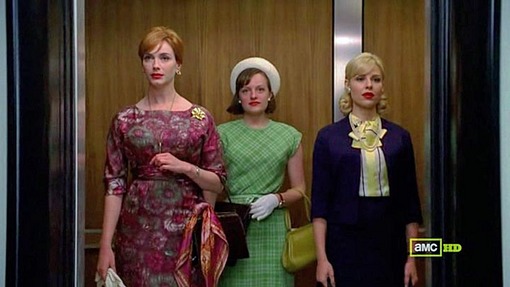
I don’t watch too much television, but I definitely read too much on the Internet. I know this because just last week I read something about television and now I can’t remember where I read it.* The writer was mock-complaining that TV isn’t as mindless and undemanding a leisure activity as it used to be, ever since “The Sopranos.” What with “The Wire” and “Mad Men” and “Deadwood” and “Breaking Bad” and “Dexter” and other non-old-network series, you actually have to pay attention to watch TV these days. (If you remember reading something along those lines, please send me the link.) No more just leaving the set on whenever you’re home in order to drown out the voices. These shows require as much concentration (and more memory and commitment) than most feature films — or perhaps (a closer comparison) modern novels.

A New York Times essay by A.O. Scott last weekend asked: “Are Films Bad, or Is TV Just Better?” Yes, it’s a false dilemma (what does the quality of one have to do with the quality of the other?), but it’s the kind of headline that catches the notice of the knee-jerk TV haters who are still stuck in the three-network “vast wasteland” of 1961. Scott wrote:

December 14, 2012

Monty Python season

Rarely has an American political candidate triggered so many associations with a famed British comedy troupe of stage, screen, television and phonograph recordings:

“I used to think that Michael Palin was the funniest Palin on earth…. [Sarah Palin] is like a nice-looking parrot, because the parrot speaks beautifully and kinda says ‘Aw, shucks,’ every now and again, but doesn’t really have any understanding of the meaning of the words that it is producing, even though it’s producing them very accurately…. I mean, Monty Python could have written this.”

— John Cleese, co-founder of Monty Python’s Flying Circus (Clip here.)

(See above. Monty Python did.)

“But Palin is as ridiculous as the competitors from Monty Python’s Upperclass Twit of the Year competition, jumping over hurdles that are nothing more than a stack of matchbooks.”

— Anne Lamott, Salon.com

“Cue marching band music and a big cartoon foot. US Vice-Presidential candidate Sarah Palin, hackers have revealed, has used a Yahoo! free webmail account to talk government business with aides.”

— David Winder, ITwire

“As Monty Python used to say, ‘No one expects the Spanish Inquisition’ — which is another way of saying that no one expects the unexpected.”

— Mark J. Penn, Politico

So many times over the last nine years (especially the last nine years) I have watched politicians on television and thought of John Cleese. No so much of the parrot sketch (to which he also alludes in the quotation above) but of another beloved Python bit he did…

December 14, 2012

A top top 10: 10 critics, 10 best(s) — and why

Ten contributors to MSN Movies cast their ballots for the best films of 2008, unaware of what anyone else would pick. A simple point scale was used to weight the choices. And the result is one of the more surprisingly satisfying year-end consensus-mixes I’ve seen so far. Yeah, I’m one of the participants, and six of my top choices wound up on the aggregate list, but still…

Best of all, each title is accompanied by a micro-mini-essay by one of the critics. It ain’t easy compressing one’s appreciation into nuggets of less than 250 words, but the effort can occasionally yield its own rewards…

MSN Movies Top 10 (bottom to top):(titles link to individual blurbs)

10. Slumdog Millionaire

9. Wendy and Lucy

8. WALL-E

7. Pineapple Express

6. The Dark Knight

December 14, 2012
subscribe icon

The best movie reviews, in your inbox