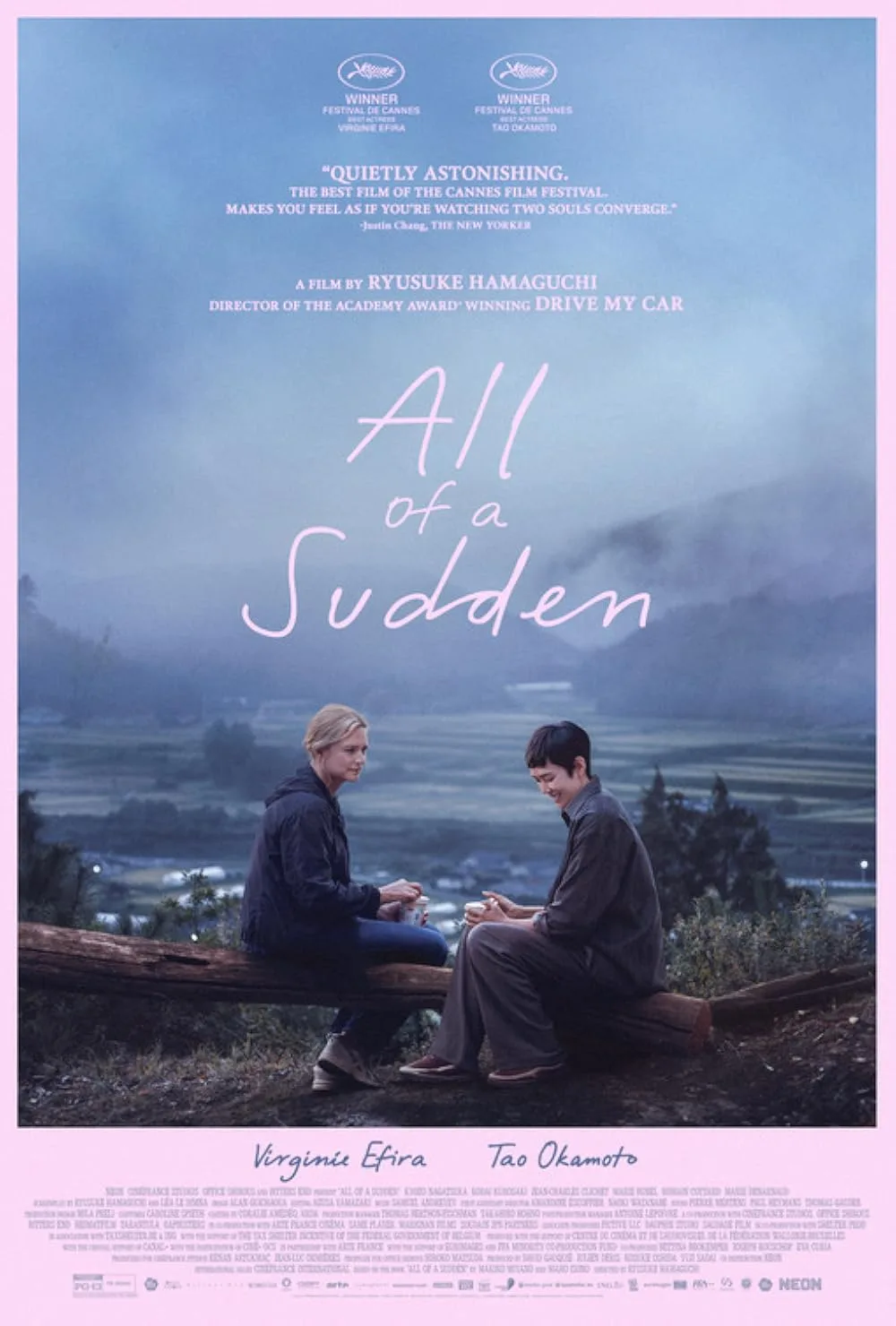
Some of life’s biggest changes seem to happen in an instant and announce themselves in ways that are impossible to ignore: a milestone event in world history or in our own personal lives, for instance, or a “eureka” moment that makes us throw out a lot of preconceptions and decide we’re tired of the usual and are ready to forge a new path. Writer-director Ryusuke Hamaguchi‘s “All of Sudden” covers all this and more.
The extreme length (3 hours, 16 minutes) even lets the movie allude to another type of “all of a sudden,” where changes have already been happening incrementally, with imperceptible subtlety, but you don’t figure out that your entire existence has changed until the day you look at what’s around you and compare it with a point in your past.
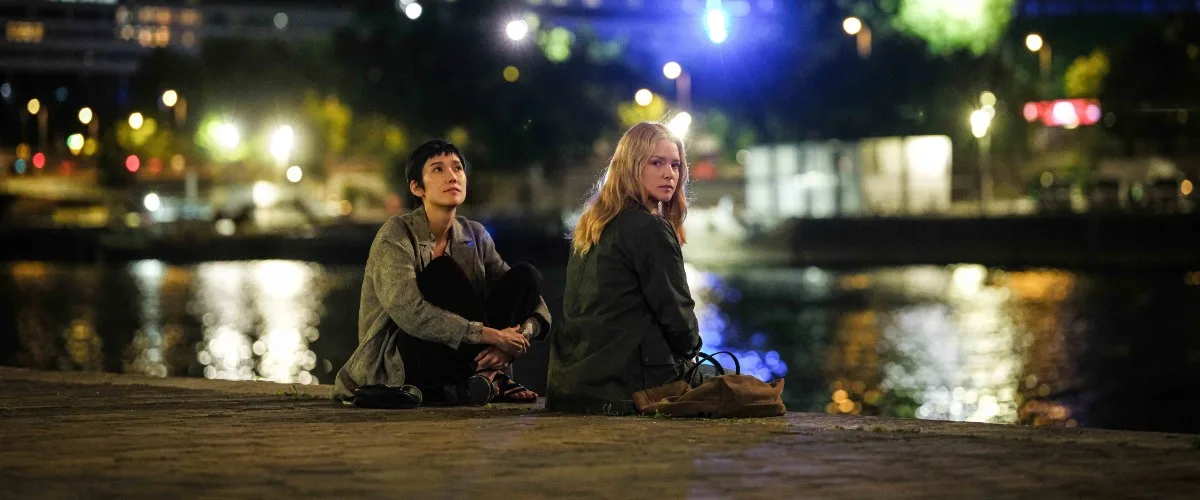
“All of a Sudden” is a French-Japanese coproduction set in Paris and Tokyo, with dialogue in subtitled French and Japanese, along with some English. It has a large ensemble cast, but two main characters guide us through the story. The first we meet is Marie-Lou Fontaine (Virginia Elfira), the director of a dementia care home where new treatment concepts are tested to see whether they can be applied to other homes run by the parent company.
The second major player is a theater director, Mari Morisaki (Tao Okamota), who meets Marie-Lou randomly, brings her latest production to Marie-Lou’s care home as part of an international tour, and clicks with her so profoundly that they become friends, then soulmates. Mari has metastatic breast cancer that can’t be turned back, only managed. She accepts her diagnosis with heroic calm, and Marie-Lou absorbs it with a caregiver’s sensitivity, but it puts a ticking clock on their relationship.
Marie-Lou and Mari have a lot of things in common. The biggest: they’re each trying to do new, radically different things within entrenched systems (nursing home care and grant-based theater) that claim to desire innovation but often end up resisting it because of cost, unfamiliarity, a lack of existing evidence that it works, or a mix.
Marie-Lou is trying to implement Humanitude, a type of care that’s based on unique personal relationships between patients and caregivers and respects how a dementia patient’s perceptions of reality and time differ from what’s considered correct. An X-shaped graph drawn on a display sheet at a staff meeting represents most people’s experience of time as an unbroken, straight line, and dementia patients’ experience as a dotted line. The gaps represent breaks from observable reality that Humanitude says should be accepted, not corrected.
Anecdotally, Humanitude seems to get good results. But the nursing staff and Marie-Lou’s higher-ups worry that the training will eat up time and inevitably be paid for with layoffs or reduced work hours, both of which are bad for patients. The nurses also warn that Humanitude’s emphasis on encouraging patients to be mobile and do many of their own mundane daily tasks puts them at greater risk of falls.
The nurses stand in for the system that Marie-Lou wants to remake. They’ve done things a certain way for decades and resent Marie-Lou for upending their routines and turning work into school. The head nurse, Sophie Lefebvre (Marie Bunel), is the face of the resistance. She’s been working in the building for decades. When she started there in her twenties, straight out of nursing school, the place was a mental hospital, the kind that used to be called an asylum and was basically a prison.
Intriguingly, Mari’s theater piece starts with the sole performer, the elderly, gentle-voiced Gorô (Kyōzō Nagatsuka), standing on a stage that has only a wire-frame bed and a large horizontal mirror for props and talking about how Italy outlawed mental institutions in 1978 and replaced them with a more intimate, community-based care system. Marie-Lou and Mari (the similar names confirm they’re partial mirrors of each other) meet after the theater performance, which Mari suddenly invites Marie-Lou to.
Then they walk around Paris and have a wide-ranging conversation that runs so late into the night that Marie-Lou all-of-a-suddenly invites Mari to stay overnight in a spare room at the facility. This entire sequence feels like a date in a romantic comedy. Despite the absence of anything resembling sexual chemistry (it’s a deep platonic friendship thing), this sequence feels like Hamaguchi’s answer to Richard Linklater’s walk-and-talk-based “Before” trilogy, as well as to dialogue-centered films by French directors like Éric Rohmer, a major inspiration for Linklater.
There are a lot of “suddens” in “All of a Sudden.” It’s fascinating to see how they lead the characters down new paths and turn the movie into something different from whatever it was mere moments before. Take the central relationship: it starts when Marie-Lou is riding a city bus through a park and just happens to spot a teenager who seems to be racing to catch up and board. This is Tomoki (Kodai Kurosaki), who has severe autism and has just run away from his grandfather Gorô, his main caretaker, and Mari as they were walking through the park.
If Marie-Lou hadn’t randomly spotted Tomoki, suddenly decided to get off the bus and see if he’s OK, then stayed with him through a rain shower that suddenly happened right when she was about to leave him, she never would have met Gorô and Mari, and Mari wouldn’t have suddenly decided to invite her to a performance the next day, causing a lot of other dominoes to fall.
Tomoki’s presence in the story is both metaphorical and physical. He’s the unplanned reality to which one must, or ought to, adjust. He attends all of Gorô and Mari’s productions. Sometimes goes onstage while Gorô is acting and starts vocalizing, hugging Gorô, and playing with the props.
This happens in the performance that Marie-Lou witnesses. Rather than pausing the performance and removing Tomoki from the stage, Gorô incorporates his grandson’s presence so gracefully that it becomes an improvised new part of the piece and an illustration of tenets of both the Italian philosophy of mental health care and Humanitude. Mari and Gorô eventually perform for patients and staff at the home, connecting with many people in the audience and illustrating and validating some of the women’s ambitions.
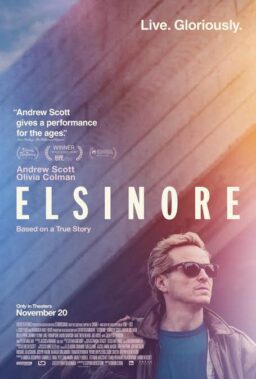
Mari is upfront about her terminal illness, and tells Marie-Lou that she decided to spend the time she has left on her art (something that the hero of another contemporary film, “Elsinore,” also does). This gives what is otherwise a very leisurely drama whatever urgency it has. You don’t know how long this relationship will last, and neither do the participants, so every moment becomes more meaningful.
That’s not to say that every moment of the movie feels urgent, or even necessary. A lot of the dialogue consists of people declaiming or discoursing on ideas, in language that sounds more recited than spoken. It’s easy to accept this as a convention of this kind of movie that’s further justified by the outspoken intellectuality of the major characters.
But there’s so much of it that “All of a Sudden” sometimes flirts perilously close to becoming the cinematic equivalent of “this could have been an email.” (The source material is You and I: The Illness Suddenly Gets Worse, a series of letters exchanged between philosopher Makiko Miyano and anthropologist Maho Isono as the former was battling terminal cancer.)
There’s also an imbalance between some of the subjects the movie professes to value and what we get to see. The most vexing is the treatment of the nurses. There are obvious educational and social class gaps between them and the administrators (and Gorô and Mari), and while the movie treats them as full human beings, and does eventually circle around and give Sophie the floor in a couple of scenes, there’s (possibly unintentional) condescension to the way this aspect is presented—as if what’s standing in the way of immense positive social change is the stubbornness of laborers.
There’s an irony, one the filmmaker is surely aware of, in titling a slow-paced, 196-minute movie “All of a Sudden.” But Hamaguchi’s breakthrough 2021 film “Drive My Car“—the very first Japanese movie to be nominated for a Best Picture Oscar, incredibly and (for us) embarrassingly—was almost as long. So it’s not like we’re unprepared for an experience that often feels more like reading a book (or a trove of documents about theater and healthcare) than watching a movie that is long but doesn’t feel that way.
Luckily, these problems and others are outweighed by the film’s ambition and intelligence. There is also something to be said for a movie that exemplifies its own principles by taking a form that requires the audience to reconsider what’s important in a story and, ultimately, the meaning of phrases like “worth your time.” This is an unusual, demanding, affecting movie that has a lot on its mind (and might open yours).