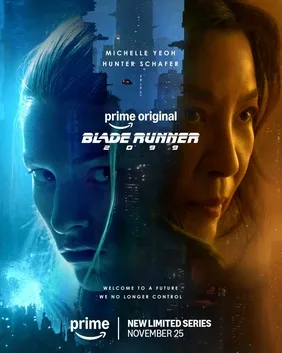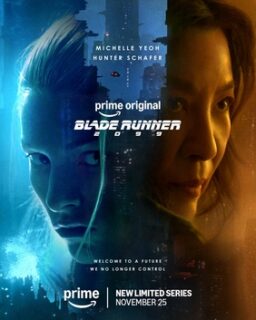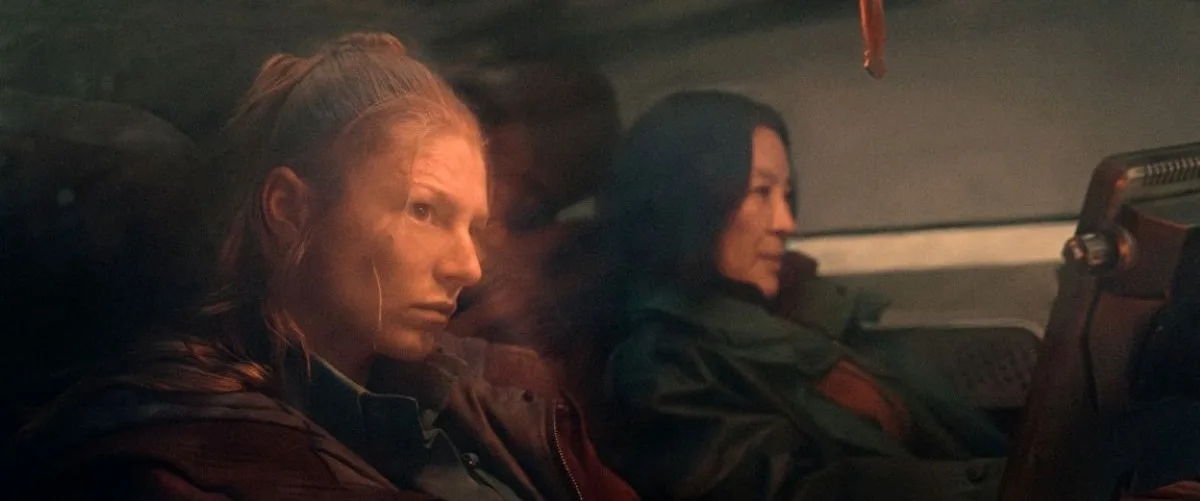
“Blade Runner 2099” fiddles around with several key elements of the mythology created by Ridley Scott, Hampton Fancher, David Peoples, and, of course, Philip K. Dick in his 1968 novel Do Androids Dream of Electric Sheep? The hazy light filtering through blinds that actually go back to noir as much as sci-fi; the orange, almost dusty hue over everything; the analog technology that looks more like 1979 than 2099; a sax-heavy score that pulls directly from Vangelis’s legendary work. The gang’s all here.
And, of course, the 8-part Prime Video series imports thematic parallels as well, asking what it means to be more human than human and digging most effectively into the idea that technology can’t replicate our awareness of mortality. Sadly, it takes what feels like forever to do so.
While creator Silka Luisa and her team clearly know their lore, they make several crucial mistakes common to modern streaming series, including self-serious pretension that turns too much of this show into a slog and, once again, a story that doesn’t justify the length of this project. TV critics have become as repetitive as defective robots when it comes to the prevalence of streaming projects that would have worked better as a film, but this is one of the most egregious offenders of 2026 in that the production just often enough finds interesting ideas, scenes, and character beats, but they tie them together with such an elongated string that it breaks.
The big twist of “BR99” is that a half-century after the action of Denis Villeneuve’s excellent “Blade Runner 2049,” the balance of power has shifted, presumably after an uprising that happened shortly after the action of that film. Replicants have taken over society, hunting the over-emotional humans out of existence, and even taking on the title of “Blade Runner” from the species that used to oppress them. Michelle Yeoh plays Olwen, an aging Replicant Blade Runner nearing the end of her pre-programmed life cycle. She ends up partnering with a human named Cora (Hunter Schafer), who is pretending to be a Replicant. They end up with a common goal: Hunting down a saved memory that could change the future for Replicants and humans alike.
The first problem is that the hunt takes what feels like forever to get going. This show doesn’t really find its purpose until the third or fourth hour. Call it “Blade Snoozer” or “Blah Runner,” because the first episode or two are downright languid. There’s too little sense of urgency, and absolutely no sense of humor. Everything is so capital-S Serious without really earning that kind of immediate dedication from the audience. The Scott and Villeneuve films had the charisma of Harrison Ford and Ryan Gosling at their centers to offset the deep thematic concerns of the writing; it’s not that Yeoh and Schafer can’t do the same thing, but they’re not given the chance here, too often victims of a plot that just pushes them from one “deep” moment to the next.
The show improves greatly after the abysmal set-up when it expands to include Tom Burke (“Furiosa: A Mad Max Saga”) as someone who is after the same thing as Olwen and Cora. His connection to the past and future of these characters, along with a sly smile that too few of these characters are allowed, gives the project some much-needed momentum right when it’s about to sink into unwatchable. The plotting picks up in the middle as well in ways that they’ve asked us not to spoil, but even that momentum can’t be maintained through to a disappointing finale.
As for performance, Burke is the MVP, but Schafer is a close second, delivering a performance a world away from her turn on “Euphoria” in a role that could have become a panicked damsel in distress. Instead, Schafer finds notes of confidence, playing a survivor instead of a victim. Sadly, Yeoh is entirely wasted in a role that the writers never quite figured out. Her arc should be the foundation of “BR99”: she’s the character whose pending death becomes the show’s only real ticking clock, but she’s often backgrounded for key moments and given too few chances to show her remarkable physicality.
One reason Yeoh gets lost is that “BR99” is overly conscious of its aesthetic to a distracting degree. The color palette is dishwater-dingy, and so much is shot in close-up that the characters don’t ever feel like they have enough room to breathe. There’s far too little sense of world-building here, which is the exact opposite of the two features in that they gave viewers the impression of active, vital worlds around their protagonists that just don’t exist on the show. Again, Burke injects life because he feels like he exists outside of the function that the screenwriters put on him; the same can’t be said for Yeoh or Schafer or anyone else really.
Worst of all, “Blade Runner 2099” feels like a wasted opportunity to make a variation on Dick’s ideas from a place that has a much different understanding of the potential and peril of A.I. Instead of updating the ideas of the book and two films for this current, anxiety-filled era, Luisa and the writers go back to so many of those original ideas that it feels dated. It’s something a Replicant might have written.
Whole series screened for review. Now on Prime Video.