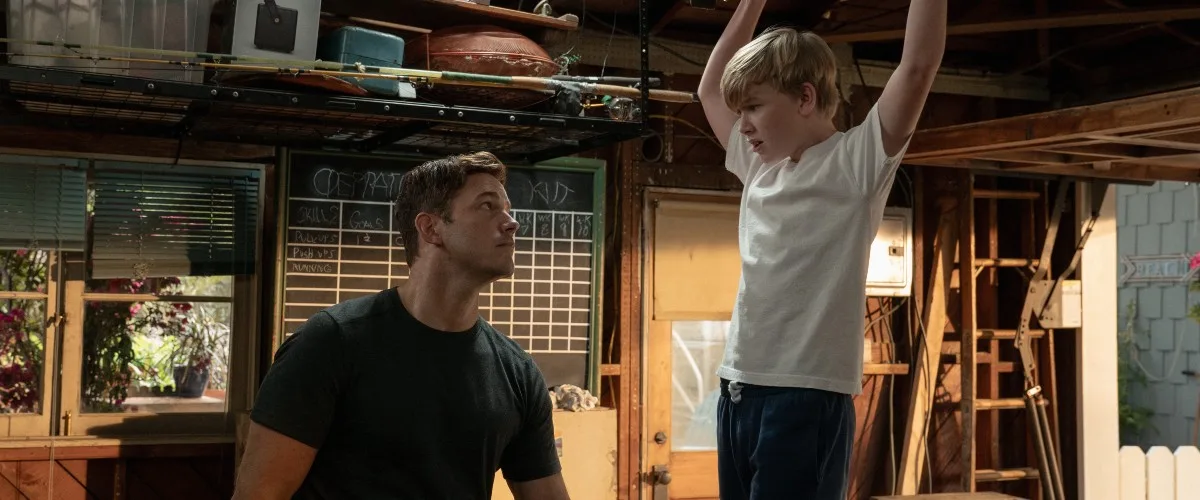
When “Way of the Warrior Kid” isn’t constantly getting in its own way, it flickers with the promise of a genuinely moving story about teaching others to exorcise their demons while wrestling with your own. Unfortunately, it is so preoccupied with its own sense of self-importance that it forgets to be a coherent movie. Teetering somewhere between a Navy SEAL PSA and a full-length Chris Pratt thirst-trap edit (Do all those scenes really call for him to be shirtless?), the film never quite lands its punches amid its frenzied pace.
It is a bitter irony that Will Staples’ screenplay moves along so briskly, because the core of the film’s message is about patience. After an opening sequence that sees decorated Navy SEAL Jake (Pratt) shot down while en route on a mission to save kids held hostage, he goes back to spend time with his sister, Sarah (Linda Cardellini), and her son, Marc (Jude Hill). (Critically, the opposing force is never named or shown, making it far too easy to root for these soldiers as they unleash righteous fury on nondescript assailants.)
Those developments take place within minutes, and Peter S. Elliot’s choppy editing does the film no favors, as it inexplicably fades to black in many sequences just to tie together two disparate scenes. The flavor of Marc’s problems is as vanilla as they come: wrestling with bullies (whose sadism is hammered up to unbelievable levels of cruelty) and feeling unrequited affection from a crush. Jake commits to helping whip Marc into shape so that he can take more control over his own life.
If that premise sounds too testosterone-heavy, director McG and writer Will Staples (who adapts the children’s novel of the same name by Jocko Willink) cleverly lean into preconceived notions one might associate with it before subverting them. Yes, part of Marc’s “training” involves an inordinate number of pull-ups, intense swimming, and early mornings, but Jake is far more interested in teaching Marc about a different kind of strength, one that is rooted in empathy instead of violence.
This is best demonstrated in a sequence where Jake takes Marc on a reconnaissance mission to his bully’s home under the cover of night. Marc hopes to prank his bully back for revenge, but instead learns of his complicated home life. As he walks back to Jake, the soldier reminds him that people carry multitudes and that while a difficult upbringing is not an excuse to act cruelly, the world would be better if we all took time to understand where people come from.
Therein lies the core paradox at the heart of “Way of the Warrior Kid”: on paper, it preaches peace, but its visual language cannot mask the glee of combat. “You only fight if you’ve exhausted every other option,” Jake scolds. While that may be the case, McG and Staples never quite do enough work to make meekness attractive. One cannot help but feel these lines (peppered in only so they can be redeployed later) are just lip service, letting the film get away with its fight scenes.
We have seen a permutation of stoic beefcake Pratt has played before, and he does little to differentiate himself from past incarnations here. The man can sell a smolder, and just as Staples’ script affords him the opportunity to reach a richer interiority, he retreats behind adages (“Discipline=Freedom”) and one-liners (“Every good partnership starts with a handshake”) that serve as stand-ins for character development.
Hill is saddled with being either histrionically angry or depressingly mopey, but in that oscillation, he finds a way to imbue Marc with a relatable puppyness, someone who is trying to reconcile the reality of who he is with the chiseled version of masculinity his uncle is presenting to him. That struggle is where the film is most thematically rewarding.
Ultimately, “Way of the Warrior Kid” is far too proud to take its own advice, which is the convoluted irony of its downfall. Jake is eager to get back into the field, but medical professionals and commanding officers tell him he cannot muscle his way out of the time needed to fully heal. There are valuable lessons here, but rather than use the straitjacket of a film to thread its narrative more intentionally, it chooses to speed-run through instead.