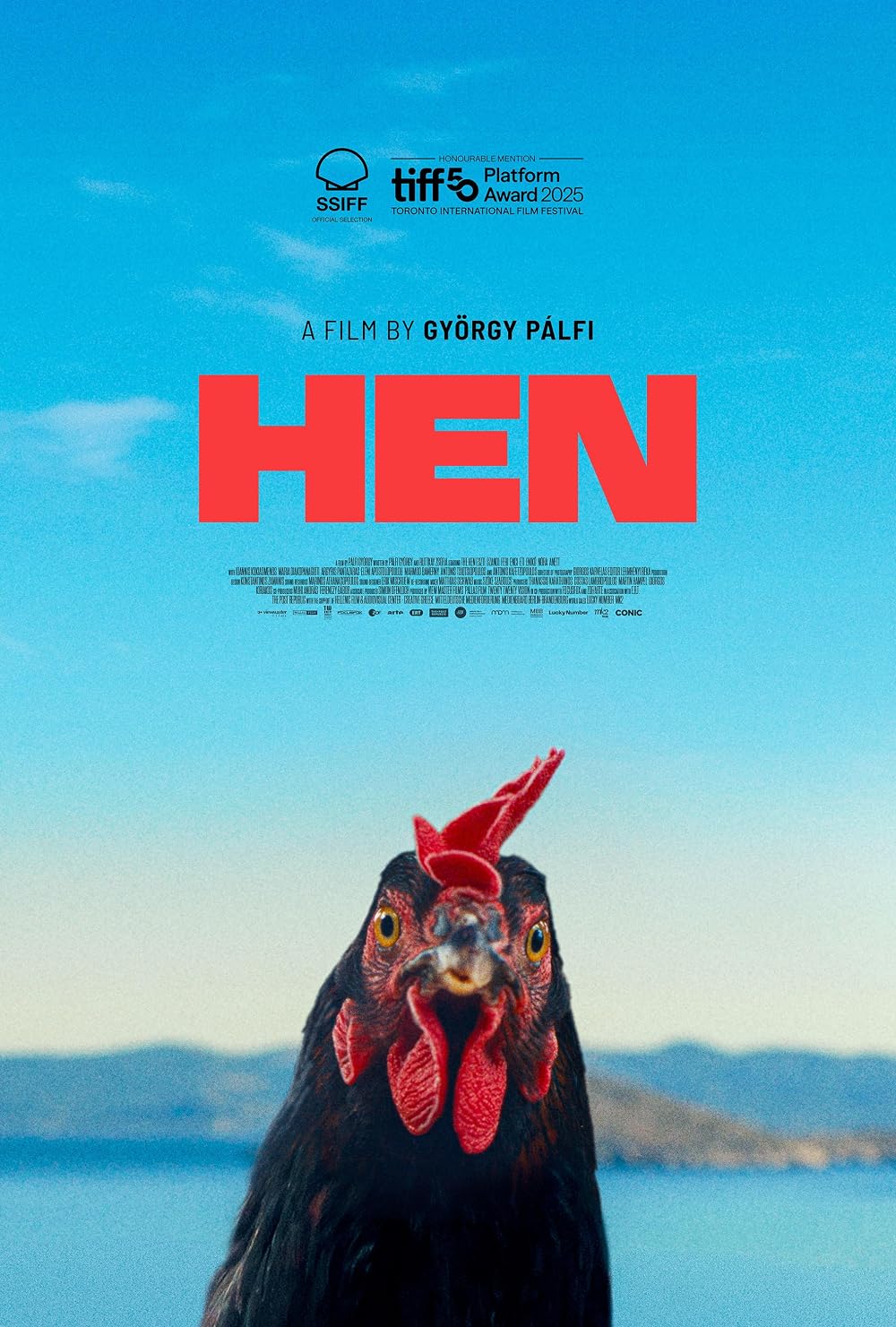
Opening with a live egg-laying that is as visceral as the opening live birth scene in Georgian filmmaker Dea Kulumbegashvili’s “April,” Hungarian auteur György Pálfi’s pitch-black dramedy “Hen” uses the adventures of its titular wandering fowl to lay bare the absurd detachment slowly creeping into our shared humanity, and our increasingly severed connection with the natural world.
After this shocking close-up of an egg laying, probably the most intimately a chicken has ever been filmed for the big screen, Pálfi cuts to the sterile factory farm in which Hen resides, filming the machines, which process hundreds of eggs and live chicks with the same coldness as any inanimate factory-produced product, with the cynical symmetry of a Jacques Tati film.
This coolness is contrasted with the warmth of the sun outside the factory, where Hen, a black Leghorn chicken played by eight avian actors: Eszti, Szandi, Feri, Enci, Eti, Eniko, Nora, and Annet, is rejected by the factory’s own because of her dark plumage. The driver in charge of transporting the chickens to their doom places Hen in the cabin of his truck, intending to bring her home for his wife to make into soup. Thankfully, fate intervenes once again, allowing the curious chicken to escape into the parking lot of a gas station. Here, a tragicomic chase sequence involving a fox mordantly answers the age-old question: why did the chicken cross the road?
A nearly wordless film, the early sequences of “Hen” have the comedic charm that Tati brought to his films, in which the bumbling Frenchman finds himself constantly at odds with the modern world. Like Hulot, Hen is often flummoxed by her surroundings, but through ingenuity—and sometimes dumb luck—she makes her way forward, seeking a better life for herself and a safe haven where she can brood her flocks of chicks in peace.
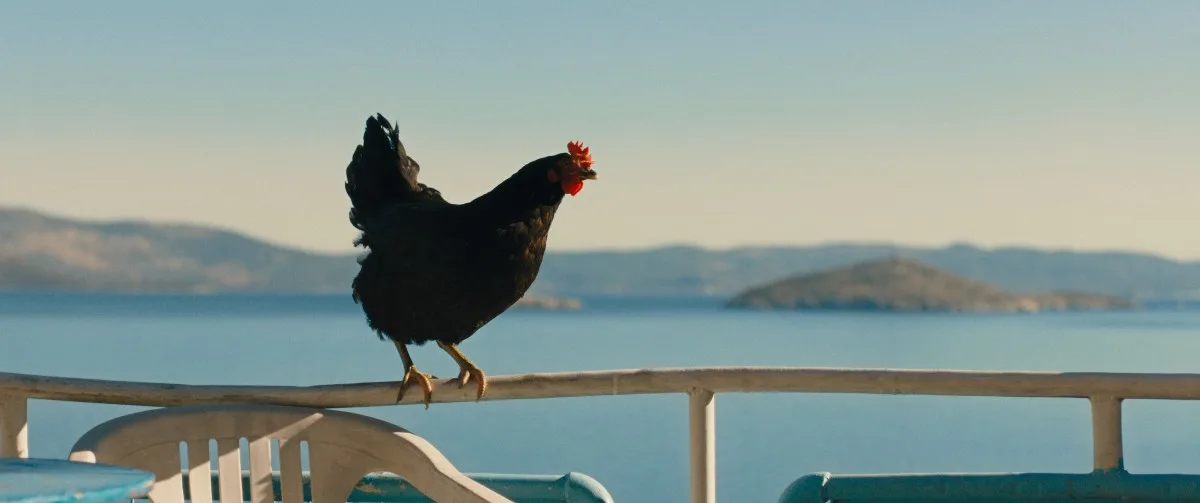
The modern world around Hen, with its bold color palette of rich red and deep blue hues, comes alive through Giogros Karvelas’ incredibly vibrant cinematography. His fluid camerawork, often shot from floor level, doesn’t quite put us in Hen’s POV, but it invites us to follow her journey from afar. Meanwhile, editor Lehmhényi Réka’s masterful cuts to close-up reaction shots of Hen anthropomorphize her emotions, placing us directly into her psychology, or at least convincing us through clever image manipulation that we know what she’s thinking and how she’s feeling.
Eventually, the tenacious Hen finds sanctuary at a small family-run restaurant in a Greek seaside village, where she soon falls in love with a handsome rooster. Here, Grigoris Bithikotsis’ classic Greek laika song “Episimi Agapimeni” creates a wonderfully absurd comic (and romantic) effect.
Meanwhile, Hen’s various attempts to live her life freely and keep her eggs until they hatch, which are often thwarted by the restaurant’s kindly older owner (Yannis Kokiasmenos), turn her never-ending quest into a thing of tragedy. In one sequence, Hen spies her eggs through the kitchen window; a close-up of the raw yolks about to be scrambled with just a small speck of blood reminds us, and Hen, of what might have been.
But Pálfi and Zsófia Ruttkay have more than just chicken rights on their mind. Hen’s journey through the human world offers the audience a glimpse of the country’s political unrest, as when Hen finds herself caught between a line of protestors and riot police, clearly ready to get violent. Later, during one of Hen’s attempts to brood her eggs in peace, she ends up on a truck bound for the coast. We quickly ascertain that the old man’s son-in-law (Argyris Pantazaras) is mixed up in human trafficking, working for a ruthless crime boss (Antonis Kafetzopoulos) who puts profits over people.
Here, “Hen” shifts gears from a picaresque adventure film into murkier, morally complex waters. As Hen tries to achieve bodily autonomy in a world not made for her, she inadvertently witnesses the worst of humanity. First, through the industrial farm, then through the abject inhumanity of the traffickers, who treat migrants with the same cold efficiency as the factory, and dispose of them with the same lack of regard for their dignity and lives. Almost every human interaction Hen witnesses, aside from the old man’s rare kindness, is rooted in profit, fear, complacency, or selfishness.
Hen’s singular mission to brood her eggs and raise them herself, despite everything working against her, contrasts with the decay of human connection we witness all around her. Hen remains unmoved by all she sees—reminding the viewer that she is an animal, after all, and doesn’t move through the world the way we do. Yet, through her gaze, we are given a mirror in which to examine ourselves.
With “Hen,” Pálfi asks us to stare into the abyss of our broken sense of community and contemplate a path toward a better future for our children, one rooted in human connection rather than capital gains.
Maybe this future is possible, if we can all work together with the same steadfast determination, resilience, and guilelessness as a humble hen.