Over the years, the term “hagiography” has gotten a bad rap. It literally means “holy writing” and was usually used to describe a chronicle of a saint or hero. Over the years, it’s come to mean a puffed-up, overly flattering account of a saint, a hero, or just about any well-known figure, including a movie star.
“Jimmy,” directed by Aaron Burns from a script by Justin Strawhand, doesn’t get its hagiography vibe by accident. Burns is an explicitly Christian filmmaker, and his account of the movie star Jimmy Stewart during his military service in World War II and the subsequent making of the epochal Frank Capra picture “It’s A Wonderful Life” depicts Stewart as a man of strong faith.
The movie also has the biographical facts on its side. Stewart was a devout Christian and, as depicted in the film, his father gave him a book of “Psalms” to take with him on his military service. In the film, Stewart’s dad, played by Neal McDonough, encloses a note with the book, telling Jimmy that the Bible verses “got me through some tough times.”
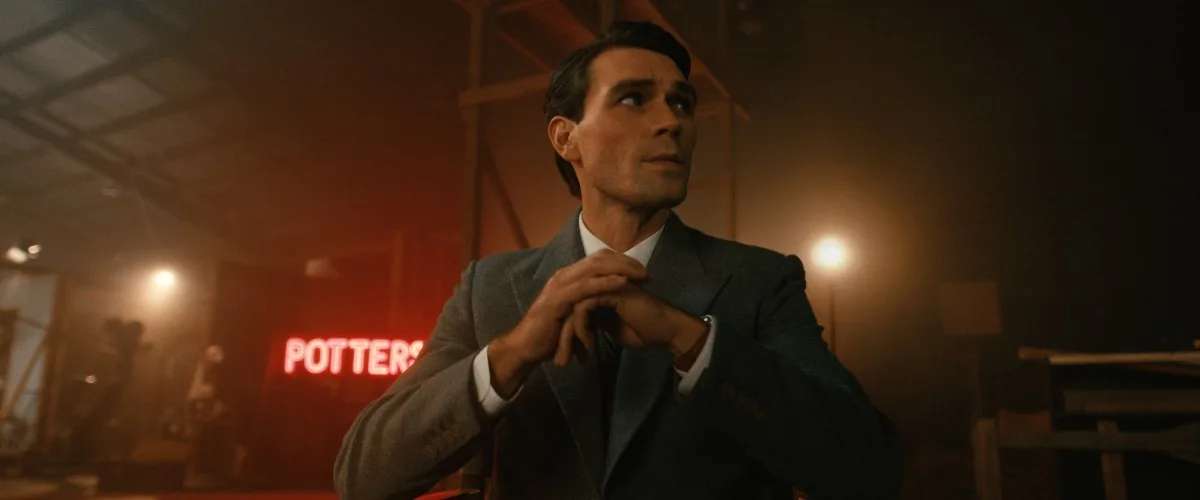
The way “Jimmy” spins its tales of Hollywood before and after sending our hero off to war often barely skirts cheesiness. Jason Alexander plays MGM mogul Louis B. Mayer, trying to convince Stewart, embodied by New Zealand actor KJ Apa—who’s got Stewart’s drawl and lankiness not quite down pat, but damn close—that he can do his best bit for the war effort by staying home and making propaganda pictures. Chris McDonald plays an avuncular Lionel Barrymore. Sarah Drew’s Hedda Hopper is never not speaking in insinuating tones. And so on. Occasionally the movie falls back on the overfamiliar; the way Jimmy cowers at a popping flashbulb when he returns to Hollywood is, of course, not exactly inapt, but it also takes a page from Scorsese’s book of visual tropes.
But the actual story, skillfully interweaving two time periods (credit is due to screenwriter Justin Strawhand), is genuinely compelling. By 1943, Jimmy is a group commander in the Air Force, and the film shows him forced to make an agonizing decision when one of their bombers, “Sunflower Sue,” is downed, presumably by a U-Boat. He chooses to press on with the mission rather than search the wreckage. This decision immediately begins to haunt him. He takes it upon himself to personally write letters to the families of the lost men. “They need closure,” he states, and the line itself is an anachronistic clunker, but we get the idea.
While stationed in England, Jimmy begins a friendship with Kara Killmer’s Lady Julia (a composite character—the real Stewart had more than one romantic liaison overseas, but it won’t do to have him be any kind of lothario here), and at one point passionately asks her, “Am I a good man?”
At the end of the picture, on the set of “It’s A Wonderful Life,” Stewart has to do his most difficult scene, sitting at a bar and addressing God: “I’m not a praying man…” Max Casella, as Capra (who doesn’t even seem to bother to try an impersonation of the real-life man), goads Stewart to “speak from the heart,” and here the movie almost squanders whatever goodwill it’s built up by presenting Jimmy with a vision, which I found a near-egregious instance of overselling.
In any event, this project is more than just Stewart-estate approved; one of its producers is Kelly Stewart-Harcourt, Jimmy’s daughter. On a personal note, I was rather tickled to see Mark Malkin, the red-carpet correspondent for Variety, as big band leader Glenn Miller. I met Mark at the very start of his career, when he was an assistant editor at Premiere magazine. Smart kid, but he didn’t know from Glenn Miller back then. (And Stewart would actually go on to play Miller in director Anthony Mann’s underrated 1954 “The Glenn Miller Story.”)