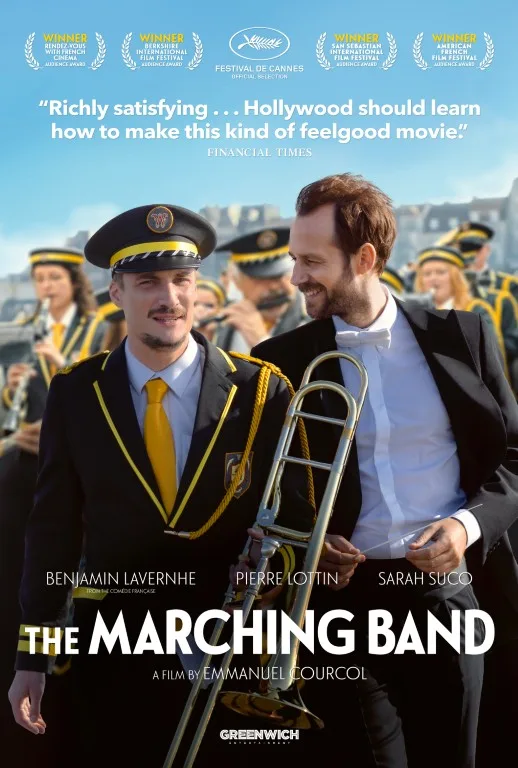
“The Marching Band,” Emmanuel Courcol’s affecting brotherly drama, possesses a life-affirming soul whose earnest feelings invariably cut down on its potential complexity.
The film begins with a stirring ascending sequence of shots. Famed conductor Thibaut Desormeaux (Benjamin Lavernhe) leads his orchestra in a rehearsal of Egmont, Ouverture, Op.84. Editor Guerric Catala cuts between three different kinds of composition: there are punch ins on the musicians dutifully following Thibaut’s charge, the physically attuned shots of Thibaut’s hands, arms, and back flexing to the pulses of the piece, and even more telling, close-ups on his face as it melts into sunken exhaustion. Thibaut collapses. In the next scene, he meets with his sister Rose (Mathilde Courcol-Rozès) to ask about a bone marrow transplant: Thibaut has leukemia.
Though you’d think “The Marching Band” would unfurl like a common cancer weepy, you’d be wrong. Because ultimately the biggest revelation for Thibaut isn’t his leukemia diagnosis, but that his sister Rose isn’t related to him. He’s adopted. With such a major disclosure, you’d think the whole film would be about Thibaut trying to find his biological family in a race against time. But it doesn’t become that. Thibaut finds his biological brother Jimmy (Pierre Lottin) quickly, like ‘within the first ten minutes of this movie’ quick. So what one learns in these early movements is that “The Marching Band” isn’t going to set up a conventional three-act plot guided by a primary theme. Rather, it’s a film about revelations. Because the more Thibaut learns about Jimmy and vice versa, the more they discover about themselves.
Despite being related by blood, Thibaut and Jimmy have led far different lives. Thibaut was classically training as a pianist by the age of 3, allowing him to rise the ranks and become a world-renowned artist. When he initially enters Jimmy’s world, he learns that Jimmy is a divorced father and a working-class guy toiling away in a soup kitchen. It’s only later that Thibaut learns that Jimmy possesses pitch-perfect hearing, loves jazz, and plays trombone in a marching band composed of workers from a striking factory. Nevertheless, Jimmy is self-conscious and quietly bitter about the life Thibaut lived and the one left just out of reach.
Both actors conjure their characters’ upbringings with precision. Lavernhe moves his lithe body with a kind of freedom in space; he can tell that Thibaut has never questioned his place or what he deserves. Lottin, meanwhile, keeps a guarded posture, shoulders hunched in his denim jacket. When the group’s conductor leaves, Jimmy hesitates to take over. Though his fellow band member Sabrina (Sarah Suco) is clearly attracted to him, Jimmy struggles to return her ardent feelings. These actors do the work the script only sometimes gestures at: Does Thibaut respect Jimmy’s artistry, or is there a high-versus-low-art conversation happening? The answer emerges further through the production design—the cozy wooden confines of Jimmy’s home dictate the warmth that surrounds him—and a final tear-jerking scene that attempts to fully fuse Thibaut and Jimmy’s different worlds.
Along the way, “The Marching Band” can sometimes play like a French “Sister Act 2.” That is, a professional artist comes to the aid of struggling working-class people, promising to have their story heard through the music they play. The opportunity for creativity gives the restless, self-doubting co-lead enough confidence to try, fail, and try again—culminating in a competition. In this case, a contest between marching bands that Jimmy hopes will shine enough of a light on the band to get the country music-loving mayor to support them in their strike (we barely learn anything about the particulars of this act of worker solidarity).
Despite these strong characters and sturdy themes, “The Marching Band” relies on some familiar narrative moves that can make the final act fairly predictable. It doesn’t help that Thibaut is a pretty forgettable character too. So the film often feels like we’re progressing steadily yet unsurprisingly to an ending that, despite its aforementioned life-affirming mood, lacks drama or spontaneity. Luckily, the bones here, even if they’re familiar to the touch, are moving enough to make it a ‘sum of their parts’ film whose relatability makes it a tender picture that strikes the right note.