In this first dispatch from Locarno is a trio of films one might call “elusive.” They all capture weighty, human subjects: sensuality, war, and disaster—with a visual and sonic approach that’s difficult to grasp and, sometimes, even harder to love. They are all formally provocative works, made to push the audience to its breaking point. Consequently, they’re like little I’ve seen this year, and I’m sure unlike anything I’ll watch in the coming months.
A sensual exploration of the body and senses, Ann Oren’s “Objet A” assuredly follows in the footsteps of her equally playful film “Piaffe,” a film about a woman foley artist whose surprising growth of a horse tail draws her into an S&M world.
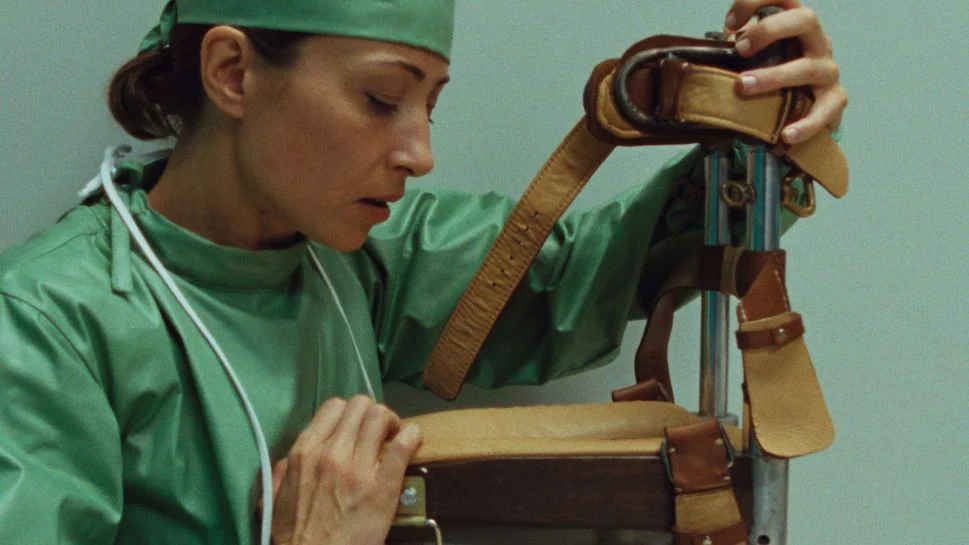
Her latest is about two married star surgeons—Ingeborg (Aenne Schwarz) and Adam (Louis Hofmann)—who’ve risen to fame by using fungi to generate skin. In scenes that recall “Phantom Thread,” they share the same daily routine: Ingeborg prepares breakfast (boiling eggs and toasting bread) while Adam works out (he does stomach crunches and uses an exercise ball). They sit in their austere black suits reading the newspaper before heading to work, where they perform hand surgeries. With one patient, a mysterious Gaia (Simone Bucio), they remove a sixth finger growing from her fist.
Through a confluence of events—Ingeborg, a kleptomaniac, fractures her leg after stealing a gold lighter from a man, requiring her to use a steampunk stump—Gaia becomes part of the surgeons’ world. The creation of this throuple causes disarray in Ingeborg and Adam’s relationship, revealing their physical distance when it comes to their physical attraction.
See, Oren is greatly intrigued by how we express our sexual desires and gain sensual pleasure. Here, the surgeons rely on their senses: touch, smell, and feel—to arouse one another. But there’s no penetration or even kissing. By simply rubbing Adam’s collarbone, Ingeborg gains satisfaction. Upon Gaia’s arrival, however, they lose appeal for one another. Ingeborg takes to licking her leather-bound stump and flirting with Gaia, while Adam peruses a bar where a nun hangs out. The latter attraction opens the film to having a religious theme, recalling Adam and Eve, especially as Gaia begins introducing apples, moss, and even mushrooms (mostly for smelling and licking) into the couple’s home.
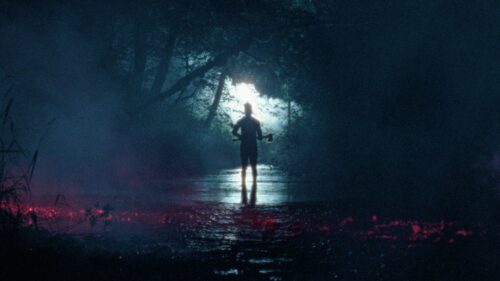
In the film’s most climactic scene, Ingeborg and Adam engage in a naked orgasmic fever dream led by a scene of the pair crawling through the woods and into one another’s psyches. Oren isn’t much for explanation or clear characterizations. Much like Peter Strickland, she makes evocations to the viewer’s desires and phobias throughout her films in a bid to elicit impulsive yet revealing reactions.
If some filmmakers want to make it clear that we’re watching a movie, for instance, then Oren makes it obvious that we’re watching human acts whose close relationships or sexual wants are only shown to be outlandish upon reflection. And while “Objet A,” like any of Oren’s works, could be accused of overt obliqueness, the sensorial craft on display, the committedness of the actors, and the provocative subject matter make Oren’s vision overwhelming and indelible.

The writer/director Uta Beria takes a decidedly political bent with his rebellious coming-of-age narrative “Tear Gas.” This is a harrowing film filled with nightmarish imagery and chilling sounds. It begins, almost fittingly, with a funeral. Avto (Gaga Shishinashvili) and his family are taking his deceased father to be buried over the Russian border. Avto, along with his 18-year-old daughter Elene (Taisia Eradze) and his stern mother Dali (Mzia Arabuli, “Crossing”), conversely, occupy Georgia. Like the solemn ceremony they are attending, their country and their family are on the verge of change.
Elene serves as the eyes to the oncoming upheaval. The green-haired teenager navigates the testy relationship between her parents—her father, Avto, is a cop, and her mother, Tina (Kato Kalatozishvili), is a reporter—with a similar dexterity required of her fellow citizens to work through a government that cracks down on civil disobedience via extralegal avenues. She also takes Judo classes that she doesn’t particularly care for as she regularly allows herself to be chokeheld to the point of passing out.
Like many around her, she feels as though she’s trapped in inaction. So when her grandmother and neighbors decide to attend a demonstration in Tbilisi, she does so with incredible eagerness. But when she arrives among the throng of protesters, she neither remains with her grandmother nor searches for her mother, who’s reporting on the demonstration. She instead becomes interested in a few defiant teens, particularly a young boy, who excite her.
In these protest scenes, which appear to explicate how several generations are united yet experiencing several different rebellious wants at once, Uta captures the frantic kineticism of protest. That’s because he filmed inside actual demonstrations, which grants his framing a kind of spontaneity around the many moving figures within this amorphous crowd. He also somehow grasps a poeticism, like when tear gas is thrown at Elene and her friends; Elene stumbles through the smoke as strobing lights and sounds of sirens invade the frame.
In another instance, her father Avto is silhouetted by the gas as he beats a demonstrator with his nightstick, making for a bold contrast between the oppressed and the oppressor. Uta bends these imaginative moments toward groundedness by including real archival footage of past demonstrations. The result is a double coming of age, so to speak, for a teenage girl and for a country.
Uta accomplishes this balance by sometimes cutting away from the protests for familiar beats—the locking of eyes between avarice teens—and to the search by Elene’s parents and grandmother to find her. Each actor approaches the fast-moving material with assuredness, which makes the somewhat broad ending somewhat disappointing (then again, I’m not sure how else Uta would’ve concluded this film). “Tear Gas” doesn’t necessarily offer a resounding rebellious chime in its closing minutes, but it does keenly say that the work is yet to be finished.

Of all the films I’ve watched at Locarno, the most impenetrable is Anna Vaz’s experimental essayist documentary “Fire Flower” (“Hanabi”). An adaptation of Yoko Hayasuke’s Journal of a Radioactive Brain, the film, which was assembled over the course of a decade, is a reaction to the 2011 Tōhoku earthquake that caused the Fukushima Daini Nuclear Power Plant to melt down. The stream-of-consciousness narrative oscillates between a meditative narrator describing their anxieties about radioactive elements in the food they consume, the air they breathe, and the ground they walk on, and interviews with different Japanese citizens who are equally worried by the toxicity (both political and physical) around them.
Vaz further scrambles the material via an aesthetic approach that’s as resistant as the wider society that refuses to accept that they’re living through the remaining consequences of the meltdown. It’s explained that many have instead called for “unity” and nationalism rather than allowing individuals to question the safety of their environment. Consequently, in the aforementioned interviews with her subjects, images of them speaking are matched with asynchronous sound, aurally demonstrating the disconnect between their truth and the accepted “reality.”
Like a journal, the narrative is further separated by dates doubling as chapters. Many of the early chapters draw out like a blade. At one point, Vaz evocatively films a sunset for a solid six minutes, allowing the reddish orange rays to envelope the screen. She wants us to sit with these images in a way that many of her countrymen will not sit with the possibility of the presence of radioactivity in Japan. As the film progresses, the chapters get shorter, almost mirroring the kind of erosion of memory often related to the aftermath of a disaster.
Finally, Vaz also wants to remind us that we’re watching a movie. She includes emails between herself and a source named K.A. (who provides videos and photos that could act as evidence) and between herself and Hayasuke. All of these components come together for a challenging watch because it cinematically actualizes fear and vulnerability of memory and awareness, particularly when it comes to the health of one’s body and mind. The film reaches for a knowing symbolism a tad too much in the summation of its many themes, sometimes even repeating itself beyond recognition. But Vaz’s single-mindedness to explore this subject in all its complexity brings one into her spell. We become subdued and lulled into a dream that more often than not lives as a nightmare.