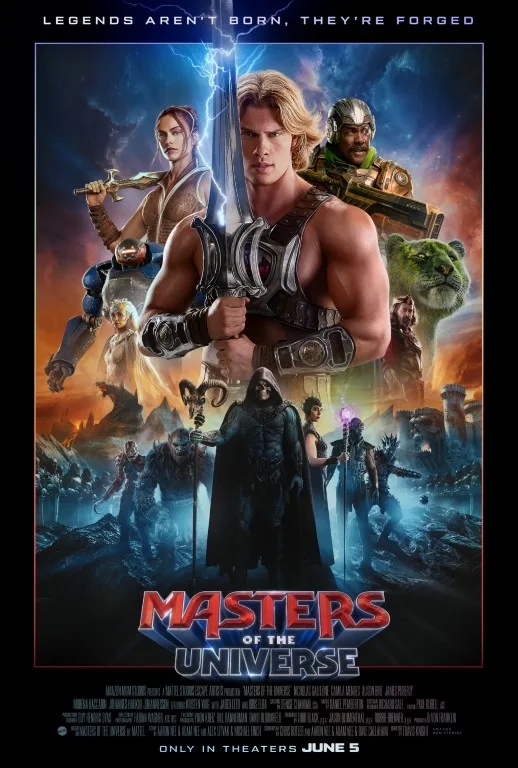

Let’s face it: We’re all Barbie girls, living in a post-“Barbie” world. In the wake of the massive success of Greta Gerwig’s droll deconstruction of the doll, Mattel quickly greenlit movies on just about every property in its catalog. Thomas the Tank Engine, Rock ‘Em Sock ‘Em Robots; you name it, it’s getting the big-screen treatment. But “Masters of the Universe” is the first of this wave, and benefits a bit from having a story and lore a bit more attuned to a four-quadrant blockbuster, with its sword-and-sorcery fantasy and “Star Wars”-inspired sci-fi touches. Even so, how do you adapt a toy line with larger-than-life characters like Ram-Man, Skeletor, and Evil-Lyn to the big screen without it being laughable?
The tack that Mattel, and director Travis Knight (several great Laika films, plus the admirable Transformers spinoff “Bumblebee”), have taken is to just glom the property onto the “Thor: Ragnarok” formula: lean into its ’80s kitsch, while throwing in enough irreverent jokes and postmodern winks at the audience to show us they’re not taking this too seriously. Problem is, that approach is a double-edged Sword of Power: when it works, it proves a rollicking underdog space adventure. When it doesn’t, it feels like it’s ashamed of what it truly wants to be.
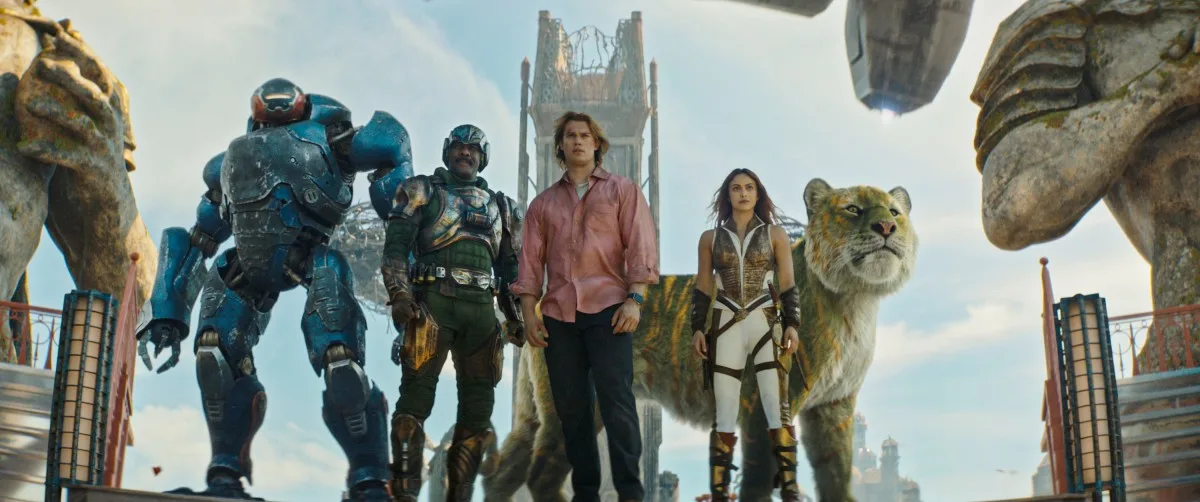
Fittingly, that’s the journey young Prince Adam (Nicholas Galitzine, all pouty lips and big muscles; happy Pride Month) goes on in his journey to becoming He-Man. A flashy prologue breezes us through the ins and outs of Eternia, an Asgard-like realm where laser guns coexist with giant talking tigers, as ten-year-old Adam struggles to keep up with the martial demands of his father’s Man-at-Arms (Idris Elba). But it’s also then that the mincing, menacing Skeletor (Jared Leto) lays siege to the capital, capturing Adam’s parents and forcing the royal Sorceress (Morena Baccarin) to zap him, along with the much-desired Sword of Power, to planet Earth.
Separated from the Sword while in transit, Adam spends the next 15 years searching for it, coasting through his menial HR job and the mundanities of life on Earth. But soon, he’s reunited with the Sword, bad guys come looking for it, and his old friend Teela (Camila Mendes) brings him back to a ruined Eternia to save the realm and reclaim his legacy.
To its credit, “Masters of the Universe” leans hard into its ’80s hair-metal aesthetics in some delightful ways. Modern effects make Eternia look like a particularly glossy playset, and Richard Sale’s costume designs do their level best to adapt the various costumes into something workable while still retaining their cartoonish boldness. Daniel Pemberton’s rock-guitar-heavy score (some of it credited to Queen’s Brian May; “Princes of the Universe” even plays over a big climactic battle) keeps the action chugging along.
As Adam, Galitzine almost feels like Tom Hanks in “Big,” a kid who doesn’t quite know how to handle the hulking adult body he’s found himself in. The costumes try to hide Galitzine’s well-publicized physique in bulky button-downs, but it’s hard to take his weeniness seriously when we can still see those pecs peeking out. When he transforms, he fills out the loincloth well, sure. But the actor feels adrift when next to folks like Elba and Mendes, who know how to calibrate the camp to the appropriate setting.
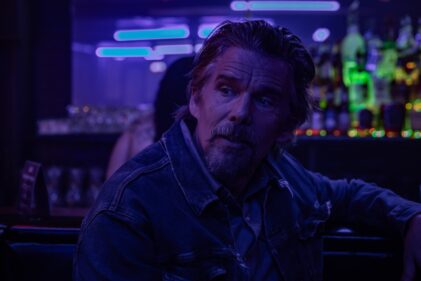
Which brings us to Leto, who, I hate to say it, is incredible in this. The actor’s been trying to transition into an A-list movie star for quite some time, but I think roles like this and “Blade Runner 2049” bring out his innate diva in ways that actually serve those films well. Even through a meticulously CGI-ed skull, Leto brings out a welcome bitchiness to Skeletor that jives well with his ’80s conception as a pure villain. He purrs with a Tim Curry-like affect and cackles with devilish glee; he tries to get his minions to join him in his evil laughs. A late-film mind-torture sequence places him in various novel contexts you have to see to believe, but you’ll cackle all the same.
If only the rest of the film were as funny as he, as screenwriter Chris Butler (a fellow Laika colleague of Knight’s), alongside the Nee Brothers (who were originally slated to direct an earlier version of the adaptation) and “Across the Spider-Verse”‘s David Callahan, strike that late-Marvel tone that feels like a comedy without saying anything funny. So many lines have the inflection of humor, but contain no jokes; “so that happened”-level remarks that feel like placeholders for gags that never got replaced. Some of it works: I love the touch that everyone’s silly names (Mekaneck, Fisto) are the product of a traumatized ten-year-old who only half-remembered his father’s army men, like the ignorant middle manager who comes up with nicknames for everyone at the office. Kristen Wiig even voices a homicidal battle-bot sidekick here, and her character barely registers—as does the action, which feels well-staged but anonymous among all the CGI flurry.
It’s funny, really, that “Masters of the Universe” is coming out smack dab at the start of Pride Month—He-Man has long been cited as an erstwhile gay icon, with his ripped muscles and bondage harness making him look like if Conan the Barbarian was drawn by Tom of Finland. His alter ego, Adam, was a foppish, feminine man who always wore pink; his transformation felt akin to coming out. There are nods to that subtext here (see the way Skeletor purrs about Adam’s muscles and his “big, shiny…sword”), but Knight’s “Masters of the Universe” is mostly a film about competing masculinities.
You see, this isn’t your father’s He-Man. He’s modern, sensitive; he’s been trained by human resources. He’s constantly pummeled with ideas about the kind of strength and dominance a “real” man should exude, and he struggles to reconcile them with the kind of guy he wants to be. That “Masters of the Universe” sees fit to challenge those ideas is an interesting wrinkle to the formula.
If only it had actually committed to those wrinkles. As with any note of sincerity in the piece, Knight and co. pulls back to the comfort of a joke, or a rolled eye. The script sees Adam’s HR training as both a hidden strength and a nod, in so many words, toward his pussification: If being empathetic is the answer, why is the very approach couched in therapy-speak and in conflict-avoidant HR representatives that the film itself treats as jokes? And don’t for a second think that the film’s desire to grow Adam into a more well-rounded man will pay off in the climax; after all, we still gotta punch Skeletor real hard in the end.
But much like Adam, “Masters of the Universe” is a film of competing identities. It wants to be the crowd-pleasing, audience-nudging, Easter-Egg-having ode to the toy line that Mattel clearly desires, while also avoiding accusations of taking the whole thing too seriously. In so doing, it’s a film that tries to serve two masters, and doesn’t have the power to really honor either.