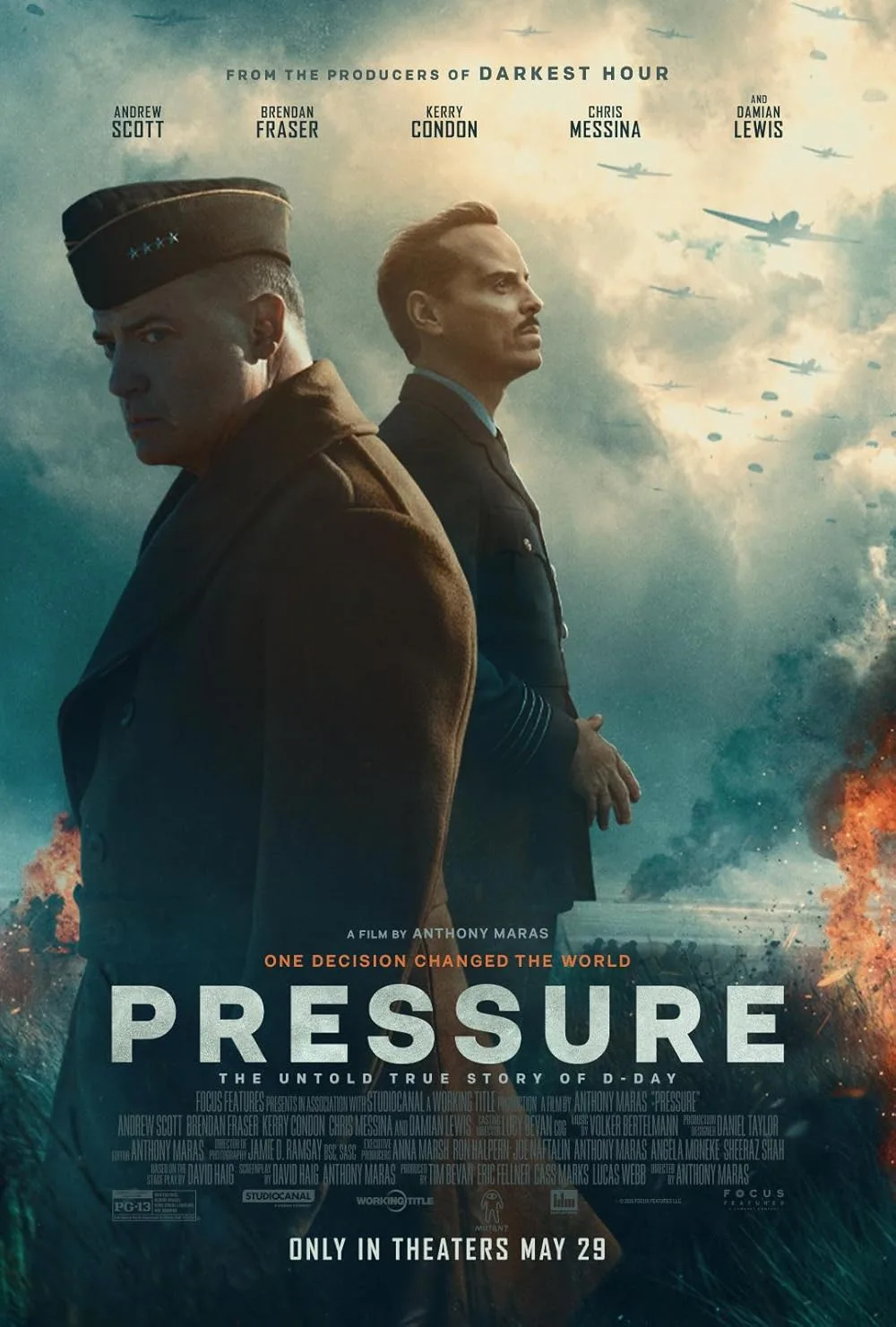

In “Pressure,” a tense, sober, powerful WWII drama, the leaders of the Allied military forces gather at a huge, map-covered table with small pieces representing planes and boats, trying to plan the largest and most complex invasion in history. Their previous effort, called Exercise Tiger, was designed to be a rehearsal. But it was a catastrophe, with failures of strategy and communication that led to more than 700 fatalities. Rattled but undaunted, US General (and future US President) Dwight D. Eisenhower (Brendan Fraser), British General Bernard Montgomery (Damien Lewis), and Royal Navy Admiral Bertram Ramsay (Robert Portal) are determined that this time they will be in control of every detail, from decoys used to deceive the enemy to the optimal tides and phase of the moon for the troop landings on Omaha Beach in France’s Normandy region.
But there are always, as two-time Secretary of Defense Donald Rumsfeld called them, “known unknowns,” and the biggest known unknown was the weather. Clear weather was fundamental to the success of what the military leaders hoped would be a decisive turning point in the war, and Eisenhower was asking for certainty. It was not just a matter of the military getting wet. The ships and planes would be unable to reach the shore if the waves were too high and visibility was too limited. But meteorological forecasting was primitive in the 1940s in a way that is hard to grasp for those of us who can simply check our phones and get a detailed, reliable reading.
The American head meteorologist assured Eisenhower that he would have clear skies on the scheduled date. But the newly arrived British meteorologist was predicting storms and was willing to say only that they were likely, not certain. The title, “Pressure,” refers to the unimaginable difficulty faced by everyone involved in planning what would come to be known as D-Day, but also to the barometric indicators being tracked by both meteorologists and leading them to opposite conclusions.
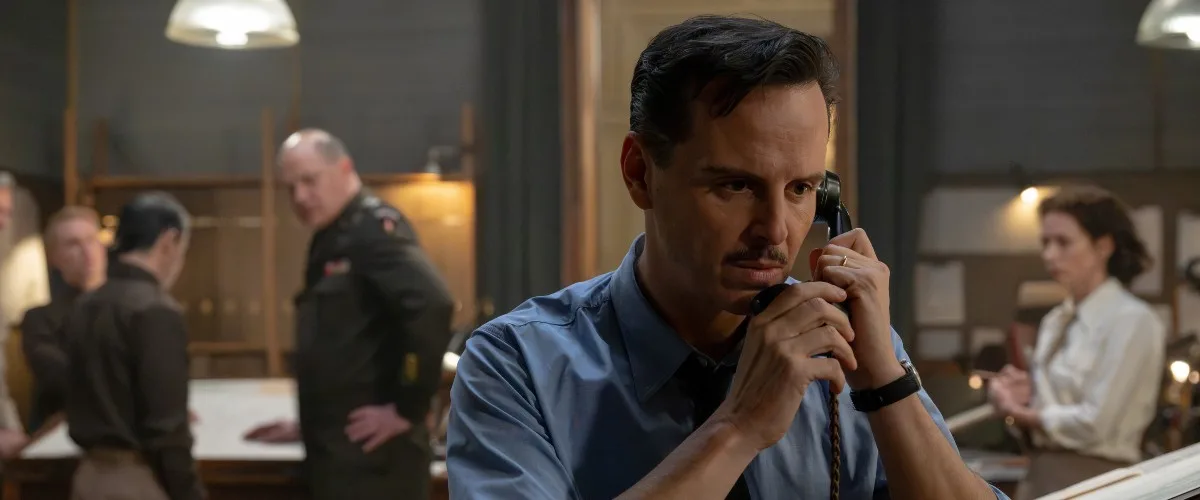
Director Anthony Maras co-wrote the first-rate screenplay with David Haig, the playwright who created the theatrical version, and they make the story so urgent that we almost forget that we know what happened. The stakes are starkly clear from the first moment. There’s no “inspired by” or “based on” equivocation about the basis for what we are about to see, just “This is a true story.” And then we see the face of a heartbreakingly young soldier dying in blood-drenched water during Exercise Tiger. The camera pulls back, revealing the devastating aftermath of the battle. And then, a scene of comfortable domesticity as James Stagg (Andrew Scott) makes breakfast for his very pregnant wife, Liz (Tamsin Topolski), before an understated but tender goodbye. Stagg is leaving for an important new job. Winston Churchill told Eisenhower that Stagg is a genius at forecasting the weather, so he has been sent to the Allied headquarters for this crucial forecast.
The American officer who had been handling the forecasts is not happy. He is Irving Krick (Chris Messina), cocky and protective of his territory. He had developed an innovative system for predicting the weather by identifying close analogs from the past. Krick is happy to be playing that role and happy to provide a prediction that makes the top brass confident that they have picked the right day. He brags that, back home, he was brought in by MGM producer David O. Selznick to predict the weather for the filming of the burning-of-Atlanta scene in “Gone With the Wind,” and points out that he accurately predicted the weather for previous battles. Stagg quietly points out that those predictions were for North Africa, where the climate is more stable and predictable than in Northern Europe. The analog system is based on historical data, looking at the factors most similar in the past and then the weather that followed. Stagg collects data from observation posts around the world to track the direction of storms that are currently active, and he has his eye on two that are likely (but not certain) to be headed their way.
Eisenhower wants Krick to be right, but he also wants to know what will happen. Stagg is honest enough to admit that there is no way to be certain. Outside their window, the sun is shining, so it is hard to imagine the weather changing so quickly. A delay would mean weeks before the tides would give them what they need, and it would be close to impossible to keep the plans secret for that long. The tension is agonizing. Stagg is also faced with terrible worry about his wife as England is still being bombed. The reserved and stubborn Stagg could easily have come across as remote or rigid.
Scott, who often specializes in quiet characters, makes us see Stagg as everything we would hope for from a man in that job: dedicated, supremely competent, and utterly decent. Fraser’s expressive eyes give humanity to Eisenhower’s military-trained focus and decisiveness. Kerry Condon brings warmth and intelligence to Eisenhower’s aide Kay Sommersby (though there is no indication of their rumored romantic relationship). Exceptional cinematography by Jamie Ramsay gives the film a muted hint of sepia, evoking the mid-century as we imagine or remember it. This is a serious film in the best sense of the term, a thoughtful film about people facing the direst problems with honor, intelligence, and courage that goes beyond the physical to include fearlessness about pursuing the truth.