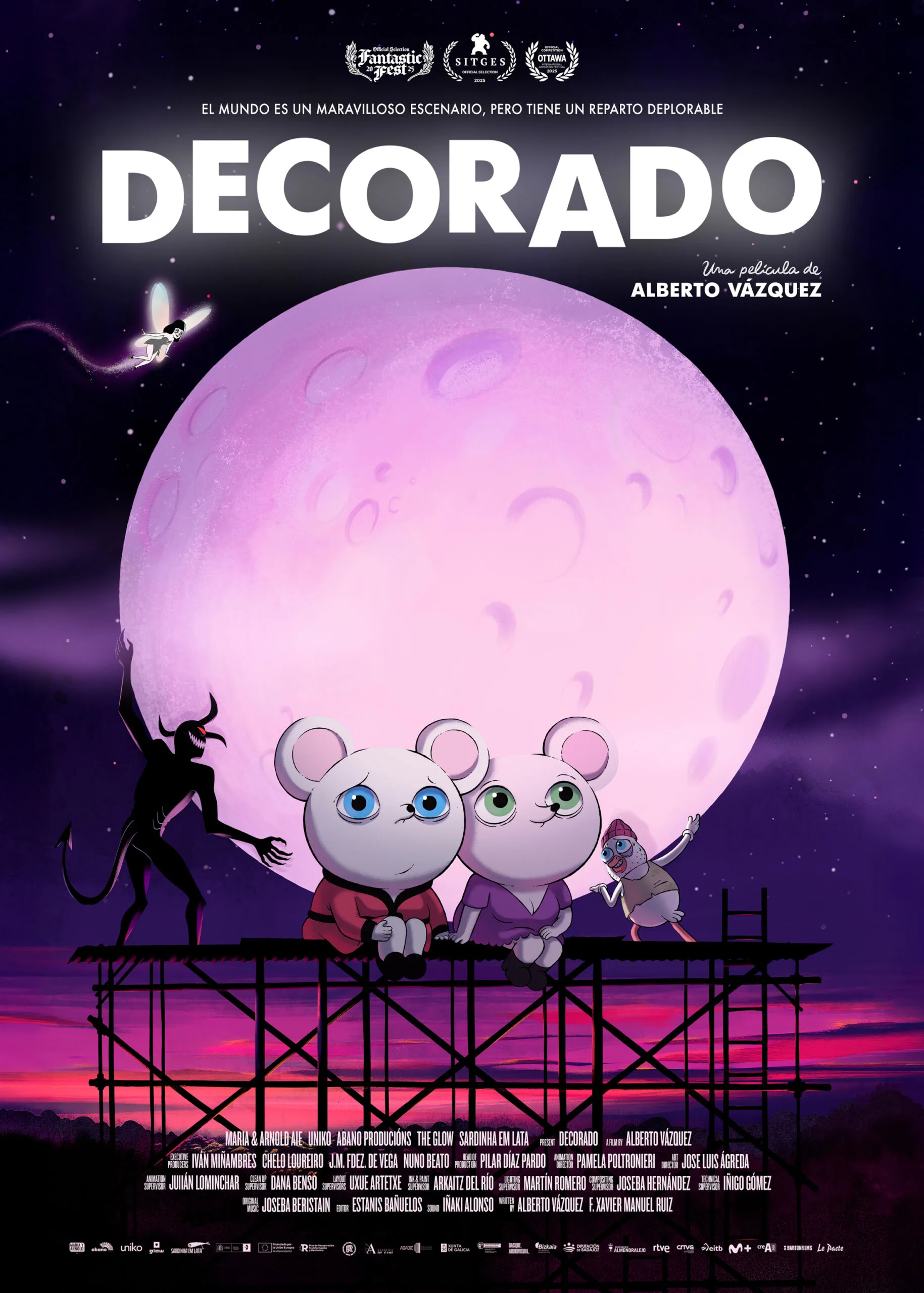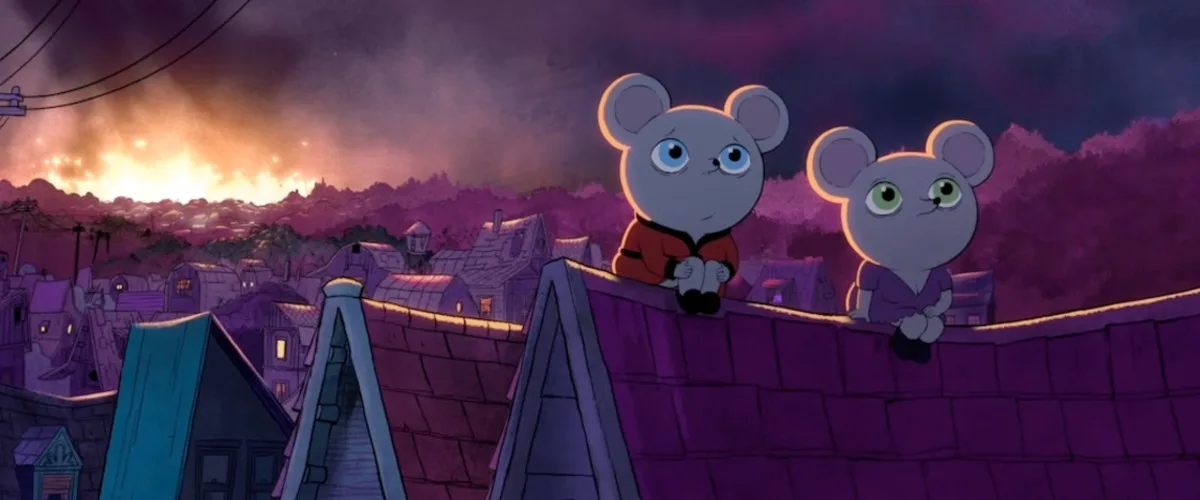
With our contemporary fixation on what is real and what isn’t—prompted by everything from deepfakes and AI slop to a longstanding history of people believing we might be existing within a matrix—it only seems appropriate that more and more films question the fabric of reality. In his latest animated feature, “Decorado,” director Alberto Vázquez doesn’t just ask whether that fabric is actually just the curtain of a set, but whether or not it’s even possible to escape that carefully designed stage.
Just as in “Birdboy” and “Unicorn Wars,” Vázquez introduces us to a world of anthropomorphic animals as a means of allegorical storytelling, with “Decorado” honing in on the tragic tale of two married mice going through it. Arnold is unemployed, middle-aged, recently off his corporate-mandated happy pills, and convinced that the world he lives in is nothing more than theatrical scenery (precisely what “decorado” translates to). His wife María serves as the sole breadwinner by way of her art, but is plagued by insecurity around her relationship and a literal Depression Fairy bringing her down.
Everything about the world that surrounds them is absurd in design, micromanaged and surveilled by a soulless corporation named ALMA, explicitly described as an Almighty Limitless Megacorporative Agency (the core joke being that the word “alma” literally means “soul”). The only escape from this city, or from the set that Arnold believes he exists within, is through a forest that anyone who dares to cross seems destined to die in, but that many try to escape from regardless. ALMA also has spies on every street corner, a massive owl who stakes out citizens who try to escape, and even a cavalcade of violent cops (As in his other works, dogs stand in for this strand of fascism).
If it all sounds a little obvious, it is. “Decorado” isn’t quite as politically dense or pointed as “Unicorn Wars”‘s fascist radicalization of young men, instead murkily including as many general societal critiques as possible in a way more reminiscent of Ari Aster’s “Beau Is Afraid” and “Eddington” rather than, say, Charlie Kaufman’s reality-bending autocritiques. In fact, one might expect Arnold’s narrative journey to veer dangerously close to the kind of “man on the edge” storytelling that glorifies these men and rationalizes their actions. But Vázquez smartly sidesteps that by focusing on the relationship between the two mice.
The sheer tragedy of their broken relationship, even as they try to make things work, is the driving force of the film. Everything around these two is a distraction, albeit often entertaining. The ache of their lives, though, also echoes in others, like a devil who loses meaning with the loss of his ability to make music or a ghost who must exist in obscurity alongside humanity.
Asier Hormaza & Aintzane Gamiz’s voice acting, when paired with exceptionally emotive animation, sells their romance and their exhaustion with how their lives have turned out. These touches emphasize the film’s thesis that capitalism sucks the very will to live out of us. With a world as dysfunctional as this one, it’s impossible not to believe that there might be a better option behind the curtain.
Some of Vázquez’s visual cues are more than a little shallow, like his obvious stand-in for Donald Duck in Pato Roni or ALMA’s headquarters looking like an industrial modification of Cinderella’s castle (so much so that it’s hard not to equate it with Banksy’s embarrassing Dismaland). Of these, the worst are the fourth-wall breaks introduced late in the film, which detract from the already smartly built paranoia around reality.
These signifiers are sometimes charming, especially when they lean away from specificity and toward a general imitation of classic cartoon physics and design. But they occasionally undercut the power of the film’s core dramatic storytelling. Certainly, an artist can take their cheap shots at monstrous organizations like Disney, an all too easy target for critiquing capitalism and forced joy; it just feels like a less potent choice in an era when they are far from the only corporate entity actively influencing human existence by way of finance and politics (a la Paramount and David Ellison).
It’s easy to ignore some of these questionable choices because of just how fluid the animation is and how talented Vázquez is at building these worlds. His graphic novels have never been translated or released in the States, but the breadth of their artistry ranges from breathtaking watercolor paintings of Lovecraft’s words to editorial cartoons reminiscent of Charles Addams.
“Unicorn Wars” certainly indulged in aesthetic shifts between scenes—”Happy Tree Friends”-level gore, character designs that feel like shonen anime by way of the Care Bears—but his work in “Decorado” is more cohesive than ever, feeling like a meticulously crafted world, albeit chaotic and overflowing with unique characters. Vázquez trades in the unsettling B&W ink work of his brilliant short film of the same name for a colorful nightmare, designed to echo and subvert the most familiar and comfortable imagery of everyone’s animated childhood favorites.
Though the surrealism and playfulness of the short film have been streamlined for a narrative feature, “Decorado” still feels like a fully fleshed-out, focused work in its own right. By homing in on this decidedly bleak tale of people (or animals) living in a society that encourages oppression in his third feature, Vázquez continues to explore the universality of these broken societal ills. By no means does he offer any answers, though; with each repetition of the quote, “In this world, it’s impossible to dream,” the burden of existence and the lack of escape from it feels all the more real.