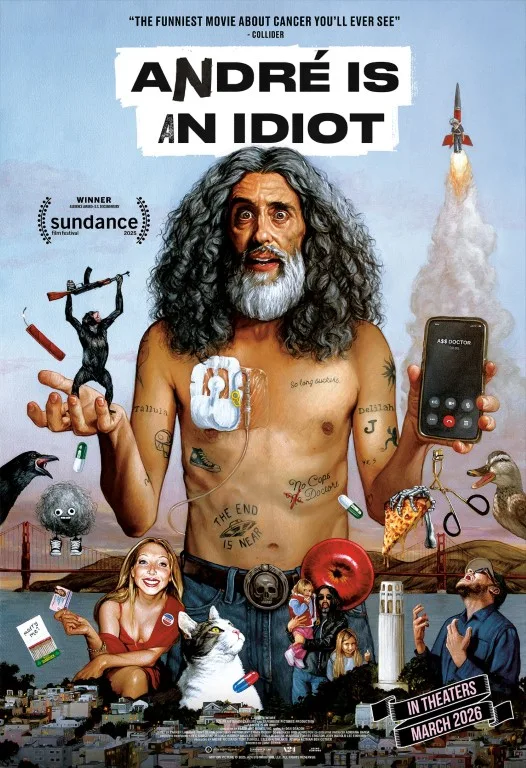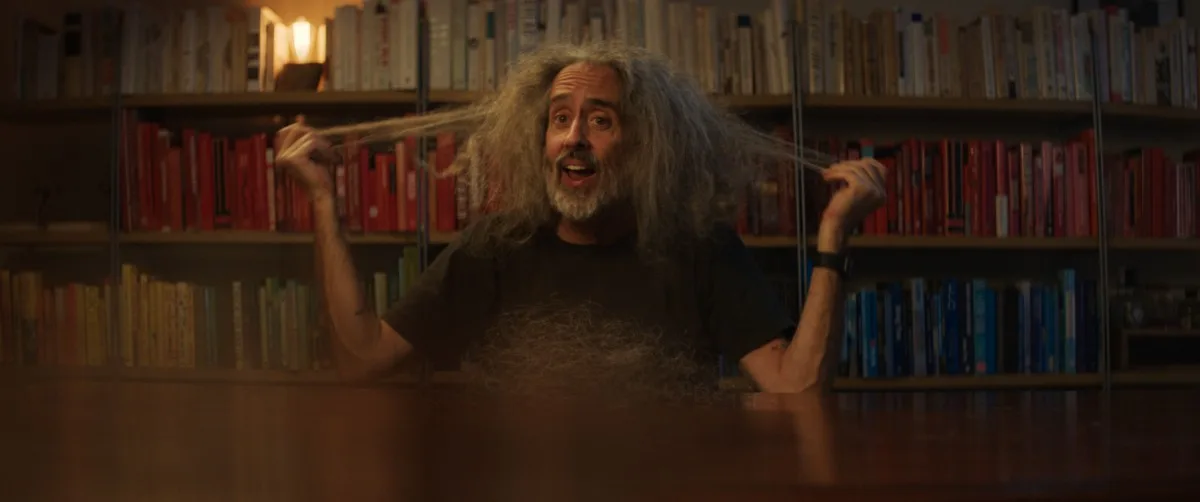
Tony Benna’s irreverent, frenetic bio-doc “André Is an Idiot” is unlike any cancer doc you’ve ever seen. Although the film follows San Francisco-based ad man André Ricciardi from the moment he received his terminal colon cancer diagnosis through his passing, the film is as singular as the man’s three-year journey with the disease. It might just save some lives.
In the first sixteen minutes, we learn everything we need to know about André. His whirlwind romance with his wife, Janice, which started as a green-card marriage and quickly bloomed into the real thing, resulted in two daughters. His ad agency career, whose legacy includes the iconic claymation Ozzy Obourne Lipton Brisk Iced Tea ads and the viral marketing for “Rise of the Planet of the Apes.” André also shares with us a graphic story about masturbating at his grandparents’ house that ended with splinters on his penis. This, he says, was the biggest mistake he ever made. That is, until he didn’t get a colonoscopy at the age of fifty. A year almost to the day after declining to get a couple’s colonoscopy with his best friend Lee, André received a diagnosis of stage IV colon cancer that had already metastasized to his liver.
Over the course of the film’s tight 90-minute runtime, we follow André on the ups and downs of his life after receiving this terminal diagnosis. Along with his take on the events, the film also features sit-down interviews with his two teenage daughters, his wife, his brother, and several of his friends. This choice often lends itself to a Rashômon-like effect, as we sometimes get almost comically differing perspectives on André and how he is coping with the situation. It also allows us to see a fuller portrait of the man outside his own self-myth-making.
André is a unique storyteller, and the film’s experimental format matches his humor perfectly. After his hair begins to fall out due to chemo treatments, he describes the hairballs as little creatures he’s now living with. These creatures are then animated in the same claymation style as the Ozzy tea commercial, with added googly eyes and sneakers. This style of animation is used throughout the film to give visual life to André’s many whimsical stories and flights of fancy.
Early on, André says that if someone else had told him they were going to make a documentary about their march towards death after a cancer diagnosis, he would not want to watch it. That he felt it would, “get really personal and ugly.” However, because he always marches to the tune of his own beat, of course, he’d want to document his own experience in the same situation. In its own way, the film does get deeply personal, if not ugly. Over the course of three years, we see André’s body change as it reacts to treatment. We see his face turn gaunt as he loses weight, we see his belly bloat as it fills with fluid when his organs begin to fail. In that sense, the film is about as personal as a documentary can get.
Occasionally the film veers into the philosophical, as when André shares that he feels “there is an awkwardness and an unease that’s always existed between people and death because we are aware of our mortality and we don’t know what happens when we die, so it’s taboo to talk about it.” With this project, André creates space, through his frank humor and endless curiosity, to really talk about death with a rare and candid honesty.
When speaking with Alex, a death howl guru, André muses that they say you’re not really dead until there is no one left to speak your name. In a sense, that’s what this film is, a chance for André to achieve a sort of immortality. While this could have become an exercise in self-serving navel-gazing, the film instead becomes something richer. It becomes a photo album left behind for those he loves, and also a way to transform his greatest mistake into a lesson for others. To encourage viewers to get their colonoscopies before it’s too late.
Throughout the film, André discusses his coping with his therapist, Peter, who spends their conversations helping André hold space for every kind of feeling. In one candid moment, Peter says to him, “It’s funny and outrageous, and it is sad that you have cancer.” These more vulnerable feelings are what André has pushed off with his humor his whole life. Now he must sit with them, and with his fear for the rest of his life. He shares that he’s not really afraid of dying, but rather afraid for those he is leaving behind, especially his young daughters.
To this, Peter offers a counter thought, insisting that “one of the gifts you have to offer your daughters is the chance to grieve a father … that is not a destructive thing to do, if it goes well, that is a powerful, deepening process. Be generous and let them be sad.” This conversation happens over the phone as André lies on his couch, petting his cat, Waffles. The camera holds on André’s face. He’s silent for once, just listening.
This is a turning point, a revelation. For most of the film, André has seemed to embrace death with both arms wide open, but that was a false portrait of confidence. Now, truly facing death, he is finally open to all of his feelings. He thanks Janice. Who, through her caretaking of him over the last few years, has carried so much of his pain. He no longer tries to make his daughters laugh; instead, he thanks them for reshaping their lives to spend more time with him.
I first saw this film at Sundance in January of 2025. I wrote then that my first instinct was to make a Cologuard joke because that felt like what André would have wanted. About two months later, my own father was diagnosed with stage IV colon cancer. I dropped everything in my life to act as his caretaker. We spent weeks in and out of hospitals. We spent one very long night watching movies and pausing every fifteen minutes so my dad could drink his colonoscopy juice. Like André, my dad approached every situation with a sense of humor. Nothing was too sacred not to make a joke out of it. He cracked a few during our time in the hospitals. But I also saw a more vulnerable side to my dad, and even sometimes an angry one.
In one scene, André takes us through his medicine ritual as he fills a plastic organizer full of countless pills. Sometimes, he just doesn’t take some of his pills because he doesn’t feel like it. It’s the kind of moment that hit me differently after caretaking my own father. Organizing his pills, trying to get him to take his potassium (hilariously, the same medicine André doesn’t want to take). There is a monotony to cancer that is often not depicted in films. There is a lot of waiting. A lot of sitting with yourself, or with your loved ones. While there is pain and anger and fear, there is also hope and humor, and most of all a lot of love.
Unlike André, my dad didn’t make it to chemo or radiation therapy. He only lived for thirty-five days after his diagnosis. He also didn’t get a colonoscopy when he should have. Colon cancer is sneaky, and it can hide. Early detection is key. It might not cure you, but it can buy you more time, and there is nothing more precious in this world than the time you spend with the people you love.
The film ends with André, from beyond the grave, sharing his final poignant diary entry via voiceover, while footage of André, before he passed away, hikes up into the hills above San Francisco and screams his literal death howl, “So long suckers!” A final title card reads: “GET YOUR F*CKING COLONOSCOPY.” If you only take one thing away from this mordant, joyful portrait of a man coming to terms with his own death, I think it should be that.