In the June 1972 press conference that Elvis Presley gave prior to his four sold-out shows at Madison Square Garden, he was asked, “Are you satisfied with the image you’ve established?” Resplendent in a sky-blue suit which has to be seen to be believed, Elvis replies, “The image is one thing and a human being is another. So…” His voice trails off, and the reporter follows up: “How close does the image come to the man?” Elvis says, “It’s very hard to live up to an image, I’ll put it that way,” and he holds his hand up in a polite but firm “that’s all I’m going to say” gesture.
The energy in that press conference is electric. Elvis did not do many interviews. He did not make the talk show rounds. He didn’t “sit down” with reporters for a one-on-one. There’s very little of him, outside of his copious catalog. The chance to get face time, even in a formal setting, was almost unprecedented. When you consider the paucity of first-person statements we have from him about what it was like to be him, “it’s very hard to live up to an image” is breathtakingly personal.
Baz Luhrmann, the current Poet Laureate of Elvis, wants to not only bridge the gap between the image and the man, but to celebrate the image—and the man—in as unadulterated a way as possible. Luhrmann wants to remove the separation between Elvis and us, to “bring him back,” not just for Elvis’ pre-existing fanbase but also so younger generations can discover him. Luhrmann accomplished this in his 2022 biopic starring Austin Butler; with “EPiC,” an extended concert film, his mission is even more explicit.
Despite the libraries of chatter devoted to Elvis, his talent often goes unmentioned. It’s like those who haven’t seen any of Marilyn Monroe’s films and assume she was just a ’50s sex symbol who overdosed. This is the sort of thing Elvis was talking about when he made the distinction between the image and the man. With Elvis, as with Monroe, the image has completely submerged the human being. You have to go back to the work they did: watch “Some Like It Hot,” “The Misfits,” “Don’t Bother to Knock,” watch “King Creole,” listen to Elvis’ gospel albums or his album Elvis is Back!, watch the 1968 comeback special. Go to the source, and you’ll find the human being.
“EPiC” (aka Elvis Presley in Concert) features restorations of two concert films which came out during Elvis’ life, “Elvis: That’s the Way It Is” (1970), and 1972’s “Elvis on Tour” (the latter featuring a montage of extant footage, supervised by the then 30-year-old Martin Scorsese). “Elvis: That’s the Way It Is” was filmed in the summer of 1970 during Elvis’ third engagement at the International Hotel in Las Vegas. An MGM crew filmed the loosey-goosey rehearsals and a number of the shows, including opening night. A “soundtrack album” accompanied the film’s release. “Elvis on Tour” follows Elvis on his frantically paced arena tour in 1972.
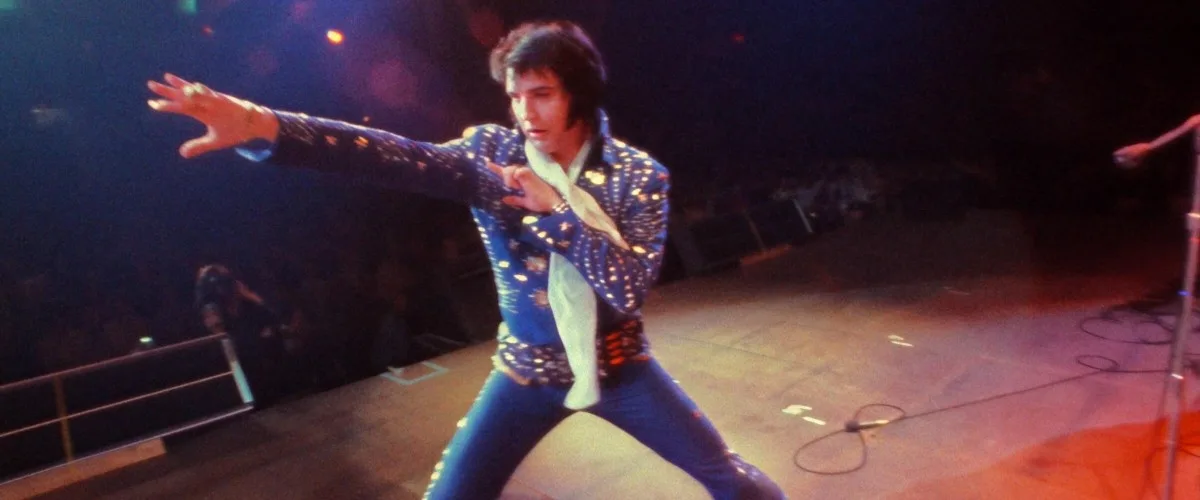
Luhrmann has pieced these two together, giving a sense of the company’s work ethic and camaraderie. Both films underwent a restoration process—visual and audio—at Peter Jackson’s facilities in New Zealand, which did such stellar work on “Get Back.” As someone intimately familiar with the two original films, I gasped at the image clarity in “EPiC.” I couldn’t believe what I was seeing, the crispness of it, the brilliant colors and beautiful contrasts, dramatic shadows highlighting the gleaming whites of Elvis’ jumpsuits. The concert leaps off the screen immediately. There’s no sign of the grain and muddiness of the originals.
At the time of his Vegas “residency,” Elvis was into big-ness bordering on gigantism: orchestras, choruses, horns. (Many who first discovered him in the ’50s resented this development. But Elvis was restless, always looking ahead. He wouldn’t be a nostalgia act.) “EPiC”’s sound restoration is overwhelming. James Burton’s guitar thrums into your ear like stereo-sound, Ronnie Tutt’s drumming is as rabid as Animal from The Muppets, the harmonizing of Elvis’ backup singers fills the space, as do Elvis’ ferocious soaring vocals.
Luhrmann’s contribution goes beyond the restoration. Crucially, the director carved out a large space for Elvis to speak for himself. There are no talking heads, no reminiscing peers, no historians “explaining” Elvis’ impact. Nothing interrupts the performances, which we are allowed to see in full. Additionally, Luhrmann overlays the whole thing with a voiceover from Elvis himself.
As Elvis fans know, there are in existence raw tapes of interviews Elvis gave in the 1950s and 60s. Sometimes some of it would be used in print, sometimes not. The recording of a 1956 interview with a judgmental TV Guide journalist is a doozy. There’s also a mid-60s tape in which Elvis delivers a meandering monologue about his life, fame, disappointments, and his mother. These recordings never saw the light of day officially until the Internet arrived. (The TV Guide interview is included on the 2011 Grammy-nominated box set Young Man With the Big Beat). Luhrmann has lifted these raw tapes and placed them over and around the concert footage, using them as connective tissue. It’s mesmerizing, Elvis’ stream-of-consciousness reflections, over the image of his glistening figure onstage. The choice is revelatory and new.
Speaking of new: in a story that sounds like the 1938 discovery of the “Sutton Hoo find,” while researching the Elvis biopic, Luhrmann did a little plundering of his own for hidden treasure. For years, there have been rumors about lost and/or unused footage from “Elvis: That’s the Way It Is.” When the soundtrack album was re-released in 2000, it featured so much new material that it was now a double album. There were audio recordings of songs done in rehearsals (which never made it into the show), and there were recordings of live numbers not included in the film, like the mashup of “Little Sister” and “Get Back,” as well as a moment in rehearsal when Elvis and the Sweet Inspirations launch into an exuberant “Oh Happy Day.” What if there was video to go along with this audio? Luhrmann went on a fishing expedition to the Warner Bros. underground vaults in Kansas. Digging through the archives, they discovered boxes and boxes of negatives of never-before-seen material. If you know the original film, you’ll immediately clock the things you’ve never seen before. Seeing Elvis and the women sing “Oh Happy Day” actually brought me to tears; they were all completely lost in it.
The shows themselves are spectacles, and yet it’s not spectacle as we think of it now, with fireworks and choreography. The stage is crowded with musicians and backup singers. Elvis is, of course, the focus, but he’s not doing too much. He goofs off. He cracks jokes. But when he digs deep, as he does with “Bridge Over Troubled Water,” for example, you realize “Oh. That’s why he’s Elvis.” He stands there in his jumpsuit, drenched in sweat, sideburns bristling. He is the spectacle.
Luhrmann took some heat for “going soft” on Elvis in 2022, and there will be those who will want more “interrogation” of the subject here. It’s worth remembering that from the moment Elvis arrived on the national scene in 1954, he wasn’t “discussed,” he was litigated. The immediate response to him was the opposite of “going soft.” He was blamed for everything. Reporters forced him to justify himself. People called for his arrest and banishment. There are decades of litigation out there if you want to find it. EPiC is a concert film, designed to entertain, first and foremost, but to remind people why Elvis was … Elvis.
For Elvis, the image and the man became one onstage. It would leave him depleted and wrecked. For him, there was no other way to do it. “EPiC” is so vivid it makes Elvis seem not like an entertainer from the past, but a figure who lives in the perpetual Right Now.