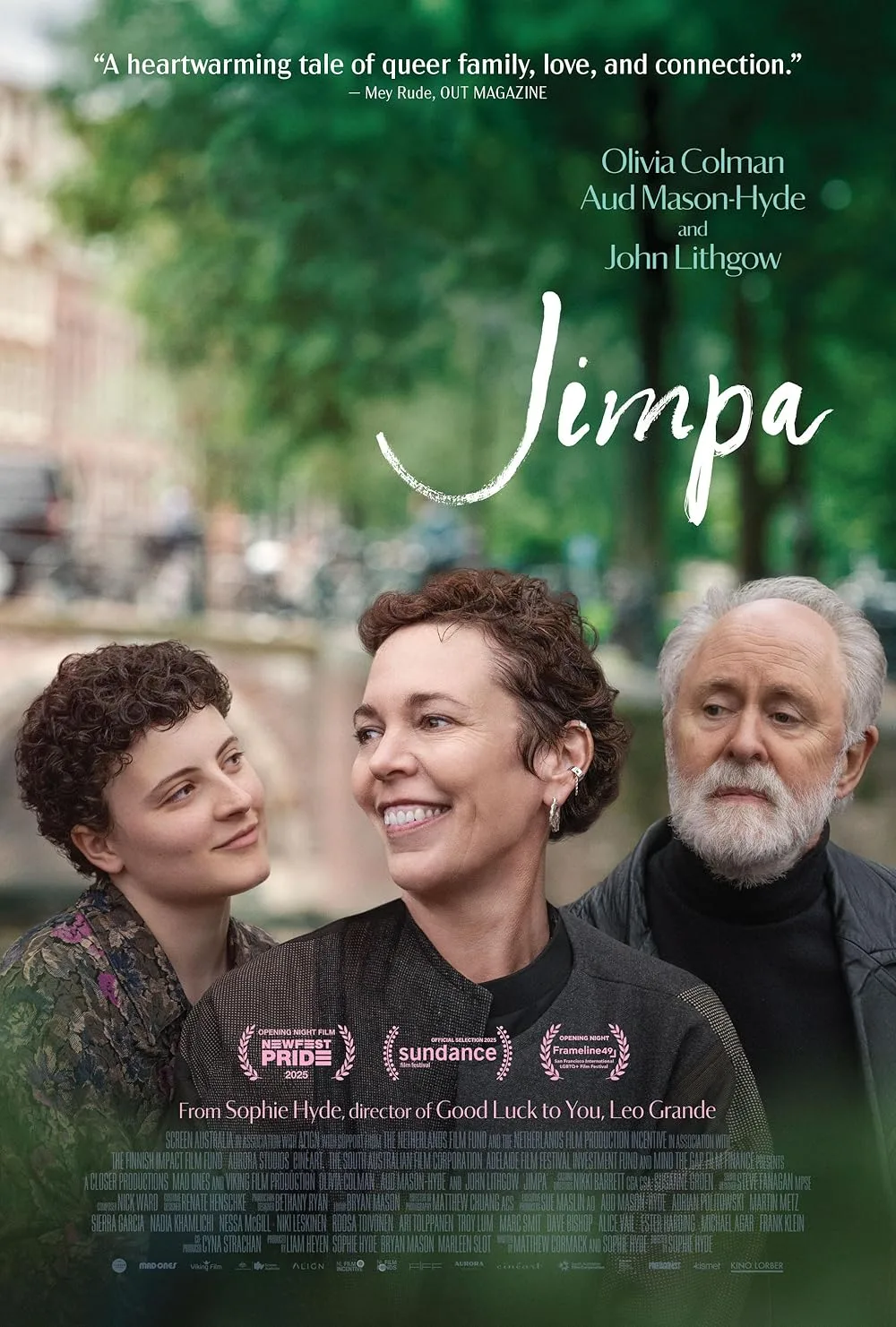


It’s tempting to grade queer film, however well-meaning, on a curve: We’re so starved for representation that, well, anything that presents us as anything other than victims and figures of tragedy should be a cause for celebration, right? Unfortunately, that pendulum can swing both ways—lionizing can feel just as stifling as pity. That’s the overriding, frustrating dilemma undergirding Sophie Hyde‘s semi-autobiographical drama “Jimpa,” a film so singularly focused on facile depictions of queer joy that it forgets to explore its characters in any depth.
The foundation here feels like a queer-focused spin on last year’s “Sentimental Value,” both tales of filmmakers attempting to heal intergenerational wounds by turning their sad stories into art. Here, we center on Adelaide-based filmmaker Hannah (Olivia Colman, a thinly-veiled stand-in for Hyde), who travels to Amsterdam to visit her father, Jim (John Lithgow), who’s spent the last several decades there as a politically-active professor and HIV-positive gay man. Hannah clings to complicated feelings about her jovial, smart, but judgmental father, particularly since he chose to leave her and her mother behind when she was just 13 to more actively pursue a life of queerness, academia, and freedom.
This, however, clashes with her nonbinary teenager, Frances (Hyde’s own child, Aud Mason-Hyde), who travels with her with the aim of spending a year with their “Jimpa” (Frances’ adoring nickname for their grandfather) and exploring queer identity and community outside their small town’s local gay/straight alliance.
When they arrive, Jimpa is, of course, a font of knowledge about queer history for Frances and clearly loves his family in the best way he can. But Hannah bristles at his old-fashioned ideas of queerness, which include trite bromides about how bi people aren’t real, and gender non-conformity is a silly thing for frivolous youngsters (curious thoughts for someone so radical in his own queer politics, but one must wonder that this is part of the real story, too). She’s protective of Frances, even as they want to leap headlong into the kind of queer community Jimpa has cultivated and come of age in a safer space.
These cultural clashes could be the core of a more interesting conflict about generational differences in queer political thought, as seen through the eyes of a supportive cishet woman who wants to understand her family. But the deep, abiding love between them all, as heartwarming as it is to see, also robs us of any real tension or excavation of these ideas. One wonders whether, had Hyde put greater distance between her life and the material, she’d sink her teeth into these ideas with greater relish.
Hyde proved with her previous feature, “Good Luck to You, Leo Grande,” that she can summon an incredible depth and complexity from older women simply exploring the curiosities around them. But where Emma Thompson in “Leo Grande” relished in finally centering herself and her late-in-life sexuality, “Jimpa”‘s Hannah is on a journey of de-centering herself. In both her scenes with Jimpa and Frances and the pre-production Zooms she has with actors screen-testing for the movie she’s making of her father’s life, Hannah grapples with just how much she knows about him, or their relationship, or the clashing notions of queerness that she sits outside of as a straight cis woman. Colman, to her credit, does her level best to register Hannah’s well-meaning confusion, and the endless push-and-pull she feels between father and child, and her desire to reconcile these questions through her art.
There’s potential in that frisson, and a stronger movie (I dare say) might have actually given the straight protagonist’s struggles a bit more focus. But one gets the feeling that Hannah (and Hyde) are timid about putting themselves in the middle of a story about queerness, and so place a lot of focus on Jim and Frances as twin poles, pushing and pulling around changing understandings of LGBTQ+ identity. Lithgow’s turn is admirably warm yet thorny (though Jimpa’s blinders around transness particularly sting when you remember he’s still choosing to help JK Rowling make money), and Mason-Hyde’s occasional flatness as a performer jives with Frances’ own need to mature in ways that help more than hurt.
Problem is, at the end of the day, they’re not the protagonists; Hannah is. In putting her on the sidelines, much of “Jimpa” loses focus, juggling three disparate stories while unsuccessfully melding them into a broader narrative about a family in the process of discovery and repair.
Early in the film, one of Jimpa’s elder-gay rants involves the fact that younger queer people have no interest in subtext (as he explains to Frances just what a “friend of Dorothy” is). “It’s all text; there’s no nuance.” It’s exactly how “Jimpa” makes you feel: Discussions of queer history and behavior play out in thunderously on-the-nose diatribes about queer politics and creaky, decades-old vocabulary lessons about bisexuality and polyamory. “I’m a big believer in compersion,” the virginal Frances tells a young lesbian they’re trying to court; rather than ringing as falsely as Vanessa Hudgens saying she’s “so into voguing right now,” the line actually works on their new love interest, and they hook up at a local cruising spot the next day. The depictions of queer joy are even more mawkish—if this were a straight person’s introduction to queer people, one would think all we do is sway around in slow motion to ukulele ballads like we’re in a commercial for anti-diarrhea medication.
Lest this review feel like punching down, it’s worth noting that Hyde’s curiosity and empathy are deeply admirable, and “Jimpa” still tackles topics of queerness and polyamory that most other films don’t. There’s a matter-of-factness to the notion of loving more than one person, or making difficult decisions to stay true to yourself and your identity, that might be enlightening to the Hannahs of the world, who don’t participate but want to love and support those who do.
But “Jimpa” is a story that feels like it’s arrived about a decade too late for its intended audience: Queer people want more from their rep than being anthropologically observed from the sidelines, and straight people have watched enough “Drag Race” to already be familiar with the concepts this film treats as novel.