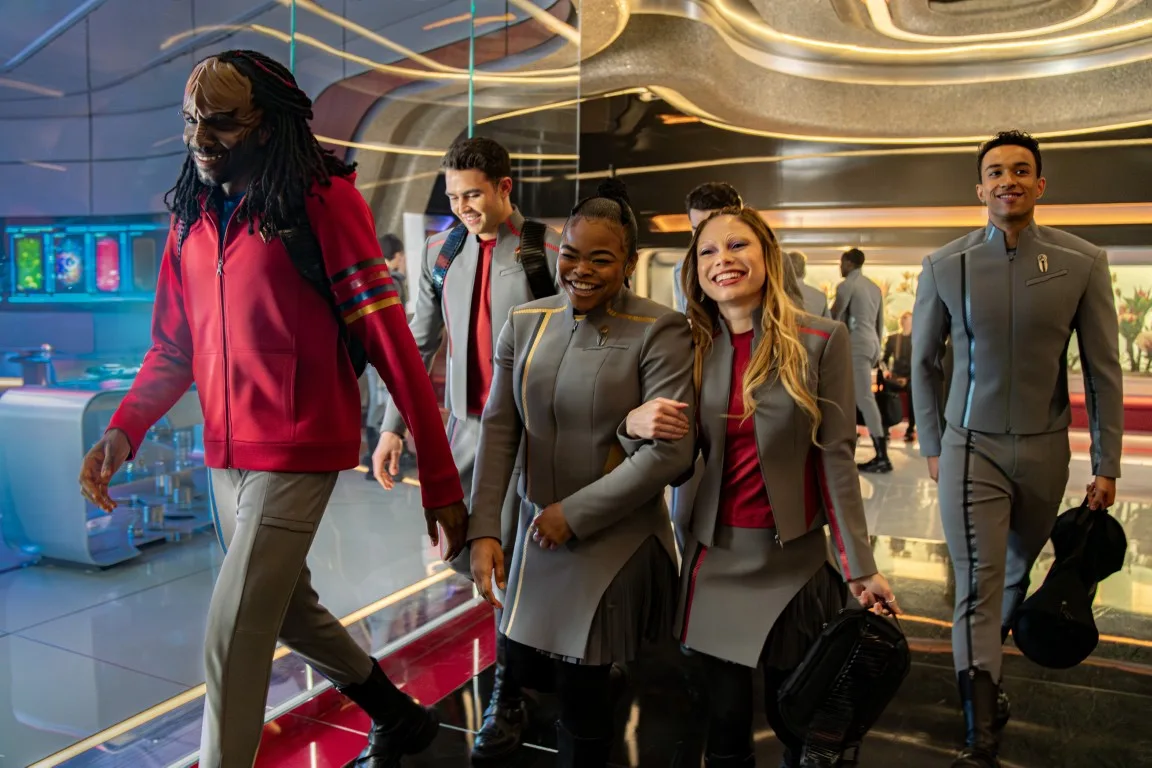
“Star Trek” has always touted its desire to explore strange new worlds; what “Starfleet Academy” supposes is, what if college is the strangest world of all? Glib as that may sound, it’s the premise behind Paramount+’s latest (and potentially last, unless more shows get greenlit) bid to keep the final frontier flowing. Take the design language and supporting characters from “Star Trek: Discovery,” the Alex Kurtzman era’s defining flagship show for good and ill, add the hot cast and adolescent conflicts of “One Tree Hill,” and sprinkle in a few over-qualified Oscar winners for good measure. Throw in a transporter, and you’ve got “Star Trek: Starfleet Academy,” a show that will irritate and inspire in equal measure.
The notion of Starfleet Academy has existed since the early days of “The Next Generation”: Where do all our stalwart Federation heroes get their training, after all? The concept has been explored in young adult novels and even a late ’90s PC space combat simulator game (one of those FMV ones where William Shatner et al. strutted around in front of a green screen in between missions; I was rather fond of that one). And despite its usual use as a prequel-bait flashback to how our grown-up heroes fared back in their younger years—J.J. Abrams’ 2009 reboot certainly spent much of its first act there—this new show clearly wants to be an entry point for newer viewers, in the hopes that the franchise’s concept, rather than its characters, can appeal.
Its biggest hurdle, frankly, comes in the specific era in which it’s set: the far-flung 32nd century, the furthest in the future “Trek” has ever gone. It’s the setting of the latter seasons of “Discovery,” which chucked its own prequel aspirations to envision a show of a Starfleet in recovery from a mysterious galaxy-wide catastrophe known as “The Burn,” which threw the Federation into disarray. It’s an audacious setting to explore, but “Disco”‘s version did little with it, apart from building a clean, over-designed visual language for the new Starfleet and throwing in some generic space pirates. This is the sandbox “Starfleet Academy” has chosen to play in, and for Trekkies bored to tears by that show’s meandering trajectory, this can be a dicey prospect to buy into.
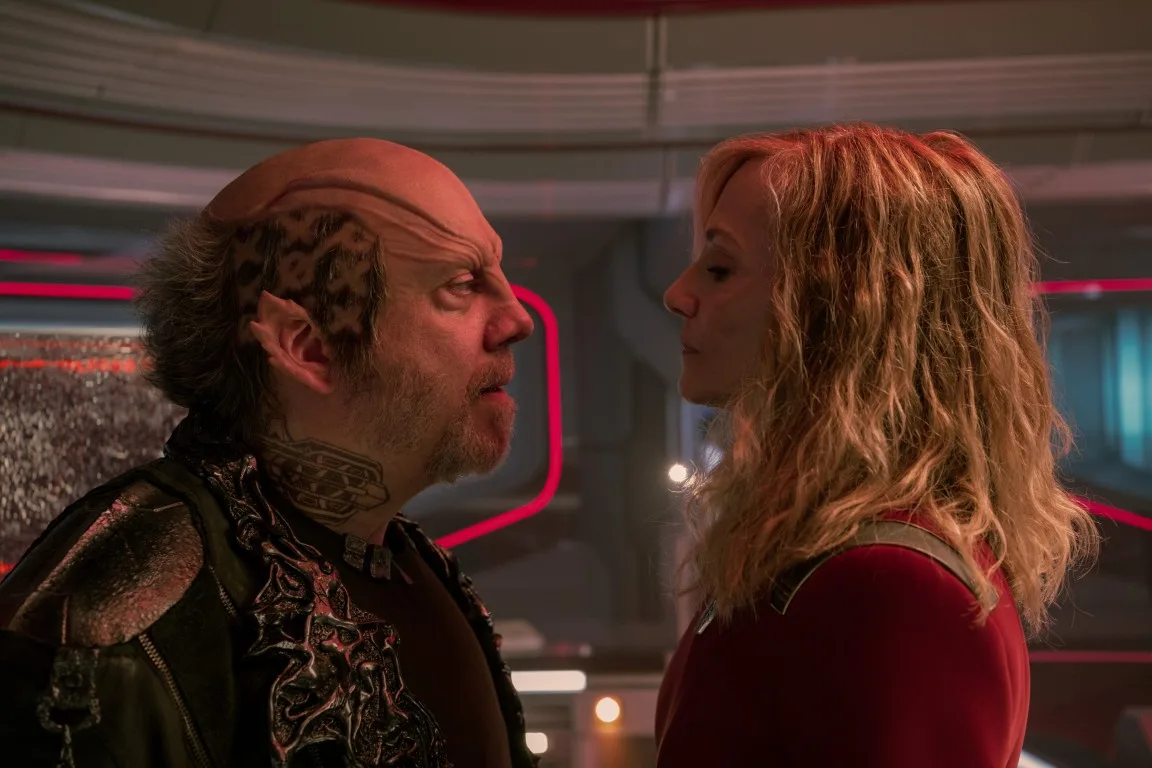
Refreshingly, “Starfleet Academy” manages to work through the bugs of its first six episodes well enough. It helps, of course, to have Holly Hunter in the captain’s chair, playing Captain Nahla Ake, a 400-year-old Lanthanite recently brought back out of retirement to head up the reconvened Starfleet Academy, finally reopened on Earth after more than a century of Burn-related isolation from humanity’s home planet. She’s also the captain of the Athena, a large, stylish spaceship that also doubles as the academy’s main building (and a nifty way for the show to both save money on sets and give the cadets some actual star trekking to do). She left Starfleet after the decision to separate a child, Caleb Mir, from his mother (a cameo-ing Tatiana Maslany) for her decision to work with scuzzy privateer Nus Braka (Paul Giamatti, having a Rhino-esque ball with all the wacky prosthetics and jewelry he gets to wear) out of bitter necessity left her riddled with guilt. Learning that Caleb, now an adult (played by Sandro Rosta), has been found, she offers him the chance to join the school’s inaugural class.
The concept of a youth-friendly “Trek” show is nothing new; one of the deceptively best shows of the Paramount era was the short-lived “Prodigy,” an animated spinoff about tween misfits who steal a Starfleet ship (and who blissfully get namedrops, and some shared supporting characters/species, here). Caleb’s journey here is like that of that spinoff’s lead character, Dal, the rules-are-for-fools rebel who reluctantly tries to fit into the squeaky-clean ethos of Starfleet. Along for the ride are his classmates: Jay-Den Kraag (Karim Diané), a soft-hearted Klingon who’d rather study medicine; Sam (Kerrice Brooks), a holographic ray of sunshine who looks 17, but who was practically born yesterday; Darem Reymi (George Hawkins), Dal’s bratty, privileged roommate and occasional rival; Genesis Lythe (Bella Shepard), an admiral’s daughter who skews hypercompetent; and Tarima Sadal (Zoë Steiner), the Betazoid president’s daughter who catches Caleb’s eye.
The show’s first episode, fittingly titled “Kids These Days,” serves as a surprisingly thrilling intro to all of these characters, the setting, and some of the more invigorating supporting characters/teachers we’ll see along the way. It helps, of course, that the premiere focuses chiefly on an exciting space adventure as the Athena runs into crisis on its way to transport the cadets to Earth. It’s a real trial by fire for our enterprising (heh) young students, and offers the grownups plenty of chances to strut their stuff as they attack the problem from both ends. (Hunter and Giamatti, in particular, get plenty of chances to vamp and spar on the ship’s bridge; their chemistry is so curiously compelling.)
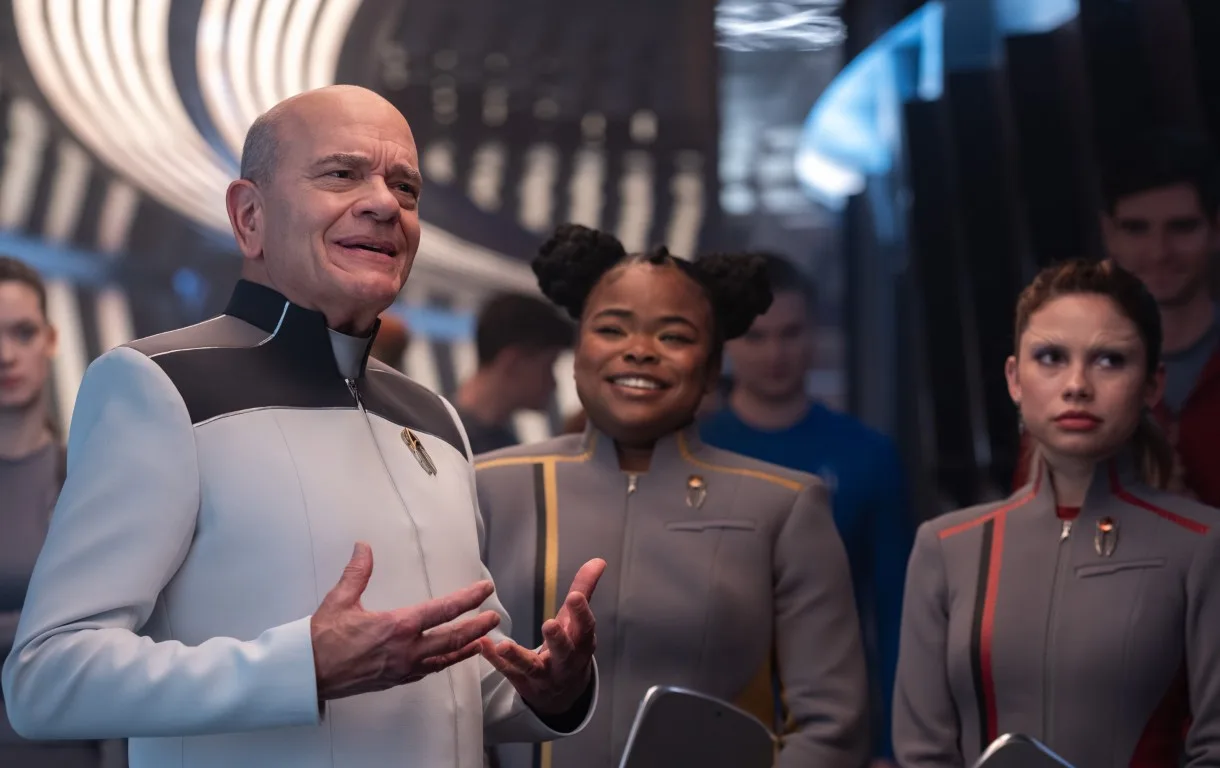
It’s when the ship lands on Earth, and the show starts to become a bit more about school, that “Starfleet Academy” scrambles to find its equilibrium. As expected, the younger cast take some time to grow into their roles, especially when immediately reflected through their older castmates, some of whom are “Trek” royalty (Robert Picardo returns as “Voyager”‘s Emergency Medical Hologram, now the Athena‘s Chief Medical Officer and a fussy humanities teacher at the Academy; he fits back into the role like he hasn’t missed a holographic step). Early episodes, which feature initial flirtations and an obnoxious inter-school sports rivalry with the Federation’s War College, show the occasional limitations of the premise and the show’s lighter, more kid-friendly tone. Frequently, you crane your neck to search for the next time Hunter will strut on screen (barefoot, no less) with a wink and a maternal smile, carrying such a fascinatingly casual presence for a “Trek” show. (You should see the way she pours herself into a captain’s chair; she sits in them so weird, she’s gotta be bisexual.)
But by the fourth episode, even those types of episodes find their footing, especially as we start to hone in on more interesting characters (and performers) like Kraag and Sam. Kraag’s focus episode is a sensitive debate about the nature of paternalistic help, both on the personal and political levels: How far do we go to help a person or a people in need, if the cost is denying them their agency and pride? Sam’s episode is far wackier, leaning on some “Ms. Marvel”-esque intertitles to illustrate the hologram’s eagerness to learn more about humanity, and her own nature in the process. It’s the kind of bubbly conceit that could get old fast, if not for the fact that Brooks’s effervescence is such a balm that she carries us through the show’s shaky sense of humor. (Get ready to cringe at some of the Marvelesque quips the characters will take you through, as un-Trek as they may seem.)
“Starfleet Academy” will certainly be an acquired taste, and it’s likely a lot of veteran Trekkies will turn their noses up at it on concept alone. Sometimes, it earns that reputation: If you hated all the times “Discovery” characters inorganically swore to hammer home how edgy and cool they were, “Starfleet Academy” may not disabuse you of that notion. But like “Deep Space Nine” before it, the show ponders what to do with a concept like the Federation if all your exploration happens right at home. And at college, where you’re still discovering yourself and your capabilities, and exploring the friendships and relationships that might last you a lifetime? If creator Giala Violo and showrunners Kurtzman and Noga Landau keep sharpening their characters’ immature edges, they might just find exciting new frontiers to explore.
Six episodes screened for review. Streams on Paramount+, with new episodes airing Thursdays.