
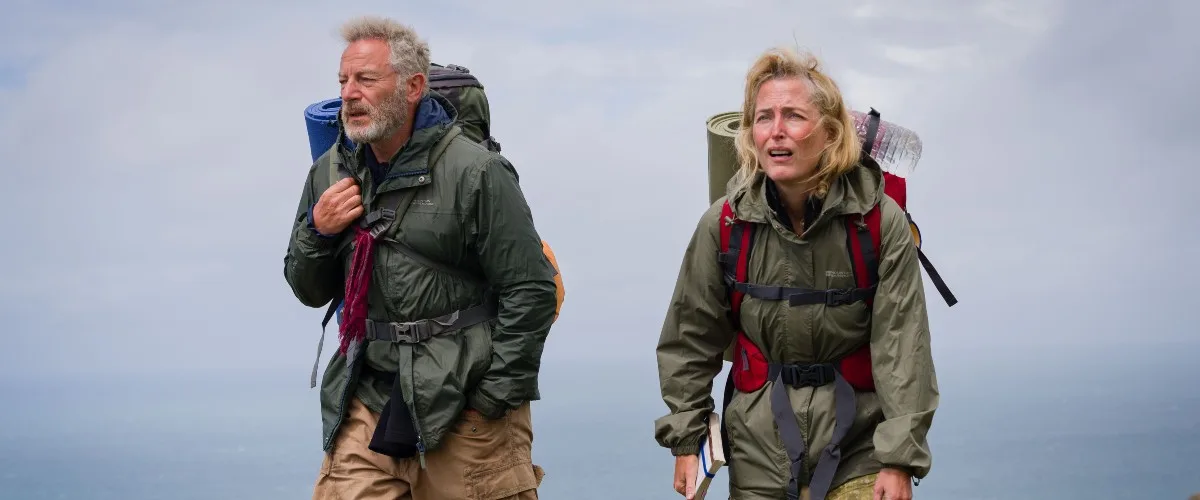
Walking is good for you. Especially as you enter your senior years, it’s a salutary form of exercise. I try to get in at least three miles a day when I’m able. There’s a phrase in Latin, “Solvitur ambulando,” which means “it is solved by walking.” It was originally coined as a physics adage, a rejoinder to Zeno’s paradox about the illusory nature of walking. How does one get from here to there? By walking.
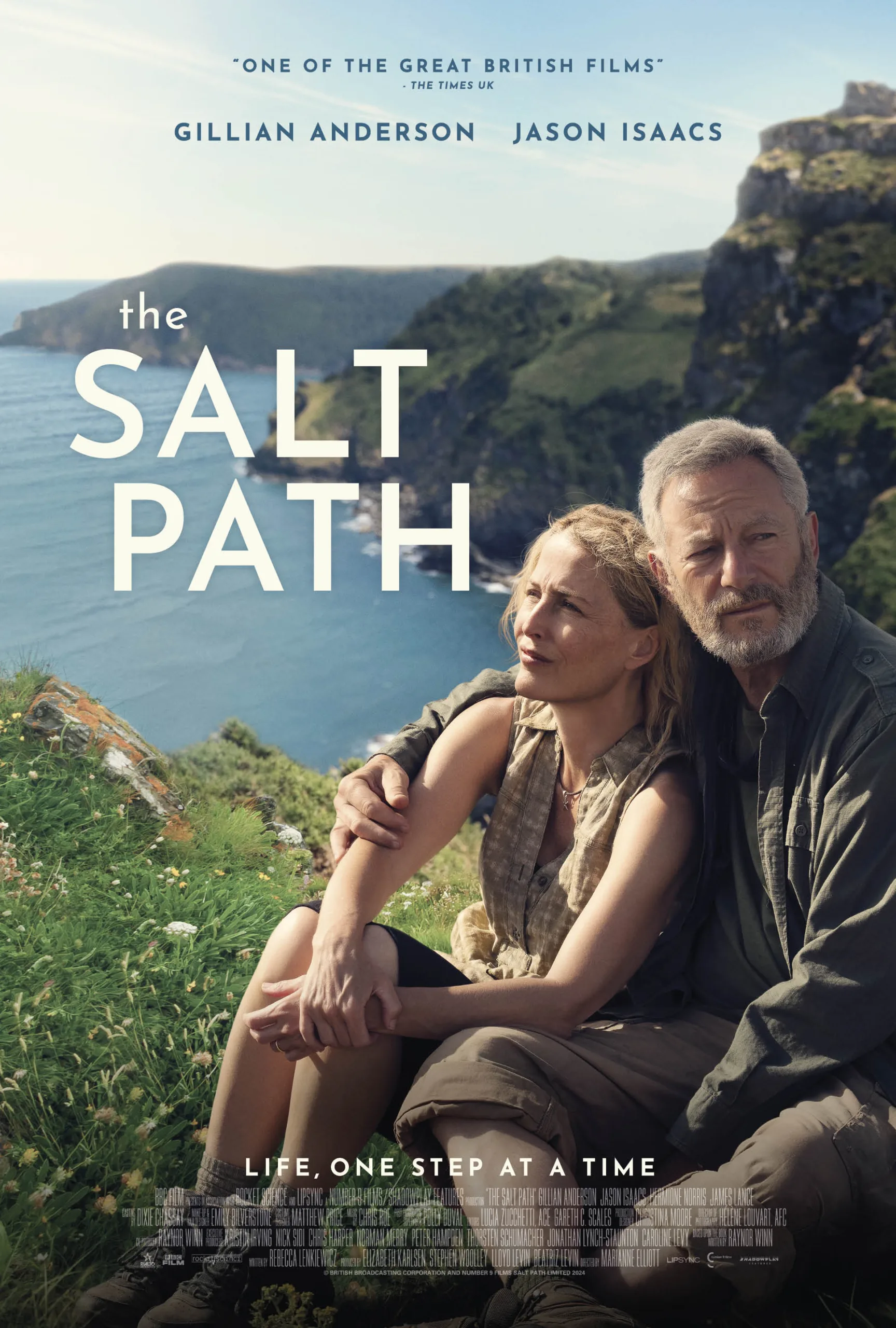
But of course, while walking, we can reflect philosophically, take in our surroundings, assess them, and assess whatever idea or life circumstance needs, well, solving. In the ostensibly factual, based-on-a-bestselling-memoir film “The Salt Path,” Jason Isaacs and Gillian Anderson, as long-married couple Moth and Raynor Winn, embark on a walk on one of the most challenging footpaths in Great Britain, the South West Coast Path, going up and down and up and down as it hugs the coasts of Devon and Cornwall. Six hundred and thirty miles, total.
Why do this? Writer Rebecca Lenkiewicz and director Marianne Elliott lay things out in a series of flashbacks. For one thing, they lose their home, one they reputedly built themselves “brick by brick,” as a friend recalls. There’s been some confusion about money. Winn has received a dire medical diagnosis: CBD, Corticobasal degeneration, in which nerve cells die, and the brain shrinks. These are situations that bear contemplating on a good long walk. They’ve got backpacks, a tent, and other supplies. Moth starts off with a sharp limp, and one is inclined to wonder how their shoes will hold up. They are beset by rather more banal problems as they move along, including a feckless child who misses a bus in Eastern Europe and calls in a panic.
There’s other stuff. When Raynor finds a secluded spot to relieve herself, she’s interrupted by a shotgun-toting patrician hunter. Matters of hygiene are indeed prominently featured here. “We need to find a house.” Moth grouses at one point. In which to use a bathroom. He grows enraged, thinking. At times it’s not good to think while walking, because he concludes, red in the face: “We had a house, and we lost it!” And they’re off to the races, argument-wise.
At times their adventure takes a turn for the almost picaresque. Winn and Raynor are taken in by some affluent young locals a little off the path and treated to dinner; it turns out the folks have mistaken Winn for the famed former Poet Laureate of Britain, Simon Armitage. Ooops. They witness a budding teen romance between the clerk at a tourist information center and a seemingly mute (but really just shy) fellow. And so on.
They dip into inspiring readings. From Seamus Heaney’s translation of Beowulf, Winn finds a pertinent passage about those who might “win glory before death.” The odds of doing so themselves decrease when they check an ATM and find they’ve got a little over a pound in their bank account—after they lost the house, neglected to cancel the insurance, and the automatic payment has drained their balance. So we watch them on the phone, trying to contact the insurance company and getting put on hold. Watching characters in a film being frustrated by being put on hold while trying to acquire crucial information is almost as compelling as being put on hold in real life.
You can’t fault the commitment of lead actors Isaac and Anderson. Neither brings a stitch of vanity to the work; they both look like hell throughout. The conclusion of their story here hits near-miraculous inspirational notes. Last year in Britain, as the movie adaptation of Raynor Winn’s book was coming out there, a series of investigative pieces in the Observer poked some disquieting holes in the story. One was that the couple lost their house because one member had embezzled money from an employer.
And there’s more. So much more that a whole documentary called “The Salt Bath Scandal” aired on Sky TV last December. And last year the real-life Winns were profiled in a feature in Britain’s Country Living magazine. In the accompanying photo they look quite posh indeed. So for all the committed acting and gorgeous green-and-pleasant-land scenery packed into the movie, its story might be worth taking with at least a grain of, well, you get the gist.