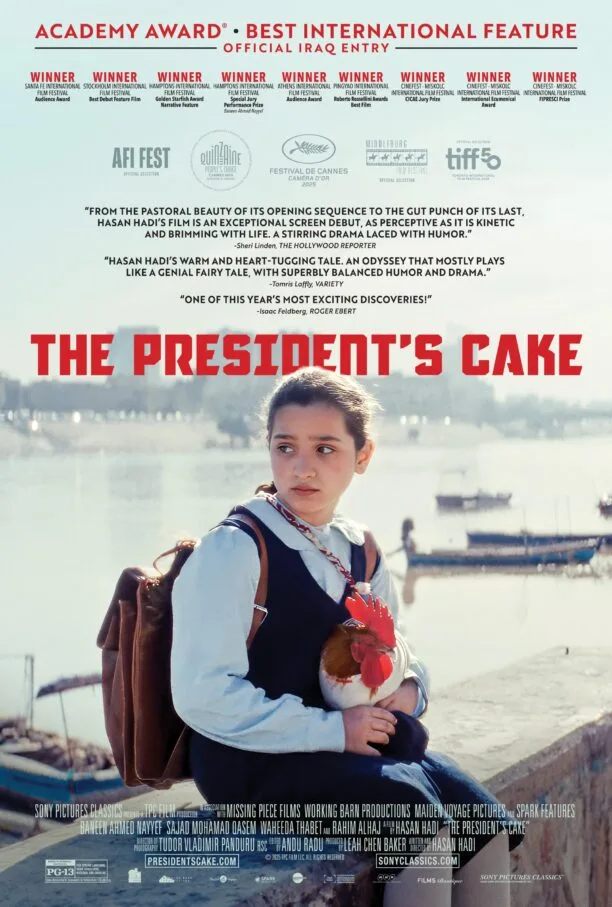

The Tigris and Euphrates rivers are unlisted co-stars of “The President’s Cake,” the story of two childhood friends living in 1990 Iraq, just after the country invaded Kuwait but before the United States and its allies drove them out. The pre-credits sequence of the children paddling a canoe at dusk, the sky a faded aquamarine, has a watercolor dreaminess—but that’s before the camera repositions to reveal a building on fire in the background, turning dream to nightmare. Every character’s trajectory is affected by these arteries of commerce and culture—especially those of the boy, 8-year-old Saeed (Sajad Mohamad Qasem), a pipsqueak who carries himself like a rebellious teen, and 9-year-old Lamia (Baneen Ahmad Nayyef), tasked by her bullying schoolteacher, an ex-soldier, with baking a cake in honor of President Saddam Hussein’s birthday.
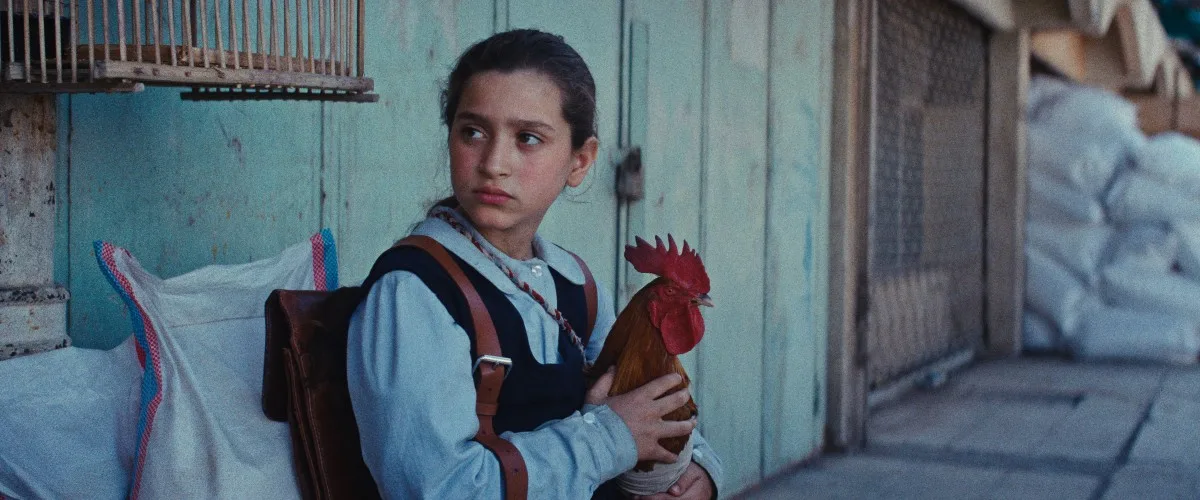
This simple assignment impels Lamia’s journey. She’s an impoverished girl who lives with her grandmother, Bibi, and a rooster named Hindi. She lacks the funds and support to gather baking ingredients, in part because of shortages caused by sanctions imposed on Iraq. Sweet and caring but quietly tough, Lamia establishes herself as the movie’s true protagonist, and soldiers on through a story that’s about more than a cake.
Celebrating a leader’s birthday under threat of punishment is nobody’s idea of a good time. But that’s how it was in Iraq circa 1990. Hussein is at the peak of his power. So is his cult of personality. The strongman’s grip on Iraq’s throat is so strong that not even his impending defeat by a US-led coalition will make him let go. If the rivers are the film’s most important unifying image, Hussein’s face is a close second. You see it everywhere onscreen, reproduced in photos, posters, and murals. The ebb and flow of time and water are emblems of eternity, captured in loving images of the rivers. Hussein’s scowling, stubbly, mustachioed mug provides an ironic contrast. Powerful sociopaths mistake their own self-regard and the flattery of bootlickers for proof that the world revolves around them, and try to mangle reality to fit their delusions. Life flows on, and in time they turn to dust.
“The President’s Cake” was written and directed by first-time feature filmmaker Hasan Hadi, who knows the storytelling terrain firsthand, having grown up in Iraq under Hussein’s rule. Period pieces that conjure up the storyteller’s subjective experience of a particular time in a nation’s life tend to yield some of the most intense and lyrical cinematic nostalgia pieces, perhaps because kids aren’t old enough to know all the facts and understand all the nuances, much less make an educated guess about what historical events might be lying in wait on the other side of New Year’s Eve, so we experience the tale more as a dream full of signs, symbols, and random beauty and terror than as a historical report.
Hadi takes full advantage of all that. There are also echoes of a school of filmmaking that made Iraq’s neighbor Iran arguably the greatest national cinema of the 1980s and ’90s: a Mideast variation on Italian Neorealism with a strong documentary flavor. Atmosphere, feelings, and small details receive as much emphasis as plot points and character arcs. The action plays out in real locations lit by available sun and everyday lighting sources rather than powerful movie lights. And the characters are played by nonprofessionals.
The latter are certainly rougher than pros would’ve been, yet so authentic and instinctive in their choices that they raise the possibility that everyone is a born actor to some degree. A scene where Bibi goes to a police station to locate her missing granddaughter and absolutely refuses to leave until she’s produced is quietly electric; you feel as if you’re not watching a scripted scene in a drama, but a documentary record of an infuriated regular person facing a representative of the dictatorship without fear and refusing to be brushed off.
Hasan got this movie made with help from some Hollywood allies, including screenwriter Eric Roth (“Ali,” “Forrest Gump”), who has a co-writing credit on the script; and writer-directors Chris Columbus (the “Home Alone” movies and two “Harry Potter” installments) and Marielle Heller (“A Beautiful Day in the Neighborhood”). These are clearly a group of professionals who know how to mix an array of tones within a single work, and aren’t afraid to crank up the emotions and give the audience some bruises. There are a few moments when the result gets too close to slick and sentimental for its own good, but the movie always steps back into a more coiled or suppressed kind of emotion, akin to the whisper of children hiding from danger.
All in all, this is a substantial and promising debut that could propel Hasan to either homegrown or international importance, depending on which he wants more. “The President’s Cake” is notable for its unvarnished, affecting performances; its digitally shot yet eerily film-like cinematography, which packs a mural’s worth of information into deep-focus, very wide frames with rounded edges. Most of all, it’s striking for the way it captures daily life in a war zone, as experienced by adults who remember the past and fear the future, and children who live in the present and are so adaptable that they normalize everything, even the unspeakable.