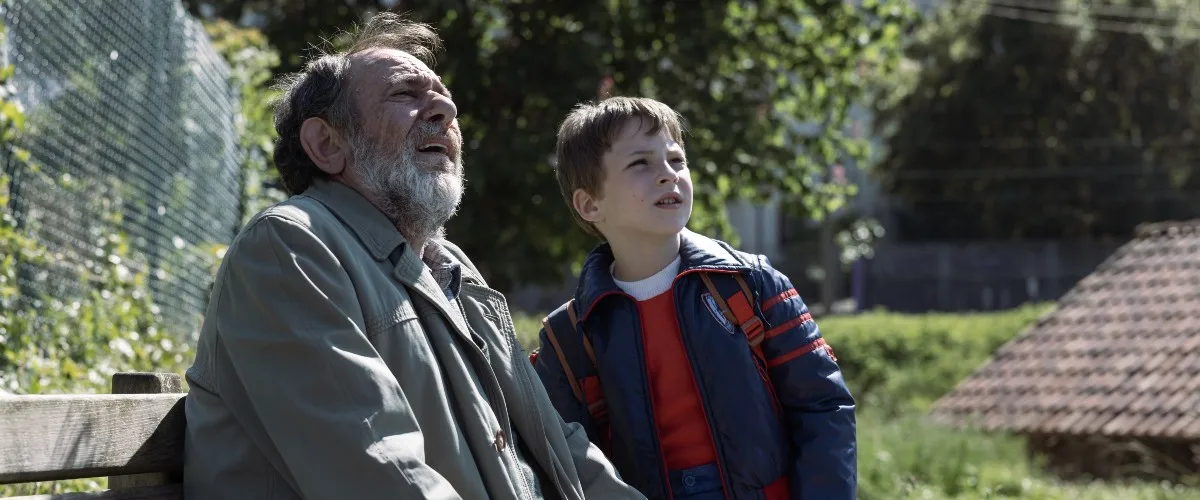
Life goes on after an untimely death in the Spanish psychodrama “The Child,” based on Fernando Aramburu’s novel of the same name. Both Aramburu and the filmmakers take inspiration from a real-life tragedy from 1980, when an Ortuella grade school’s gas boiler exploded and killed 50 kids and three adults. “The Child” concerns the mourning for one of those children, Nuco (Alex Infantes), who’s survived by his devastated parents, María (Belén Cuesta) and José Miguel (Pep Ambròs), and adoring grandfather Nicasio (Karra Elejalde).
The filmmakers, led by writer/director/producer Mariano Barroso, offer no solutions to this defining grief. Instead, they answer incidental questions with contrived answers. That’s especially frustrating since Nuco’s death alienates the three co-leads at the beginning of the movie. They only continue to drift apart from each other after that, leaving the story to skid along with a half-sudsy and half-ponderous plot that revolves around flaring tempers, canned emotional breakdowns, and a little melodramatic intrigue, too.
Everybody misses Nuco in their own way. Nicasio pretends that his grandson’s still alive and not only escorts him to school every weekday morning, but quarrels with Nuco in public, too. José Miguel, on the other hand, wants nothing more than to move on and is offended by Nicasio’s self-delusions. And they are self-delusions, as the filmmakers remind us whenever they re-establish that the older patriarch’s still mentally and emotionally composed enough to know what he’s doing. That’s a major revelation for María though, so it takes her the rest of the movie to catch up. Meanwhile, she struggles with her increasingly strained relationship with José Miguel, who wants another child. This shapeless litany of events is occasionally gassed up by adultery, infertility, and bad sex.
We don’t learn much about Nuco before he dies and that lack of context sets the table for the unequally split ensemble character study that follows. This three-part drama is held together by secrets and discoveries, which are carefully dispensed throughout, but only whenever the plot needs to move along. That focus on inciting details soon reduces the three co-leads to effigies who are defined by their schematic behavior. They hold their breaths a while and then get launched at the next plot-pushing moment. Nobody really has an inner life, which makes hard to get swept up in their big feelings. That’s especially disappointing given how hard Cuesta and her co-stars work to seem less like types and more like people.
As María, Cuesta spends most of her scenes trailing after her male co-stars. She’s more sympathetic though because she spends more time on screen without necessarily knowing everything about herself. That’s mostly thanks to Cuesta’s performance, too, since her inquisitive personality’s often revealed through her sensitive and evocative body language. She’s convincing even when the moviemakers hustle María through a baggy gauntlet. The same could easily be said about both of Cuesta’s main co-stars though, and particularly Elejalde, who gets more space than the rest to perform like a character actor.
Both Cuesta and Ambròs frequently get lost in their over-inflated and under-developed roles, which are eclipsed by various plot twists that remind us of how relentless life appears to both María and José Miguel after Nuco’s death. Elejalde, on the other hand, takes full advantage of the sometimes-maudlin choices and always generous opportunities afforded to him by Nicasio’s over-indulgent actions. He’s helped considerably by the attention that Barroso and his colleagues lavish on their cast’s individual facial expressions and physical movements.
Ambròs gets stuck with the least compelling part since José Miguel’s only insecure and every new scene only re-affirms that. So there’s never anything to wonder about José Miguel, who chews with his mouth open. Too bad that a lot of María’s drama revolves around José Miguel’s reactive behavior. He sets the pace for her role and is so sporadic and eruptive that the rest of the movie never becomes more urgent or momentous.
Likewise, an abiding lack of mystery stifles María and Jose Miguel’s shared story until its melodramatic conventions seem more glaring than they actually are. It’s obviously not great that “The Child”’s basically an over-extended soap opera despite its 100+-minute runtime, including about seven minutes of end credits. What’s worse can be seen in every scene where Nicasio overshadows his own daughter in a movie that should really be more about her. María’s son dies, then her marriage takes a hit, and now her dad’s walked away with “The Child.” Some cliches can’t catch a break.