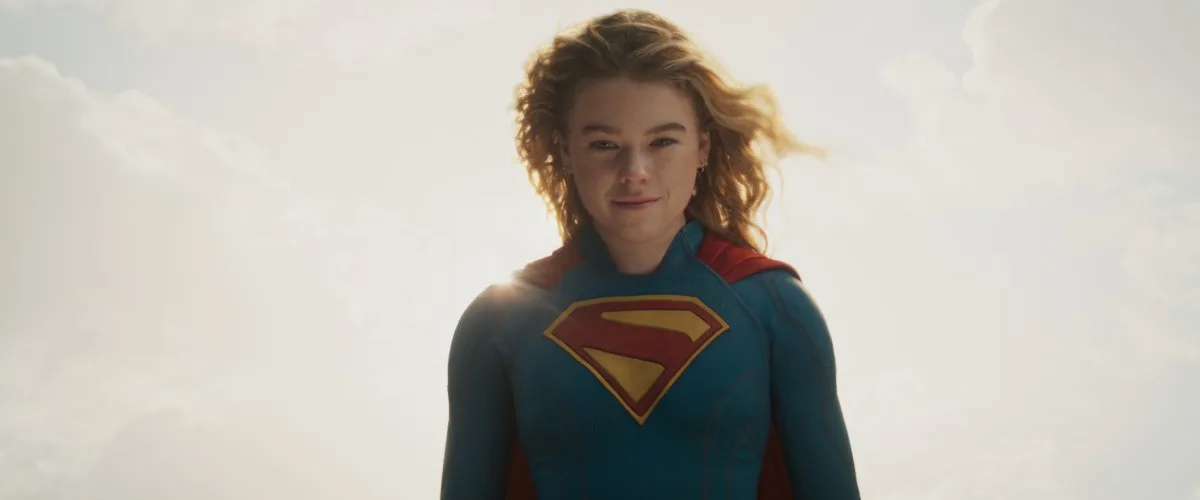
You’ve got to hand it to the movie studios for their bravery. Despite the proven superhero fatigue in the air—yes, the cinematic universe franchises they’ve been shoving down the throats of multiplexes are no longer guaranteed money-grabbers—they keep trying to rejuvenate the appeal of capes and spandex, while spending a gazillion dollars on these efforts. Enter “Supergirl,” a DC Comics flick by Craig Gillespie, director of far superior efforts like “I, Tonya” and “Lars and the Real Girl.” It might very well be a winner at the box office, and it thankfully doesn’t require that much homework in order to follow. But that doesn’t mean that this noisy and unimaginative picture, powered by little else than merely passable action sequences, flat humor, and a collection of slimy intergalactic characters with fangs, fins, and numerous eyes around their oddly-shaped noggins, is any less headache-inducing.
Most offensive is perhaps the 101-level feminism that “Supergirl” still tries to sell, nearly a decade after “Wonder Woman” (and many similarly-minded flicks since then) sparked a frustrating discourse in culture, as if one’s love and support of a female superhero would measure their commitment index to feminism and representation in media. In an early scene in “Supergirl,” with a script written by Ana Nogueira, a young girl (more on her later) wonders why Superman gets to be a “man” when Supergirl isn’t called a “Superwoman”. Chuckling in irritation, I begrudgingly looked around at my nearly 85% male press screening. (This is just how the ratio felt and is obviously not an accurate or scientific headcount.) And I wondered how much longer we are expected to make do with, even cheer for, these cutesy and shallow faux-feminism you-go-girl crumbs, when the industry’s commitment to real gender parity has been on a demonstrably steep decline everywhere else, especially since the start of COVID.
Still, I strapped in for the tale of Kara Zor-El—aka, Supergirl—portrayed by an appealing and committedly acerbic Milly Alcock (whom I look forward to seeing in films that don’t include the word “super”). A survivor of Argo City and Planet Krypton after its destruction, Supergirl has been living a nomadic lifestyle on the heels of her Planet Earth days, the details of which we learn in clumsily scattered flashbacks that involve no other than her cousin, Superman (David Corenswet). Her unkempt trailer also houses Krypto, her CGI dog that looks, well, extremely CGI, even though his basic movements were apparently based on an actual canine. (Do we not deserve as much as a real dog in the role?)
Everything the movie tells us in this segment about the ways Supergirl has been dealing with trauma and grief is a big “cool girl” cliché. She is a hard-drinker, a wisecracker, a no-nonsense fighter; qualities that are supposed to conceal her vulnerabilities. In other words, her character is conceived as just another cookie-cutter “strong female” cliché that mistakes any slight, normal human shagginess for complex, messy feminine depth.
Soon, Supergirl is visited (actually, nagged) by the young Ruthye, the aforementioned kid, armed with her powerful family sword. Played by Eve Ridley, another charismatic performer I look forward to seeing more of in something better, Ruthye is out for revenge, pursuing the ruthless intergalactic pirate Krem (Matthias Schoenaerts), who murdered her parents. Rejecting Ruthye’s plea for help at first—one she disarmingly recites like a riddle that she’s memorized—Supergirl soon joins forces with her, after her dog Krypto gets stabbed by poison and needs an antidote in mere days to survive.
Sadly, the film that follows consists of one superfluous sequence after another, where Alcock gets plenty of opportunities to stretch her muscles in a highly physical role. There are other space pirates that enter the story’s orbit, breaks taken at intergalactic watering holes, and various scenes of fast-paced butt-kicking and face-punching. In the end, you can’t help but wonder why the emotions of these characters don’t pack as much of a punch.
If there is one theme that “Supergirl” does well, it is Supergirl’s insistence on protecting Ruthye from a murderous action that will weigh heavily on her heart in the future. While predictable, this is the mere reward of the surface-level relationship the movie builds between the two drifters, a shared understanding that revenge doesn’t take the pain away in the long run.
The other reward of the film is the fact that (major spoiler alert) Krypto lives. Of course, he does. Then again, he is only CGI.