The events of Ray Bradbury’s short story “There Will Come Soft Rains” occur today: August 4, 2026.
Like so many dates in science fiction, this one probably seemed far away when it was chosen, but once it was finally upon us, it passed like all days.
This morning, I re-read the story, which is sent in Allendale, California, in the last house left standing after a nuclear war. Bradbury doesn’t come out and tell us the cause was nuclear war. He lets us figure it out through his descriptions of the place: “The entire west face of the house was black, save for five places. Here the silhouette in paint of a man mowing a lawn. Here, as in a photograph, a woman bent to pick flowers. Still farther over, their images burned on wood in one titanic instant, a small boy, hands flung into the air; higher up, the image of a thrown ball, and opposite him a girl, hands raised to catch a ball which never came down.”
I first encountered “There Will Come Soft Rains” in the fourth or fifth grade, when I was a fledgling reader of science fiction literature. That’s old enough for a precocious child to read many Bradbury stories, but perhaps not this one. When I read it, in the late 1970s, the Cold War between the USA and the former Soviet Union was starting to heat up again, after several years of what was called detente. At school there were nuclear drills. We’d go into a basement, huddle in an area without windows, and shield our heads with our arms. The events of the story scared me because they envisioned what I was afraid of.
But the story itself scared me, too. It wasn’t like other Ray Bradbury stories. There were no people in it, just an AI system that had some humanoid characteristics but wasn’t a person, plus a dog. And it moved with a ruthless inevitability. Even though it seemed as if the absolute worst thing had already occurred, the story hadn’t hit bottom yet.
Bradbury formed many a writer’s consciousness, and conscience. He was one of the foundational English-language science fiction writers, in the pantheon with the likes of Arthur C. Clarke, Isaac Asimov, Kurt Vonnegut, and Harlan Ellison. Bradbury wasn’t interested the type of world building that’s honored in science fiction today: tediously prosaic, a spreadsheet in prose form. His novels and short stories were called science fiction, but might’ve been more fantasy or fable. Bradbury usually treated science fiction trappings as a shortcut to get the reader where he needed them to be. Think of The Martian Chronicles, a so-called “fix-up novel” composed of 15 Bradbury stories set on Mars. His version of the red planet has a breathable atmosphere, blue hills, and canals, and is mainly an imaginative space where the fiction equivalent of one-act plays can be set.
There was a substrata of science fiction buff that didn’t consider what Bradbury did to be science fiction. In an appreciation of Bradbury published after his death in 2012, Slate contributor John Plotz wrote, “Bradbury’s rocket ships were not souped-up fighter jets. Instead, they were the latter-day descendants of Joseph Conrad’s sailing ships: You traveled on them not so much to encounter adventures (‘Look, Buck, another Alien!’ ‘Shoot him!’) as to think about what the encounter might mean (Wait, who’s really the alien here?). His Mars was not an arid red desert, it was filled with towns where enigmatic old ladies puttered around on the same kinds of charming but pointless errands little old ladies do in Marcel Proust’s Combray.”
Bradbury seemed be of two minds on the matter, proudly claiming himself as a science fiction writer while also distinguishing himself, Plotz wrote, as “just about the only American science fiction writer to claim, proudly, the label ‘fantasy’ for his books.”
However you classified it, Bradbury’s work routinely did something that many of his esteemed peers could never attempt: it moved you. I doubt anyone came away from an Asimov or Clarke story weeping cathartically, however wondrous their visions were.
“”I’ve often been accused of being too emotional and sentimental,” he once said, ‘ ‘but I believe in honest sentiment, and the need to purge ourselves at certain times, which is ancient. Men would live at least five or six more years and not have ulcers if they could cry better.”
Bradbury’s best stories could make you cry, or look over your shoulder in case something wicked was coming. His fiction moved readers as a poet or songwriter might, through the sound of his chosen words and the way they flowed, stopped, and changed direction; and the images, which were so symbolically charged that they could bypass rational thought and reactivate that Anthropocene era forager inside us that’s delighted by rainbows and scared of thunder.
“There Will Come Soft Rains” is possibly the greatest example of Bradbury’s ability to summon the uncanny mainly with descriptions of panoramas, man-made objects, and the occasional nonhuman being, such as the dog that shows up to find its former caretakers, barking in desperation. “The front door recognized the dog voice and opened. The dog, once huge and fleshy, but now gone to bone and covered with sores, moved in and through the house, tracking mud.”
Like those episodes of Rod Serling’s “The Twilight Zone” that claim a permanent spot in viewers’ imaginations—such as “The Eye of the Beholder,” “The Monsters Are Due on Maple Street,” and “Time Enough at Last”—Bradbury’s masterpiece has a twist and a lesson. The twist is small-scale and cosmic: the coup de grace that finally brings the house down is accidental, caused by the wind blowing a tree bough through a window, toppling a bottle of solvent onto a stovetop, which has been turned on by the AI system in anticipation of a family dinner. It’s very “Twilight Zone,” but years before that show debuted. As in “Time Enough at Last,” which also revolves around nuclear war, the protagonist (in this case, the house) thinks they’ve gotten through the worst of it, only to be undone by some mundane and random misfortune.
As for the message: “nuclear war is should be avoided no matter what” seems self-evident now. But it wasn’t in 1950, five years after the United States became the first (and so far, only) country to use nuclear weapons against a civilian population, in Hiroshima and Nagasaki. Since that day, the militaries of the world’s most prosperous nations had been drawing up plans to inflict proportionate atom bomb damage on whatever foe attacked them (assuming they weren’t the ones that shot first) while protecting high-level officials and enough citizens to maintain a bare-bones government and resurrect society.
Bradbury saw through that nonsense. In “There Will Come Soft Rains,” there’s nothing left but charred landscapes, the remains of living beings, and one miraculously preserved house. The house eventually dies, too. The message under the message is, I think, something like, “Don’t assume you’ll be the exception for whatever reason—wealth, power, connections, the latest technology, your own supposed cleverness. No one will be spared.”
I also think it’s possible to read this story as a more generalized cautionary tale (even though Bradbury said he hated cautionary tales) that was spurred by the threat of atomic warfare but provokes other associations. There’s a touch of the ancient tale of Atlantis, destroyed with floods and fire by the god Poseidon as punishment for the Atlanteans’ corruption, depravity, greed, and insatiable desire to conquer other lands (Athens, specifically). Plato formalized the story as a warning that empires could fall.
Bradbury might’ve been thinking of Plato in connection to the nuclear arms race, a rivalry perpetrated by colonial powers and driven, like so many ill-fated and grandiose schemes, by hubris. And what is the nuclear bomb but the ultimate expression of hubris? “I am become death, destroyer of worlds,” Robert Oppenheimer said after seeing the first mushroom cloud—and not in celebration. The power to incinerate cities in a single blow, long ascribed only to gods, was now an option for the species that invented bloodletting, the cholera belt, and the electric tablecloth.
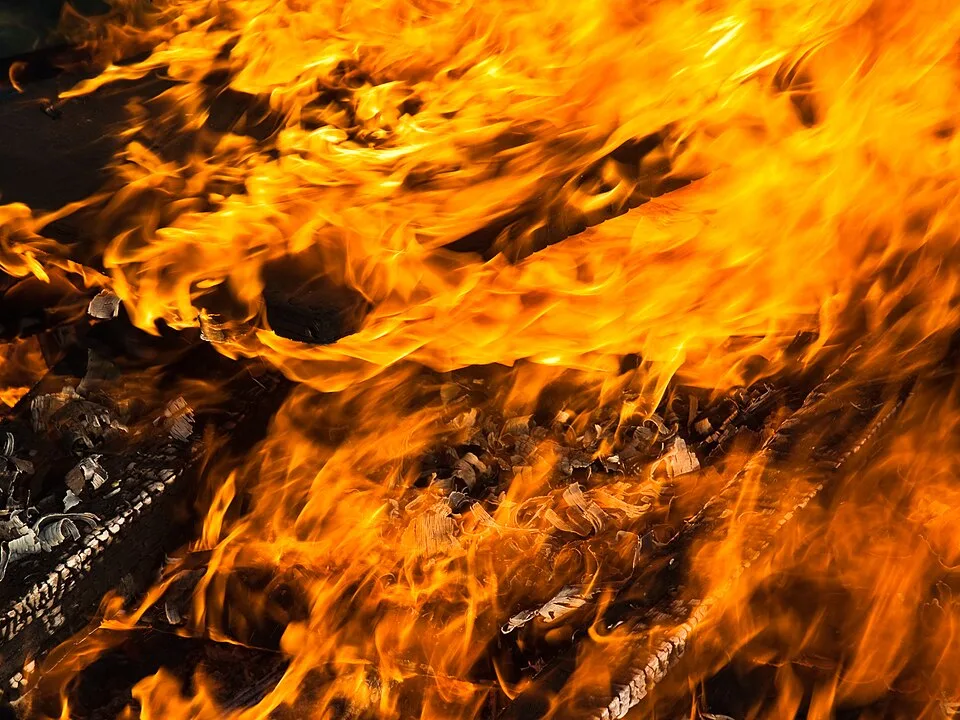
Readers might also think about the stories of the Titanic, the Hindenburg airship, and the old World Trade Center, all of which were touted as the biggest-ever examples of a particular kind of thing, and a testament to the cleverness and ambition of the human race. The AI system in Bradbury’s story is capable enough to continue running every aspect of the house even after society is reduced to cinders, but is incapable of understanding that the rituals are for naught. “Fire, fire!” the alarm system helplessly screams, as if the house itself has ceased to be what it actually was and become a living creature itself—one that had been whistling through the graveyard, so to speak, ever since the bombs fell.
The title is a tribute to the title of a poem by Sara Teasdale published in 1918, the year before the signing of formal agreements ending World War I, and shortly after Germany started its spring, 1918 offensive, which made much of the world worry there was no end in sight.What I take from it is that we imagine human affairs to be the most important thing on the planet, but they are only large- and small-scale movements of a species that’s one element in an ecosystem but deludes itself into thinking it’s the only one that matters. The poem starts with a parenthetical, ‘(War time)’. The first half describes a few of nature’s minor splendors (swallow, frogs, plum trees, robins) before delivering the knockout blow.
Not one would mind, neither bird nor tree
If mankind perished utterly;
And Spring herself, when she woke at dawn,
Would scarcely know that we were gone.