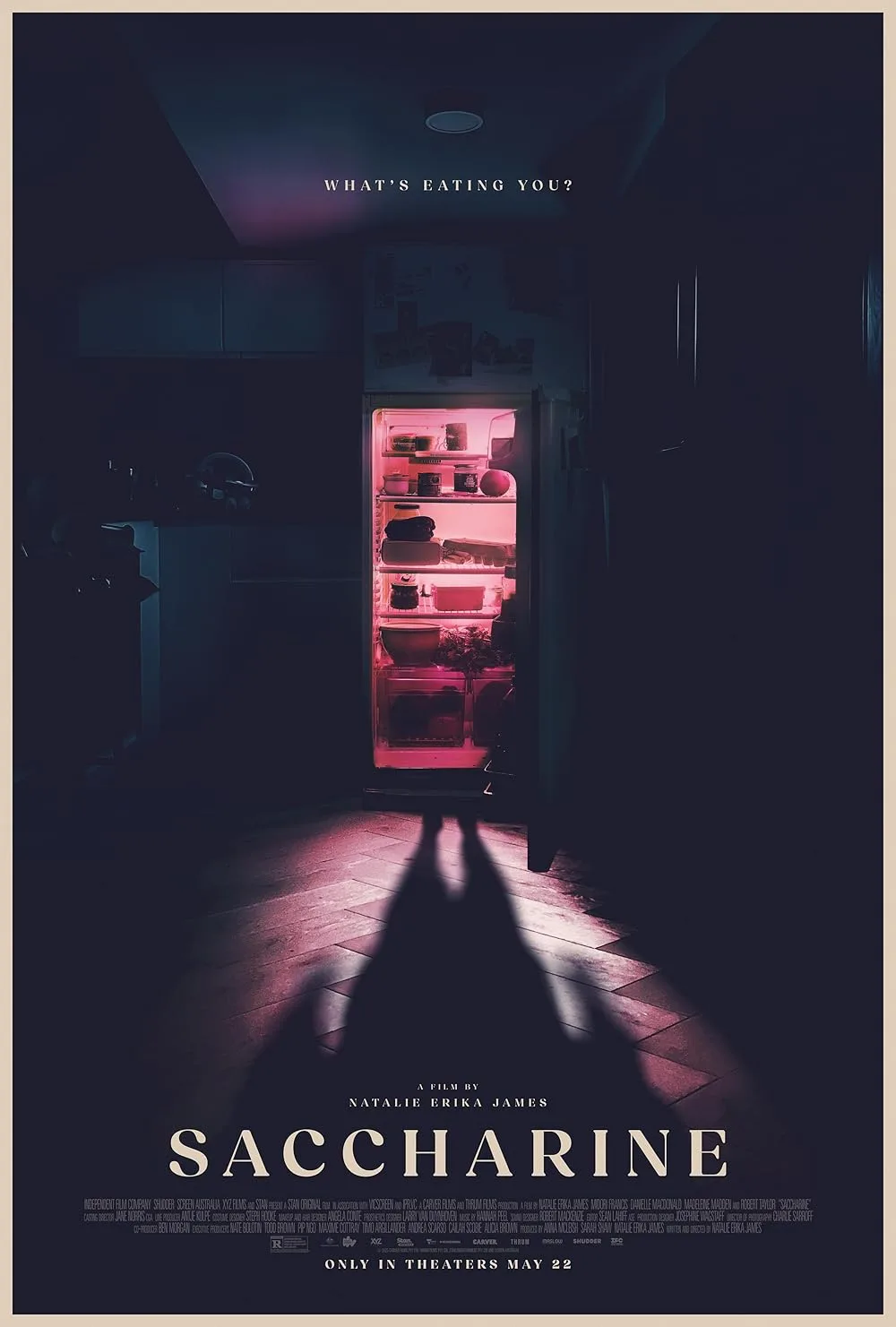

Even in the few short months since Natalie Erika James’ stylish and distressing body-horror flick “Saccharine” premiered at Sundance, the push for GLP-1s and other weight-loss supplements has intensified in the culture. These days, it’s unlikely to take a subway ride in NYC without seeing several ads featuring such jabs, or to scroll Instagram without coming across promotional offers for Wegovy or Willow.
That is obviously not to dismiss the countless positive effects of GLP-1s, or to judge anyone on a weight-management journey of their own. But the emotional effect of these drugs’ wide (and somewhat unregulated) availability on those living with body dysmorphia alongside an abusive relationship with their bathroom scale is also undeniable. Urgent, clever, and infinitely cinematic, with a series of unsettlingly gruesome practical effects, the Melbourne-set “Saccharine” unfolds against this very real-world backdrop, where, all of a sudden, there is an oversaturation of body-image messaging.
In the foreground is Hana, portrayed by an extraordinary Midori Francis, deeply committed to Hana’s unsettling emotional and physical transformations throughout. A medical student presently working on cadavers who have been organ donors, Hana seems quietly dissatisfied in her life despite having the endearing support of her best friend Josie (Danielle Macdonald), struggling with her body image in spite of being perfectly fine and healthy. Maybe a romantic interest can offer some temporary relief. Or another project of the self-improvement variety.
Enter Hana’s instant crush, Alanya (Madeleine Madden), a fitness instructor and life coach with an Instagram-famous program that Hana shows an interest in in order to impress her. At first, we aren’t sure whether Alanya is the real deal, but her program seems to focus on a reasonable approach to gradual weight loss through an exercise routine.
It’s around the same time that Hana runs into an old school friend she barely recognizes at a bar. We understand that this currently skinny woman was once overweight, and introduces a shocked Hana to the gray, a weight loss pill that helps the user to rapidly drop several sizes, no matter what they eat. (Actually, the more you eat on the gray, the more you seem to shed the lbs.)
A quick lab test shows Hana that the very expensive gray is nothing more than human ash, so she starts producing her own by cremating the body parts of a cadaver (who used to be an obese cancer patient), she and her fellow med school friends have been working with. It turns out that swallowing the ashes of a generous organ donor who’s been dealt an unlucky hand at health isn’t only unethical and unthinkably coarse in a dystopian sense. It’s also deeply dangerous.
Gradually, “Saccharine” becomes an effective combination of gross-out body horror that thematically recalls some recent stunners like “The Substance” and “The Ugly Stepsister,” and a heartrending haunted house picture like James’ very own atmospheric psychological horror “Relic,” on grief, loss, and generational trauma, among other things. The invisible baggage we inherit from those who raised us is very much at the center of “Saccharine” too, once we understand that Hana’s dad has been dealing with bodily issues his whole life, and her sweetly fretting mom (a memorable Showko Showfukutei) has been overcompensating for their familial problems with the kind of constant care Hana doesn’t seem to want.
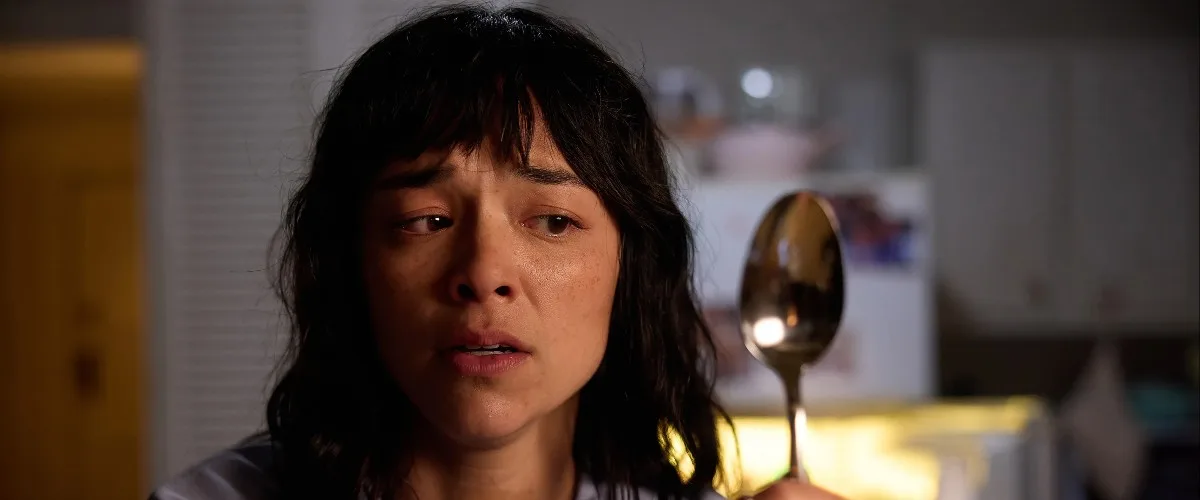
It’s in this environment that the naked ghost of the cadaver (the students cruelly call her Big Bertha) starts invading Hana’s home. Through clever effects, James’ camera (and Hana’s eyes) only sees Bertha on convex surfaces like a spoon or a kettle. Sometimes, she lurks on the corner of a room, getting unnervingly close to Hana. Other times, she even traps her under her weight, only to disappear when Hana binges on everything that she can eat, while awake and in her sleep.
It would be a misread of “Saccharine” to assume that the use of Bertha’s body to create jump scares and silent terror somehow body-shames people. Smartly, James uses Bertha’s presence as a way into Hana’s deepest thoughts and most shameful fears and acts. As the film articulates, there is something deeply consuming and draining about obsessing over one’s self-image, worsened every time you open a social media app that inundates your senses with either unrealistic beauty standards or half-hearted body positivity messaging that is anything but empowering. On the one hand, Hana knows that she should respect this deeply selfless woman. On the other, she unconsciously denies Bertha the right to her humanity by reducing her to her vulnerable body parts to alleviate her own vulnerability.
There are times that “Saccharine” becomes a tad repetitive amid numerous binge-eating sessions and grisly scenes where human bodies are cut, and guts are spilled. But in a way, that repetitiveness mimics the experience of living with body dysmorphia, where concerns over weight, food, and image are constant leeches stuck on one’s subconscious. It also gives the viewer ample opportunities to take in James’ gifts as a sophisticated horror director and stylist, even when the film doesn’t quite land. Still, from a scene set in the basement of Hana’s building, where sticky trash bags resemble ghastly faces, to a gorgeously eerie score and sound effects that deepen the film’s uncanny qualities, “Saccharine” proves that in a great horror movie, fear and helplessness work hand in hand. And James is expertly in control of it all.