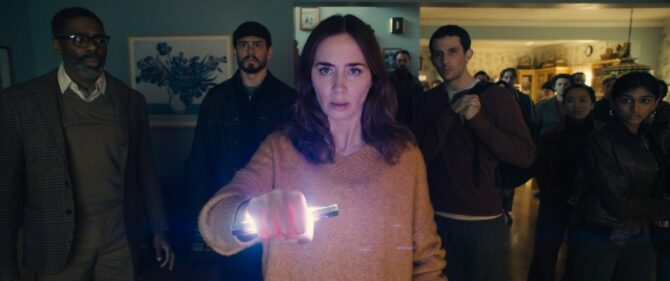

When Homer (Ben Petrie) and his wife Diana (Grace Glowicki) arrive at the isolated mansion in the woods, they are hopeful that the mysterious doctor’s radical new treatment might be just the thing Diana needs. Diana walks with a cane and has severe memory loss from a traumatic brain injury. She can’t remember what happened. The “trauma” mansion is beautiful, and she appears to be the only patient. The doctor is nowhere in sight. In every room in the house hangs a portrait of the same woman, her unhappy, manic face gleaming off the walls. There’s something very weird going on.
“Honey Bunch,” co-written and directed by Dusty Mancinelli and Madeleine Sims-Fewer, revels in the weirdness. The interior of the house is old and “cozy,” as though it has been untouched since the Victorian-era. There are just two staff members: the main caregiver, Farah (Kate Dickie), and her husband, Delwyn (Julian Richings), who murmurs instructions to himself as he sets the table. Farah informs Diana that the portrait on the wall is of the doctor’s beloved, deceased wife, which—like much in the film—explains a lot while opening up more confusion. Diana receives her first treatment, which involves sitting in a room, staring at a strobe light. (These scenes deserve a trigger warning for being potentially seizure-inducing.)
Signs and signifiers of the “not-right-ness” of this place are all around, and Grace can’t make sense of what she sees. Homer stays with her during her treatment, but sometimes he isn’t where he’s supposed to be. He “goes for a walk” in the middle of the night. He vanishes from the dinner table. Unsettlingly, Grace catches glimpses of Homer and Farah huddled together, whispering. They seem to be keeping secrets from her, about her.
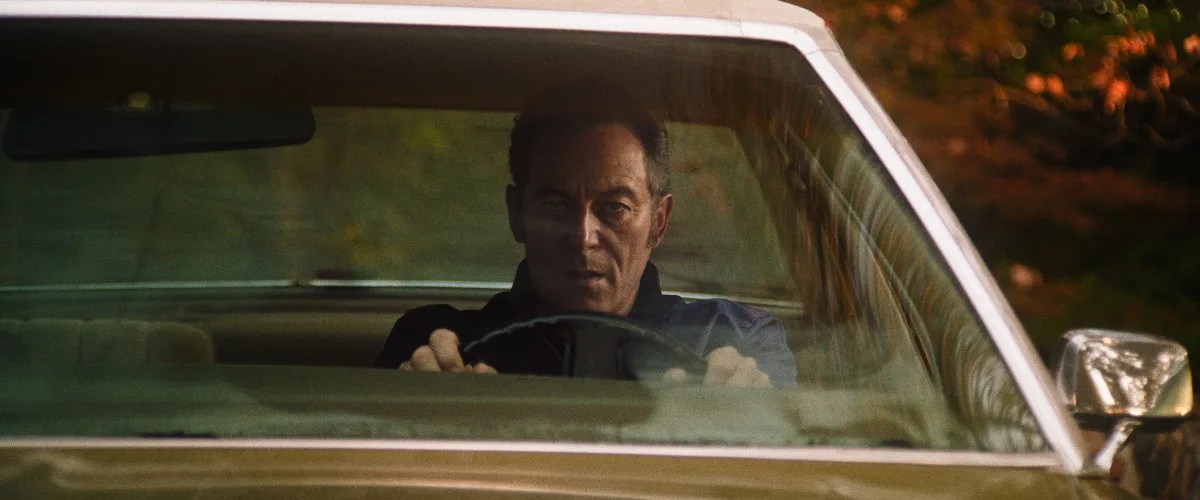
The atmosphere shifts when a new patient arrives: the teenage Josephina (India Brown), accompanied by her supportive, gung-ho father, Joseph (Jason Isaacs), who cheers her on during physical therapy. Grace feels the contrast with her own situation, distrustful of her husband and growing uneasy that something is being kept from her. Ominously, after dinner, Joseph says to Homer in private, “You’ve got to tell her.”
This potent set-up is evocative of so many stories told in different ways at different times. There are shades of Shirley Jackson’s The Haunting of Hill House in the setting and premise. “Gaslight” is a clear and disturbing reference, and there were moments when the film called up “The Innocents” (particularly the shot of the strange woman standing in the garden, seen from afar). The hedge maze on the property should need no special passcode to decipher. Homer and Diana agree that Farah has “Mrs. Danvers vibes,” implicitly comparing the trauma mansion to the Manderley of “Rebecca.” These cinematic and literary references create an environment of associations and echoes while avoiding derivativeity. The filmmakers are not trying to bury their inspirations; they acknowledge them upfront. “Honey Bunch” places itself in the tradition of haunted-house stories and creepy-husband-sick-wife stories, allowing the references room to play.
Glowicki and Petrie are married, and both are film-makers and producers as well as actors. In 2024’s “Booger,” Glowicki played a girl who goes through some weird transformations after being bitten by a stray cat. It’s a wild, full-bodied performance, requiring boldness and commitment to capture the viewer’s attention. Here, as Diana, Glowicki has to go to some truly horrific places, both physically and emotionally, swinging from one extreme to the other. Petrie’s Homer is a shifting kaleidoscope. You’re never sure what you’re going to see when you look at him. His tears, when they come, seem genuine, but you’re not sure what he is actually crying about. Both performances are filled with ambiguities and unexplained gaps.
“Honey Bunch”’s tone is one of ambivalence and confusion, uncertainty and dissociation. The film is often very unnerving. When the answer is finally revealed, when Diana discovers what has been going on, something important is sacrificed with her newfound clarity. The answer to the mystery somehow dissipates its impact. On the flip side, the reveal is not a satisfying explanation. It just creates more questions. This is true through the film’s extraordinary final moment, where confusion re-entrenches itself. A lesser film would have presented the past in a golden glow of nostalgia, the “before” of Diana and Homer’s relationship in contrast with the grim “after.” Here, there is no dividing line. The “before” is just as thorny and strange as the “after.” All is not well in “Honey Bunch,” and all was never well.
In an era of stark division, not to mention demands for simplistic storytelling one can absorb while doing household chores, “Honey Bunch” revels in the uncertain, ungraspable, the neither-nor of it all.