One of the few ingenious ideas Lucasfilm has had across its increasingly stale Disney+ “Star Wars” era has been handing various animation studios their own lightsabers via the anime anthology “Star Wars: Visions.” Unlike their live‑action and Lucasfilm Animation counterparts, studios like Trigger, Aardman, Science SARU, and Kinema Citrus found their own creative universes within the galaxy, breeding newfound innovation and delivering striking animated tales—marking some of the best stories the franchise has told, at least before “Andor.”
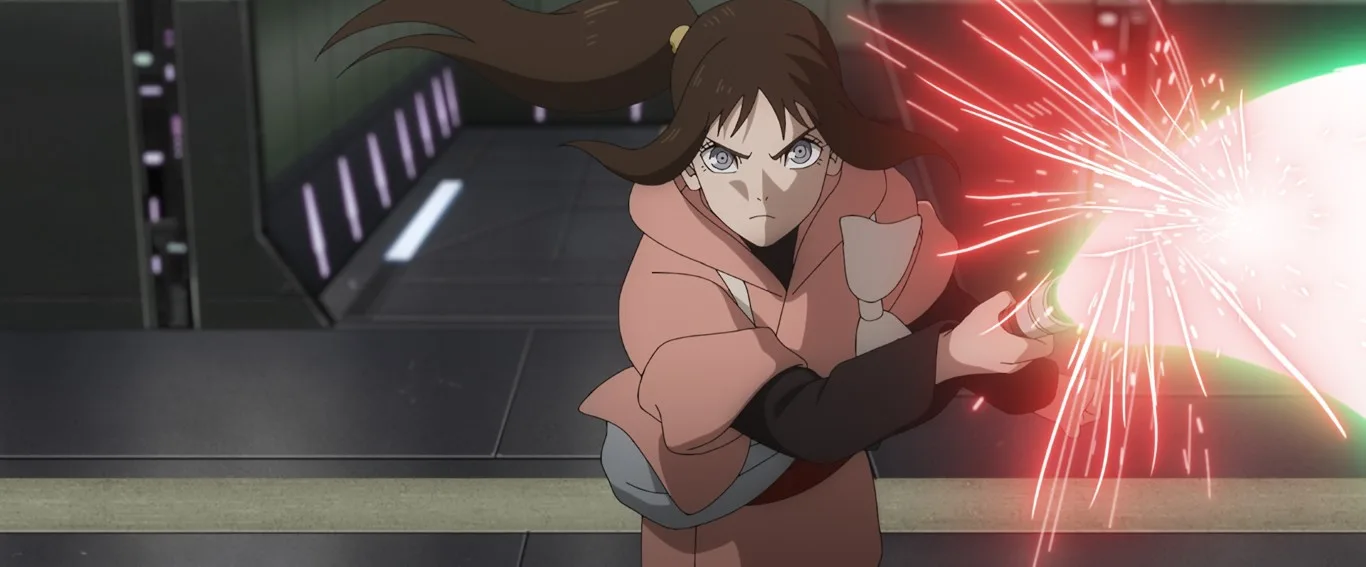
As Disney+’s long‑form storytelling has evolved, it seems even “Visions” had to follow suit. The spin‑off banner “Star Wars: Visions Presents” expands on the shorts, blowing them up to complete miniseries lengths. It made logical sense to call on Production I.G (“Ghost in the Shell”, “Haikyu!!”, “FLCL”), given that their Visions short “The Ninth Jedi” introduced an ongoing space-western-styled story about a powerful young Jedi named Kara (Kimiko Glenn) learning the way of the Jedi when it’s nearly nonexistent—particularly after the “Child of Hope” episode in Season 3 ended on a cliffhanger. The eight‑episode anime miniseries, simply titled “The Ninth Jedi,” follows up in a moving, action-packed spectacle brought to life with astonishing animation.
Following the events of “Child of Hope,” the balance between the Jedi and Sith has been dismantled. Today, they either operate as merchants or warlords. There’s no functioning Jedi Order to bring peace throughout the galaxy, and lightsabers are practically extinct following the imprisonment of Kara’s sabersmith father/former Jedi Knight Lah Zhima (Simu Liu). His captor is the mysterious imperialist Lord Nawaam (Young Mazino), a Shredder‑like tyrant on a conquest to take control of the galaxy using a destructive crystal as a weapon. As Nawaam seizes planets by force, a ragtag group of Jedi warriors—including Kara, her Jedi master Margrave Juro (Andrew Kishino), Ethan (Masi Oka), Homen (Patrick Seitz), and Kara’s droid Four‑Nines—try to restore order.
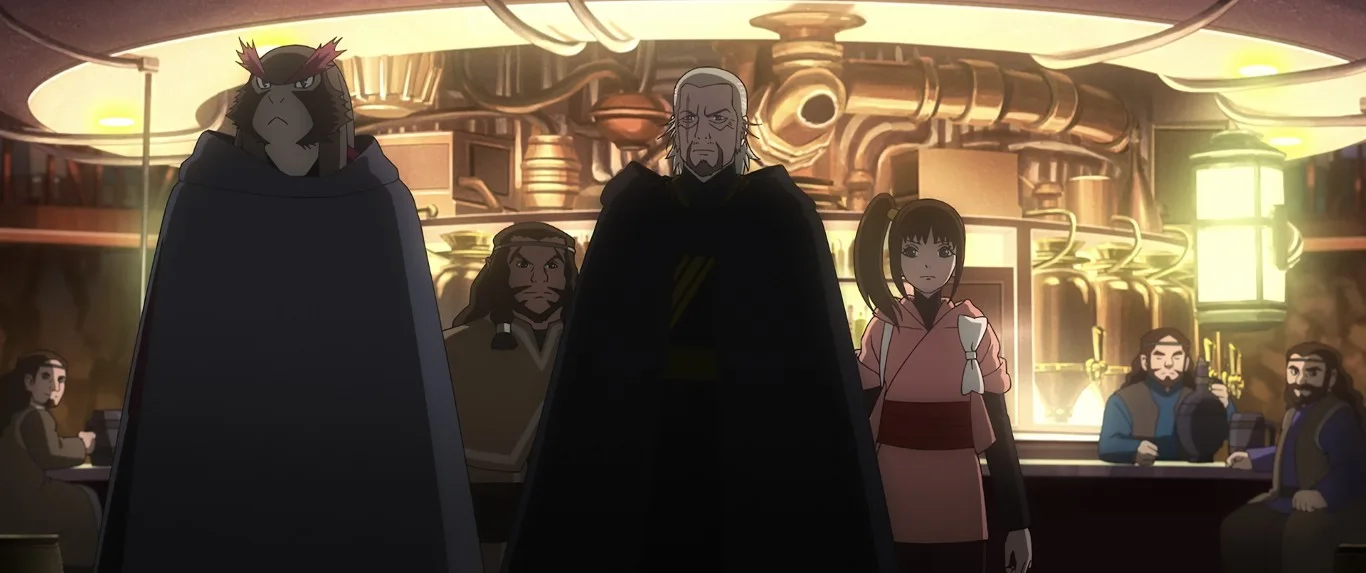
The first episode, “A New Threat,” leaps right into the visual splendor as the Jedi rebels evade Nawaam’s second‑in‑command, the last Sith Gennoh (Fedor Chin). After a successful escape, the team searches for allies across planets, starting with Juro’s old Jedi colleague Lord Dunbai (Brent Mukai) to aid their cause. Meanwhile, Ethan and Four‑Nines are sent to pose as spies aboard Nawaam’s ship to rescue Zhima.
While all of that may sound like a typical Star Wars setup, the first episode ends on a shocking twist regarding Nawaam and his lightsaber that poses an intriguing variable to the entire principles of morality, especially in this lawless realm. However, it takes a while for its saber to find its spark.
The first few episodes set aside our relationship with Kara across the two shorts, so it can expand on its standalone worldbuilding. But with that, the series falls into the generic war‑oriented “Jedi vs. imperialist” confines, wavering between “assembling allies” beats, its heroic protagonists like Juro bearing much resemblance to Obi-Wan, and dedicating much of its runtime to long‑winded lore. The third episode, “Voices of the Past,” delivers on its title by introducing a Zelda‑like Tafflah (Chase Sui Wonders), a former Jedi whose entire existence is dedicated to expository details of the Jedi’s past.
The thin characterization across the season’s first half is bothersome, especially since “The Ninth Jedi” presents a strong direction for its conversation—at least excluding Zhima, whose role as the miniseries’ catalyst follows through on a nuanced take on the Jedi Knight archetype.
Frankly, “The Ninth Jedi” looks phenomenal. Director Kenji Kamiyama (“The Lord of the Rings: The War of the Rohirrim,” “Ghost in the Shell: SAC_2045”) presents a more finely polished visual style than the preceding shorts. He and his animators balance 2D characters across 3D environments under a stronger, more cohesive presentation, with superior character designs and consistent, fluid movement. It’s the best‑realized vision Production I.G has offered of the galaxy, with sweeping, vibrant backgrounds and thrilling lightsaber battles. It brought me back to being a kid, remembering how stellar Star Wars in the animation medium can truly be in 2D. No franchise show has been this visually mesmerizing since Genndy Tartakovsky’s “Clone Wars” series.
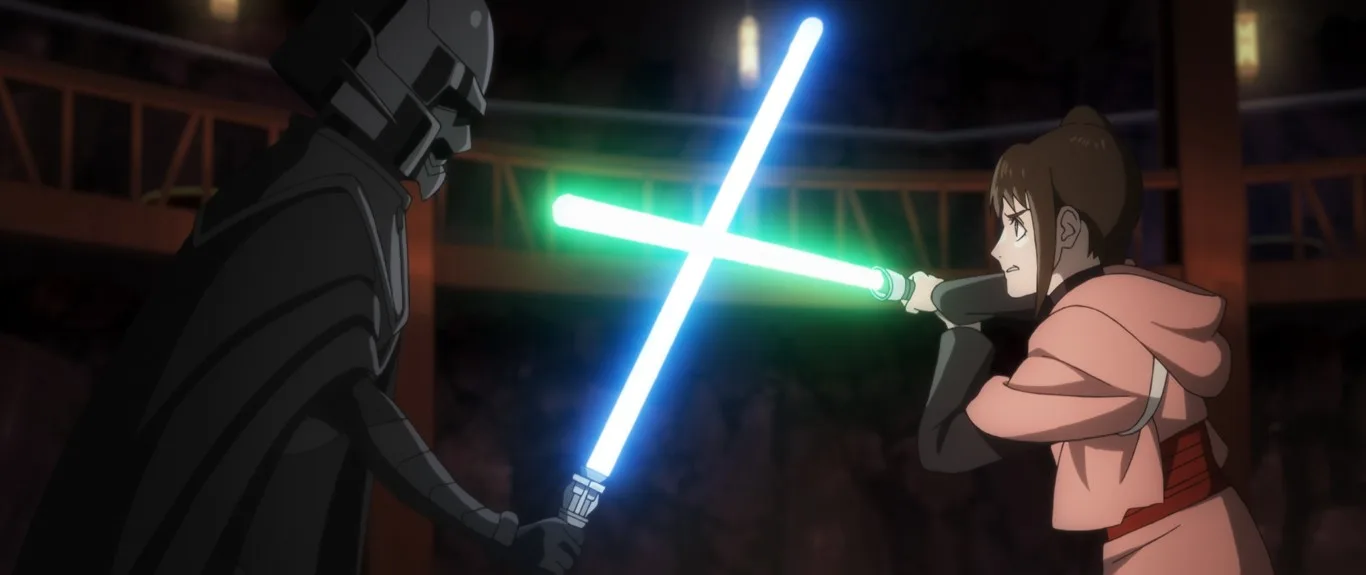
By the season’s midpoint, “The Ninth Jedi” finally finds its Force strength once it drops lore and refocuses on character. Once it realizes this is Kara’s story and brings her back to the forefront, it becomes a powerful and exhilarating coming‑of‑age tale of self‑discovery that takes smart thematic directions. The series disrupts the black-and-white morality of traditional “Star Wars” stories with moral gray areas, with even the Jedi’s lightsaber colors playing an integral role. There are shocking story turns, and certain colors take on certain meanings; Jedis are described as “giving into nothingness,” introducing an element of nihilism to the Jedi philosophy we haven’t seen in this respect before. By the end, the story becomes a thought‑provoking, triumphant fable against nihilism in a time very reflective of our desolate sociopolitical moment. It doesn’t just let its characters and themes find unity—it roots itself in earnest emotion, evolving into something profoundly above some of its other live‑action or animation counterparts.
With all its flaws, “The Ninth Jedi” is a stunning and sometimes poignant “Star Wars” story. It also seems to be the right course for the Star Wars franchise: letting other creatives realize their own visions of the galaxy across the animation medium. It’s surely more enticing than whatever Dave Filoni is doing at the moment.
All episodes screened for review. Premieres on Disney+ August 5th.