
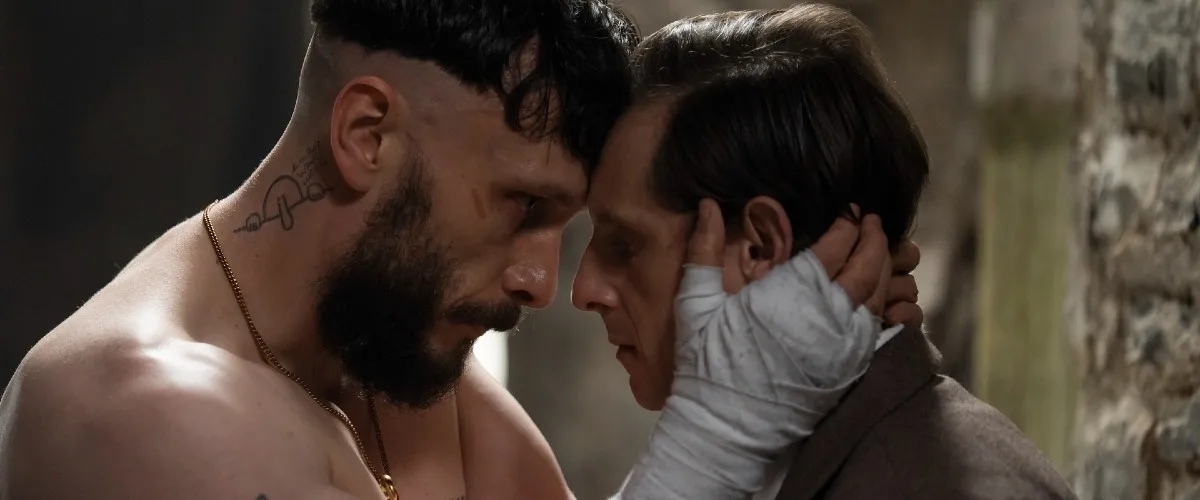
Did you watch “Adolescence” and wonder what might have happened if the teen murderer simply grew up without learning a thing? Did you watch “Baby Reindeer” and find its portrayal of obsession a bit mild? Did you watch “Succession” and find yourself feeling a twinge of empathy for three monsters who just wanted approval and love from a parent who was never going to provide it? If you answered yes to any of the above, Richard Gadd has got a show for you.
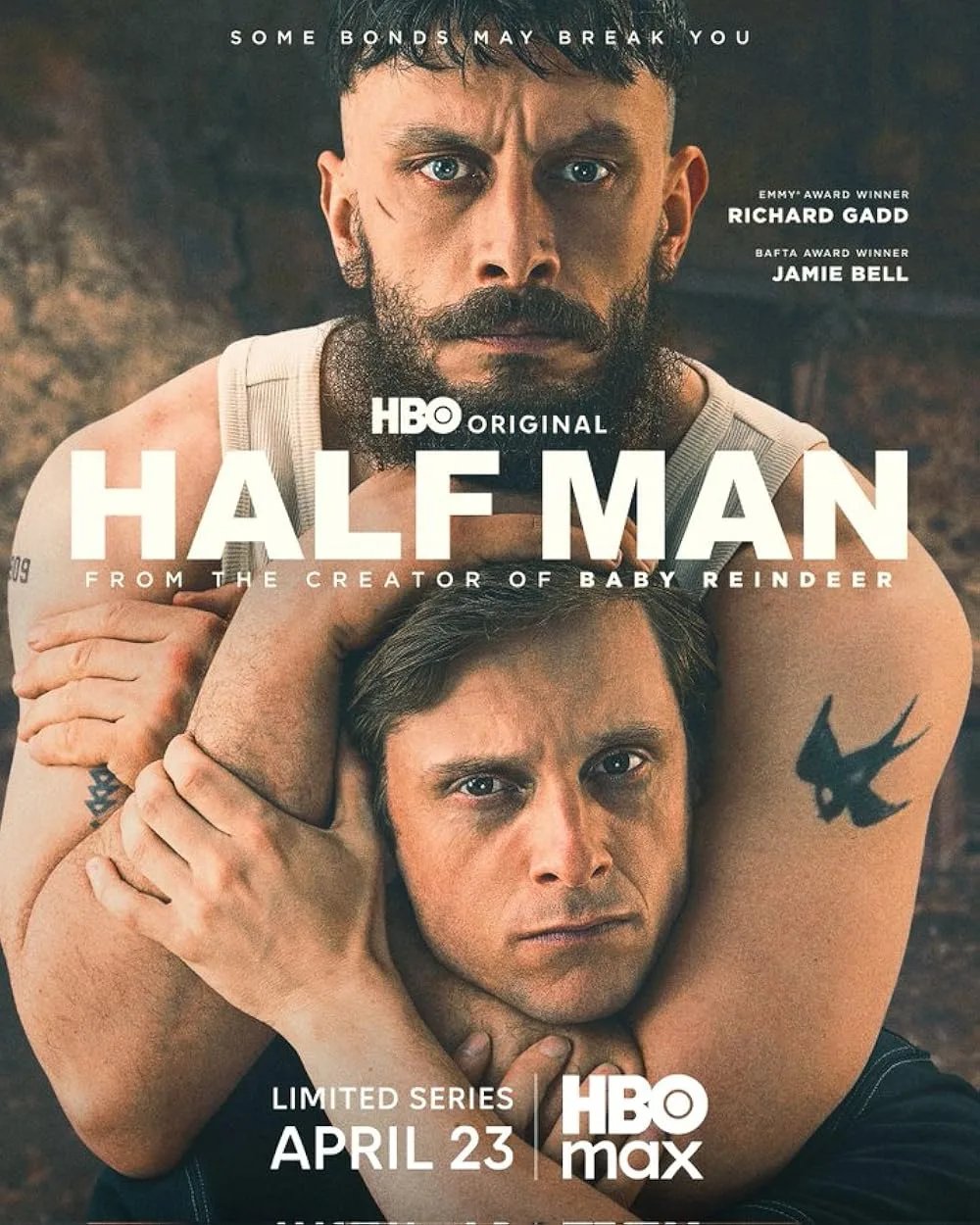
Written entirely and created by Gadd, “Half Man” is a new limited series about the seemingly unlimited ripple effects of toxic masculinity. It is like nothing else on television right now. Unrelenting in its despair, forcing the viewer to confront what society’s demons spawn in children, who go on to become beasts as adults. The series’s central questions are fascinating—What happens when a terrified child’s entire identity is shaped by and dependent on a bully’s largesse? Can anyone whose humanity is governed by anger ever turn back?—and it does not claim to have answers. Its depiction of the ramifications of unchecked rage in a man and his victims, however, is a brilliant and discomfiting six-hour horror film.
Teenage stepbrothers Niall (Mitchell Robertson as a teen, Jamie Bell as an adult) and Ruben (Stuart Campbell, and later Gadd himself) have some things in common: the latter’s father is an absent, abusive alcoholic, and the former’s is dead. The boys’ mothers are in a relationship, a fact that inspires homophobic gossip in their small town. Niall is bullied mercilessly at school while oblivious teachers drone on about exams. His chief bully is arguably his harridan of a mother Maura (Marianna McIvor), who plainly informs him that her partner Lori (Neve McIntosh) is moving in with them. Lori’s son, Ruben, will be joining too, just as soon as he’s released from juvenile detention after serving a sentence for biting off a boy’s nose. It’s not long, though, before Ruben’s violence begins to provide a buffer for Niall at school, who, in turn, helps Ruben cheat on a test.
That’s where things take the signature Gadd turn. One night, Ruben interrupts his own hook-up with girlfriend Mona (Charlotte Blackwood) to tease Niall, and slowly but surely, “the brother from another lover” (as Ruben insists he and Niall call each other) helps the terrified teen lose his virginity.
This is where the story truly begins, and the scene is one of the best in recent TV history. Revulsion, love, desire, and coercion blur together, and the only truth is that from now on, Niall will be in complete thrall to Ruben, forgoing his own humanity at every turn for crumbs from the only person who has shown him what he perceives as love. (There’s a great shot, the next morning, as the pair sits on the floor against their beds as the sunshine streams in; the beds behind them take up most of the shot, as their joint sexual encounter will color their dynamic forever.)
And Ruben, well, all he has learned to do, long before he ever became Niall’s sun and moon and stars, was to detect a person’s weakness and use it against them. The pair’s dynamic isn’t on a collision course; it’s a series of explosions set against a lifetime of heartbreak, cruelty, and abuse, culminating on the day of Niall’s wedding.
Gadd layers the psychological impact of each scene with equal parts dialogue and silence; so many writers and directors would benefit from trusting what both the characters and audience are capable of when everyone simply pauses to think. While there are some (surprising) mordant comedic beats, they don’t last long. The writing of “Half Man” makes “The Wire” look like “Bluey”: numerous horrors are represented in vivid detail, almost like a family tree of social ills, including misogyny, classism, multiple types of assault, homophobia (internalized and external), untreated mental illness, abusive parenting, and a few that remain under embargo.
Every choice Gadd’s leads make goes right back to their woeful childhood, where their own fear and pain were neglected by the very people who are supposed to protect them: their parents. Everyone operates around Ruben’s needs, wants, explosions, and breakdowns. No one feels safe to leave the abuser because no one has been able to consciously recognize him as such. The chaos is at least familiar. Change is terrifying.
Gadd and Bell are doing career-best work here. As Ruben ages, Gadd finds a slower, heavier gait and a lower, almost simian vocal register, substituting short grunts or heavy breaths as contributions to conversation. There’s never any telling whether his grunt signals his love or his incoming fist. As his counterpoint, Bell taps into a brokenness, a glass-eyed sorrow that has to be seen to be believed; practically all the suffering in Niall’s life can be traced back to his internalized homophobia, which Bell portrays with heartbreaking sincerity, shaded by Niall’s own morally dubious choices.
Campbell and Robertson are wonderful too; their dynamic is equally frightening, for there is a sparkle in teenage Ruben and Niall’s camaraderie that throws the abuse into even further relief. It’s not just the brutality that stuns; it’s that there’s lightness too, just under the surface, crying out to be accessed, nurtured, cherished, seen.
And McIvor wins the Livia Soprano Award for best representation of an emotionally desolate, manipulative, almost comically malignant mother. Every time she sees her son, she has a new betrayal to inform him about. At one point, I audibly screamed at my computer. One wonders how many Mauras have aided the destruction of their own Nialls.
The series is also a feat of intimacy coordination. Every consensual scene is shot and directed in a way that makes it clear: yes, this is something the parties involved have agreed to and are enjoying. Scenes of assault are shot in stark opposition; it’s gut-wrenching and horrifying, and there can be no debate. But the scene in which Niall’s turmoil ferments, in which his psyche latches onto Ruben, is shot to perfectly convey that there is no clear way to read this. Yes, there’s arousal, but there’s also duress, control that no one consented to, and implicit violence. “Half Man” is a beat-by-beat examination of the convoluted and confounding nature of trauma. If Niall and Ruben’s lives were chains, the metal links got tangled decades ago, and no one would even begin to know how to undo the knots.
The series isn’t flawless. There are dips in pacing here and there, and a few of the women characters could be better written. Often, the monologues feel better suited to a play than they do to television. But the density and layered nature of the writing win the day. “Half Man” makes one thing abundantly clear: Everyone else churning out scripts for TV is a writer. Richard Gadd is a bloody artist.
Entire series screened for review. Premieres April 23rd on HBO Max,