In this year’s World Dramatic Competition program, I watched three films that are irrevocably tied to their cultures. Each examines experiences of girlhood and coming-of-age against the backdrop of England, Mexico, and the Philippines. Stylistically, two wholeheartedly commit, for better and worse, while the other neglects to fully lean into its choices.
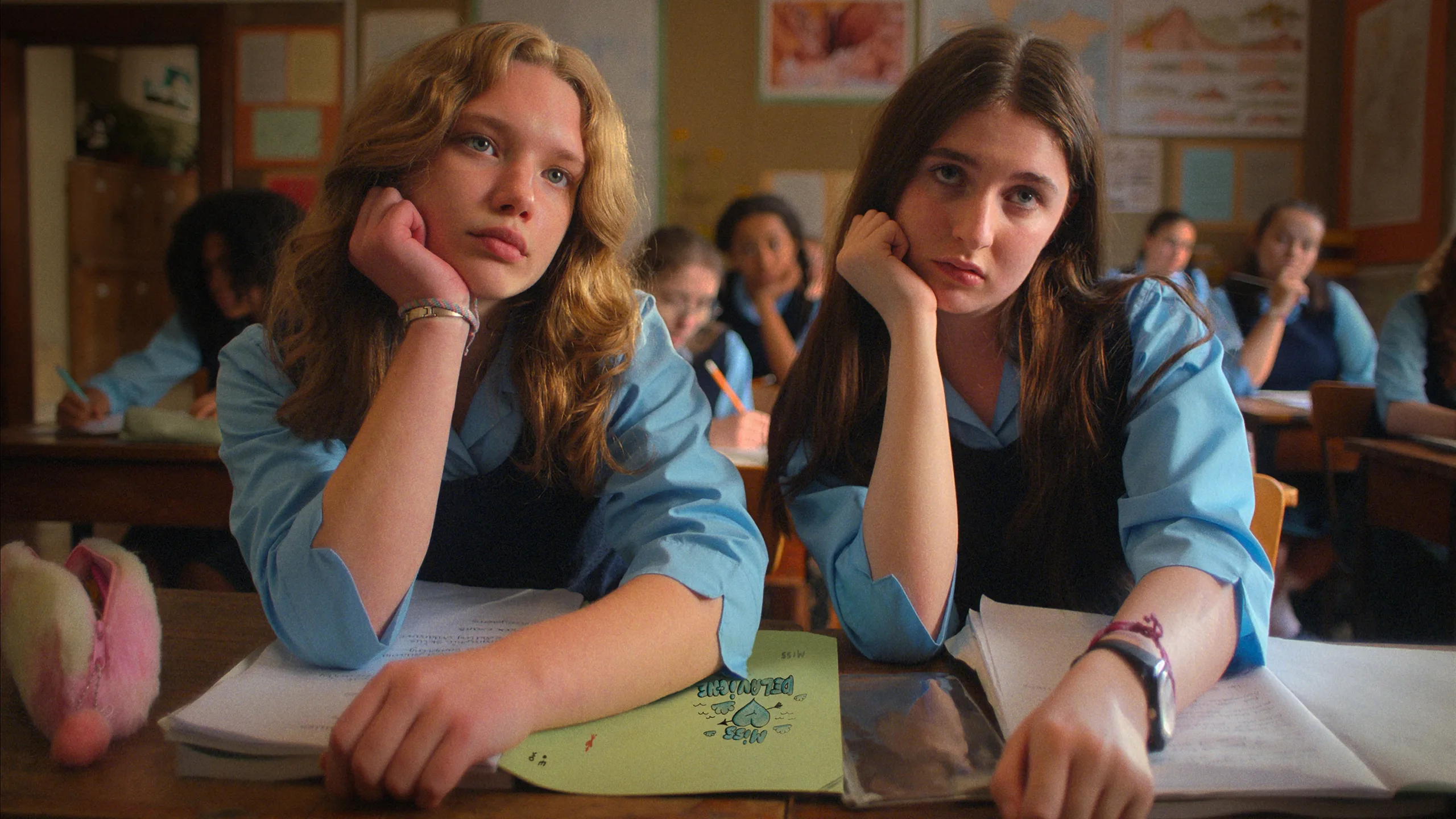
Molly Manners’ whimsical bildungsroman “Extra Geography,” based on the short story by Rose Tremain, follows best friends Minna (Galaxie Clear) and Flic (Marni Duggan) through their days at a British boarding school. Thick as thieves, the girls traipse through the academy as if they own it, all the while embarking on the quest to become “well-rounded” and “worldly.” Whether excelling in chemistry class or annihilating on the lacrosse field, they do just about everything in sync, including their proposed summer goal: falling in love.
The girls tackle the task with the same diligence as any other school project, taking notes, conducting research, and engaging in theoretical discussions on the topic. They decide the object of their affections must be decided at random: the first person they see when they close their eyes, wait, and open them in sync. Complicating matters is that the person ends up being their Geography teacher, Miss Delavigne (Alice Englert), who is oblivious to the scheme.
As the girls endeavor to woo their instructor, the gamification of their coming-of-age experience lends itself to a competitiveness that threatens their once water-tight bond. Manners’ often symmetrical framing choices and quirky direction play well to the jest of Minna and Flic, while also reflecting how the girls so often feel like halves of the same whole, making it all the more affecting when fractures between them begin to show.
The young performers’ chemistry is tender and relatable, reminiscent of the time when friendships make or break a life. Clear and Duggan embody a very relatable, very British deadpan sense of humor, marked by angst and misguided teenage confidence. It’s an echo of the times, where, as a teen girl, everything is serious. The destination of womanhood is perceived to be at the end of a road marked by ticking boxes of measures toward maturity. Experiences are gained not for the lessons they teach but for the sake of having them. Awareness of your own cluelessness is nonexistent, and once it eventually comes to light, it’s a complete reckoning.
“Extra Geography,” for me, awakened feelings of teendom that I had so distantly felt that I nearly forgot them. Absurdly funny yet unafraid to tap into the grief in intense female friendships, Manners’ film is not just about growing up but also about bracing against cycles of validation and codependency that we all come to realize must be abandoned.

While “Extra Geography” commits to its whimsical quirkiness, Rafael Manuel’s “Filipiñana” fully immerses itself in contemplation, leaning so far into it that it’s the film’s greatest fault. “Filipiñana” is an endurance test, an exercise in slow cinema that is almost certain to leave viewers winded. Adapted from a short film, it almost feels like Manuel extended the runtime through an egregious reliance on long shots (they’re tiring and plentiful).
Isabel (Jorrybell Agoto) has been hired as a tee girl at a luxury country club in Manila. An absurd job, placing golf balls on the tees before every swing (because god forbid the wealthy players do a lick of labor themselves), is at the center of Manuel’s thesis about class exploitation in the Philippines. As Isabel settles into her work, she grows unnerved by her environment.
Everything at the golf course is a performance. For example, workers lie in wait for buses of tourists to arrive, breaking into song as soon as the doors swing open. Activity at the country club is practically choreographed: whether it’s a group of golfers swinging or landscapers snipping garden shears, it is done in perfect unison. This eerie display of a pseudo-hivemind among both patrons and employees is indicative of a locale whose culture relies on order and hierarchy. Like a forced smile, the hyper-manicured landscape of the country club itself is both attractive and sinister: meant to welcome but indicative of a facade.
With cinematography by Xenia Patricia, the look of “Filipiñana” is inarguably stunning. Color and texture are beautifully captured, whether in close-up portraiture or voyeuristic wide frames. In the beginning, the aforementioned long shots prompt us to check every corner for fear we might miss something, but by the end, it all feels like an unfulfilling, forced game of I-Spy.
The film’s pace is painstaking, detracting from its attempt to survey the chasm between work and play. This dichotomy, in addition to the pairing of infatuation v. resentment that Isabel feels towards her boss, serves as a strong foundation for dissecting the Philippines’ relationship with class and colonialism. However, Manuel’s overindulgence in style took precedence over a much more interesting source of substance.

Suzanne Andrews Correa’s “The Huntress” is another film about cultural hierarchy and subjugation. Taking place in Juarez, Mexico, where rape and femicide are frequent and unpunished, Luz (Adriana Paz), herself the survivor of an attack, has become a vigilante.
The film primarily follows Luz, who works at a tech factory, along with many other women who are required to take numerous buses to work. These buses are a frequent site of attacks, including Luz’s own, and every scene that occurs on them is marked by anxiety. Juarez is defined by this fear: women come to work battered, cannot be on the streets alone at night, and are even questioned when walking around during the day. To be a woman in this city is to be on the brink of violence at all times.
As the mother of 14-year-old Alejandra (Jennifer Trejo), who isn’t yet aware of the way predatory men look at her, Luz knows that her daughter’s innocence will not last forever. Desperate to create a world where men live in a bit more fear of enacting violence, Luz guns down two bus drivers. Inspired by the real story of Diana, Hunter of Bus Drivers (her true identity still unknown), Correa’s film posits a meaningful, speculative personal history.
Parallel to Luz’s story is that of Ximena (Teresa Sanchez), whose daughter is missing, though presumed dead. She hosts search parties full of other mothers looking for potential remains of their lost children in the desert. A figure of the wide-spanning cultural issue, Ximena’s character is more of a symbol than a three-dimensional addition to the film, and “The Huntress” has a void where a deeper version of her story exists.
An investigation of rage and institutional neglect, Correa’s film is thoughtful, telling one woman’s story intimately yet resonating holistically. The factory where Luz works is owned by Americans, and looming over her head at all times is the fact that she is seen only as a number: a statistic of productivity. The police are neglectful, if not perpetrators themselves. The news, despite knowing the history of assaults on buses, doesn’t even acknowledge the fact when speculating on the shooter’s motive. These cycles of erasure and invisibility are well woven into Correa’s script, as is the ignorance that perpetrates them.
Paz does an excellent job of embodying the cocktail of anxiety and rage that defines Luz’s days. She navigates emotion with an authentic, conflicted blindness, hooked up to the tow of her feelings rather than in the driver’s seat. But Luz’s desperation refuses to be passive. Even as she collects emotional blows, she just as quickly makes decisions to adapt (save for one harrowing scene, where she freezes).
Correa employs surreal sequences that are stylistically at odds with the effective, grounding realism of the rest of the film. As metaphors for Luz’s psychological ghosts, they don’t quite work, sometimes cheapening the organic horror of the scene. But overall, Correa crafts a film that doesn’t shy away from the weight of its subject, nor from the understandable, though perhaps unfulfilling claim of its conclusion.