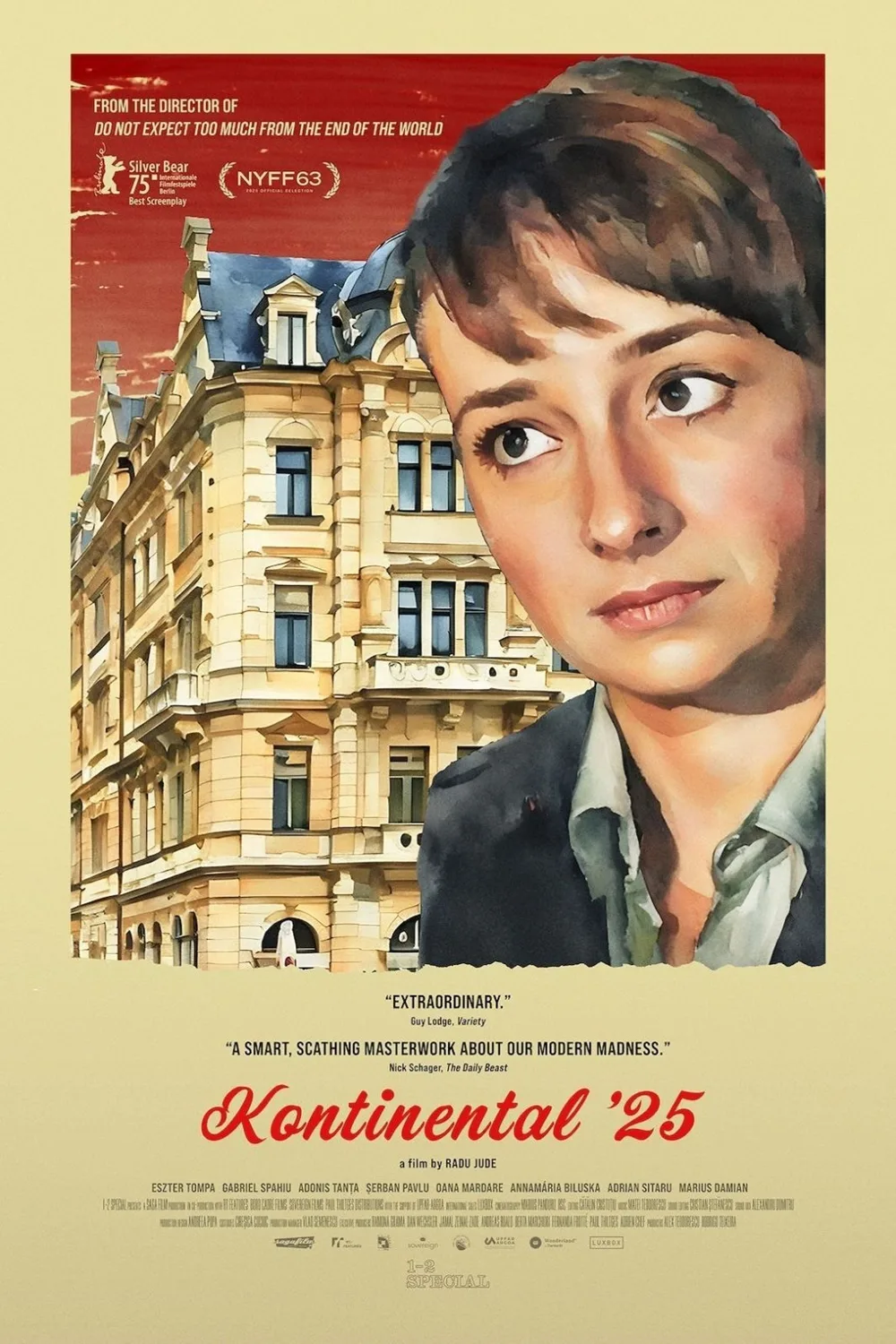
In his 2025 “Dracula,” the cinematic provocateur Radu Jude (whose oeuvre includes the nearly self-explanatory titles “Do Not Expect Too Much From The End of the World” and “Bad Luck Banging or Loony Porn”) closed his near-endless proceedings with a sort of projectile vomiting, flooding the screen with AI-generated pornographic imagery. One of several metaphors for vampirism in that film, to be sure. Jude’s new film is an unusual companion piece to his purposeful piece of desecration; as Jude himself puts it, “If ‘Kontinental ’25’ is my answer to Rossellini, let’s say ‘Dracula’ is my love letter to Ed Wood.”
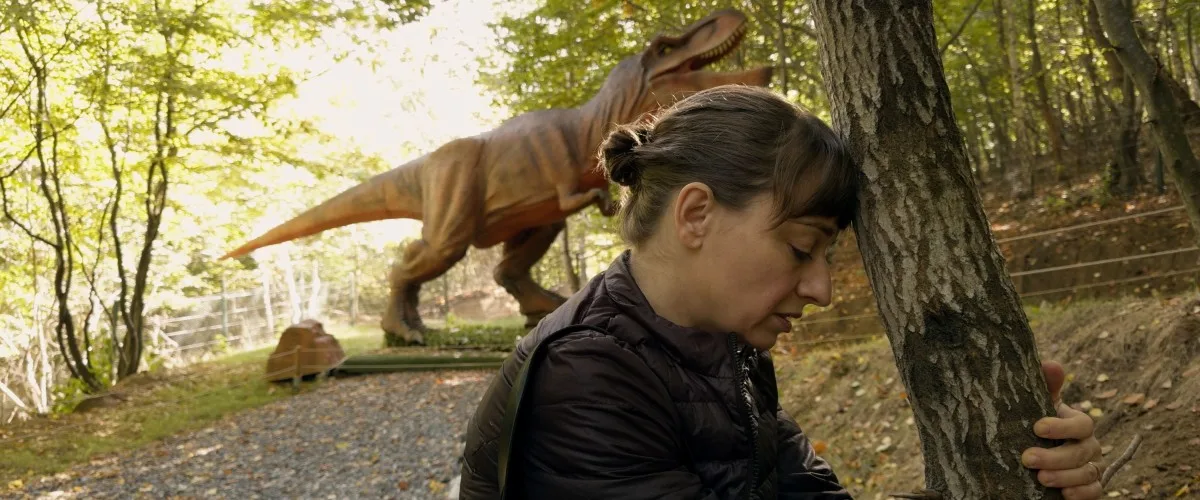
The Rossellini film in question is 1952’s “Europa ’51,” whose title echoes “Kontinental ’25”’s title, albeit not in any actually meaningful way. “Kontinental” is the name of a spanking new hotel that’s going to be put up at the site of an old, decrepit building, a building that has been entirely vacated except for one tenant, an old man not so much living as hiding out in its basement. Eszter Tompa plays Orsolya, the bailiff charged with persuading Gabriel Spahiu’s Ion to leave. Ion’s life is one of privation. When we first see him, he’s wandering in a wooded area populated by animatronic dinosaurs; an amusement park attraction that has outlived its attraction, so to speak. We wonder, could he be foraging for mushrooms? But no, soon he gets into town and begs, hassling people in outdoor cafes. Romania’s social safety net, it seems, isn’t anything to write home about.
Once Orsolya comes into his life, it seems as if Ion would rather die than give up what little he’s got. And so he does. In a harrowing manner, just as Orsolya reluctantly, or “reluctantly,” sends in some ICE-like agents to retrieve him. (A wag on the scene refers to them as her “Teenage Mutant Ninja Turtles.”) At her office, Orsolya receives assurances that she’s in no way liable for what occurred, and she repeats these assurances to herself, but she’s wracked by guilt nevertheless, and for the remainder of the film she tells her story again and again, in scenes that bristle with stinging irony, including a visit to her mother which concludes with the mom calling Orsolya an unspeakable name.
Life seems stuck in a groove in this picture; for much of it, nothing moves forward. Much is made of the fact that Orsolya is an ethnic Hungarian living in Romania; the name of the prelate Aron Martin is evoked, and Orsolya’s best friend works for an NGO that assists the Roma people. A young sanitation worker, with whom the married Orsolya has an impulsive and somewhat squalid affair, tells her a fake tale of Zen philosophy that reduces everything to farce. And while this film is often funny, its ultimate bit of wisdom, from the New Testament, is dark and undeniable: “Sufficient unto the day is the evil thereof.”