“Brilliant. And scary.”
That was my instant reply to a text from a friend the morning after we saw the world premiere of Luca Guadagnino’s “Artificial” at the New York Film Festival. The NYFF hasn’t been known for world premieres, or at least it wasn’t until last year, when A24 unveiled Josh Safdie’s “Marty Supreme” in a surprise screening event, launching it to major critical acclaim, a world box office near $200 million, and Oscar nominations, including Best Picture. That success reportedly inspired other distributors to see the festival as a place for world premieres, and it may have inspired the NYFF as well: this year it hosted seven.
As widely reported, Amazon MGM produced Guadagnino’s film, but then dropped it and Neon picked it up. Did the larger company fear Silicon Valley’s reception? While “Artificial” takes a probing approach to AI, it doesn’t come across as an indictment of the forces producing it. Rather, it is a very engaging, dramatic and sometimes quite funny portrait of a particular slice of that culture, one that developed over several years and led to a particularly notorious incident: the attempt of the board of OpenAI to oust its charismatic CEO, Sam Altman, and his fast and successful campaign to turn the tables and overthrow his opponents.
What do such boardroom machinations have to do with the promise and perils of Artificial Intelligence? Actually, “Artificial” makes a strong case that the human element, all the imponderables of personality, ego, and conflicting agendas, shapes how this technology is being ushered into the world, and what it may do to it.
The film, please note, doesn’t predict anything–neither utopia nor dystopia. Yet by focusing on the recent past rather than the impending future, it shows how AI’s rapid development has raised an accelerating set of questions and problematic possibilities.
At the Q&A following the NYFF premiere, the film’s original screenwriter, Simon Rich (former SNL writer and son of columnist Frank Rich), said he’d been concerned about AI since a childhood friend warned him of its dangers. He’s clearly studied the subject in depth, because “Artificial”‘s script brings a sense of authenticity to a complex story, even as it necessarily condenses it. That Rich’s fast-paced dialogue may sometimes overwhelm viewers with flurries of tech jargon, but it only serves the story’s immersive flow.
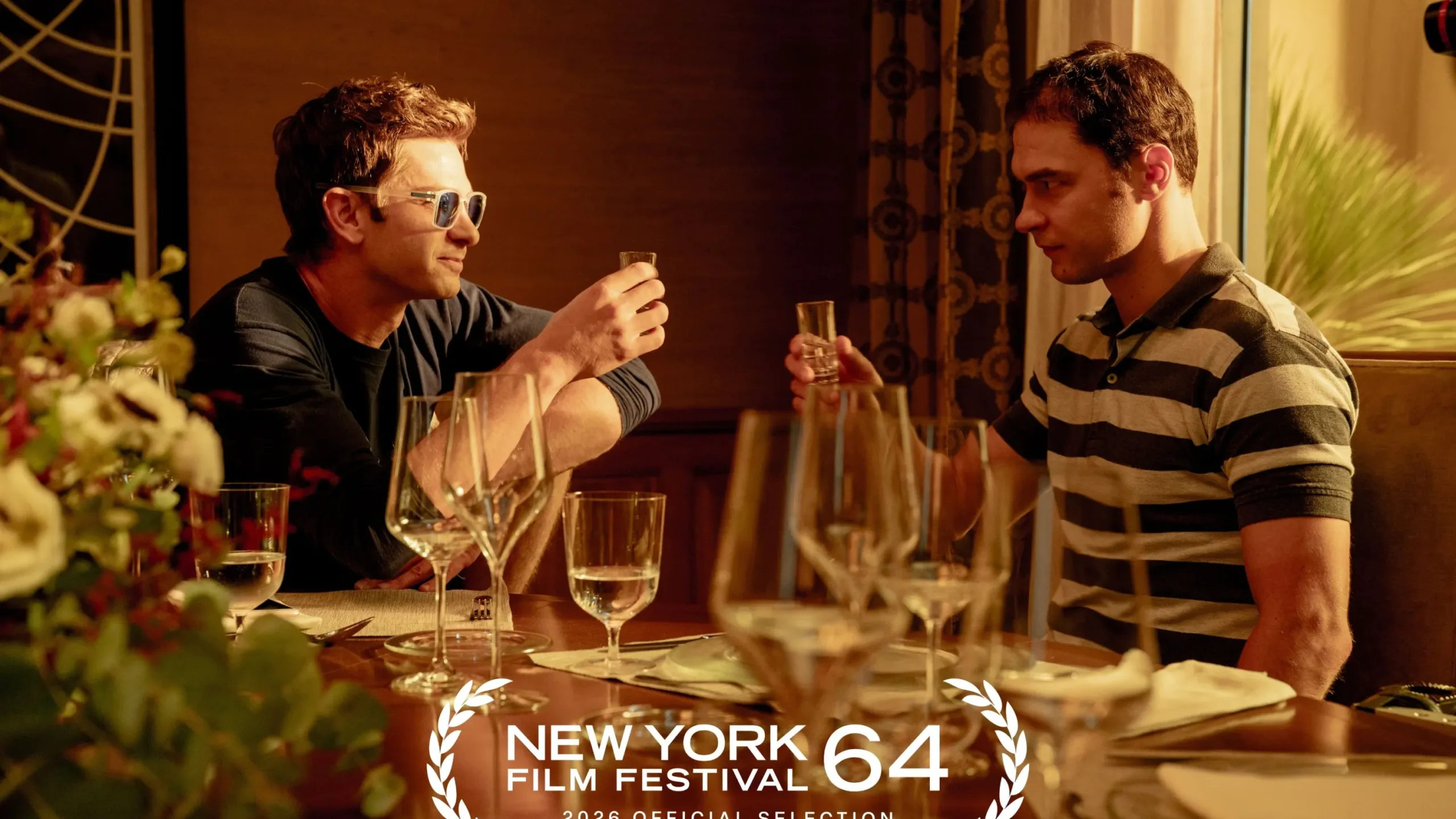
It begins in Toronto in 2003 when a 17-year-old native of Russia, Ilya Sutskever (Yura Borisov), enters the lab of future Nobel Prize winner Geoffrey Hinton (a terrific Mark Rylance) and so impresses the brilliant professor that a partnership is soon born, one that will take them to Silicon Valley and the hallways and workspaces of Google. A decade-plus later, their pioneering AI work attracts the interest of Stanford dropout Sam Altman (Andrew Garfield) and his pal Elon Musk (Ike Barinholtz). The charming but morally slippery Altman recognizes the genius of upright, idealistic Sutskever and offers a corporate collaboration meant to bring immeasurable benefits to the human race, while, of course, enriching the technology’s masterminds.
OpenAI was founded in 2016. The boardroom battle that forms the story’s crux comes in 2023. In the intervening years, we see the rise of a fast-paced, celebratory culture among young people, forcing a technological revolution whose nature no one understands. For viewers who’ve followed this tale in news reports and magazine articles, it’s fascinating to see how Guadagnino and Rich bring the characters, their labors and conflicts to life. But perhaps the best thing about the film is that it doesn’t require any advance knowledge of its subject and milieu; newcomers are just as likely to be swept up in its torrent of events and emotions.
This is filmmaking of a very high order. Arguably Guadagnino’s best work (it’s leagues beyond his “After the Hunt,” which opened the NYFF last year), “Artificial” has a great sense of atmosphere and a constantly evolving narrative drive. As for the acting, it might be best described as a semicircle. On one side, there’s the film’s most focused and realistic performance (and the one that will deservedly garner the most praise), Borisov’s Ilya Sutskever. On the other side, Barinholtz’s cartoonish Elon Musk is so broad it almost doesn’t work.
Between these extremes, and borrowing elements of both, Garfield’s Sam Altman is forceful but duplicitous: a gifted leader and a quasi-sociopath. As the story progresses, especially at the climactic showdown with Sutskever and OpenAI’s board, Altman’s personal power becomes increasingly crucial. He’s obviously not the only billionaire calling the shots in the AI game, but he makes you wonder: Do we really want the planet’s future in his hands?
The world premiere of “Artificial” at the NYFF felt eerily timely. Although it could not have been predicted by the filmmakers or the festival, just a month before the film’s screening, a 27-year-old AI researcher named Jacob Coxon, who had worked at OpenAI and resigned from Anthropic, issued a statement saying, “The people building AI earnestly believe that it could kill us all by the end of the decade…[M]any executives and senior researchers will couch their phrasing in the press to sound sensible—but I hear the same people express fear privately. No other human activity poses this level of danger.”
That warning has reverberated worldwide and sparked wide discussions about the dangers of AI and the need to contain it. Among other greater consequences, it might well make “Artificial” the most important dramatic movie of 2026. And while I understand Neon’s Oscar strategy of releasing the film on Christmas Day, I left its world premiere not only shaken and dazed, but also wishing it could go into theaters the next day.
Notes on some of the other world premieres at the 2026 New York Film Festival:
Mani Haghighi’s “I Deserve a Lover Whose Every Rise Sets Fiery Dooms Raging Across the Skies” is a documentary portrait of two Iranians as eccentric as the film’s title: painter and conceptual artist Nasser Bakshi and his partner Roghayeh Najdi. The duo has assembled a vast archive of artworks and found objects that chronicle the lives of ordinary Iranians across generations, and the film (shot just before the current U.S./Israel war on Iran) explores their world in an amusingly digressive, unconventional way. A leader in the post-Kiarostami generation of Iranian filmmakers, Haghighi isn’t primarily a documentarian (his masterpiece “A Dragon Arrives!” really deserves a belated U.S. release), but it’s great to see one of his films at the NYFF.
I imagine that Tony Gilroy’s “Behemoth!” will have its admirers, but I am unfortunately not one. Which is a shame: I’m a fan of Gilroy’s Jason Bourne scripts and especially his complex, brainy 2007 thriller “Michael Clayton,” which he wrote and directed. His new film starts promisingly: a professional cellist (Pedro Pascal) enters a Los Angeles recording studio to work on the score for a new movie.
Gilroy reportedly worked with nine composers to shape the drama’s musical dimension, and that element has its pleasures and fascinations. But they merely form the aural wallpaper of a hodgepodge story that jumps around in time and space, chronicling the cellist’s soap-operatic life. While Pascal, one of our best actors, gives an energetic, committed performance, the character never rises above a philandering boor.
Tom McCarthy’s “The Statement” is even more tiresome than Gilroy’s film. This numbing talkfest dramatizes a literal meeting that took place over three days in October 1980 at a Florida hotel. About 20 scientists and policymakers, appointed by the U.S. Congress, drafted a statement on carbon dioxide and climate change. The film offers some strong performances from John Turturro, Paul Rudd, and Paul Giamatti, but its drama is as boring as its premise sounds.
In my ranking of 2016 films, I put Ava DuVernay’s “13th” in the number one spot. This terrific documentary looked at the way the 13th Amendment, which abolished slavery, was misused to create a new form of slavery in the American prison system. The film earned and deserved widespread critical acclaim, but its sequel, “14th,” which premiered in the Closing Night slot at the NYFF, almost certainly won’t get the same general approbation. See Jourdain Searles’ review to find out why.