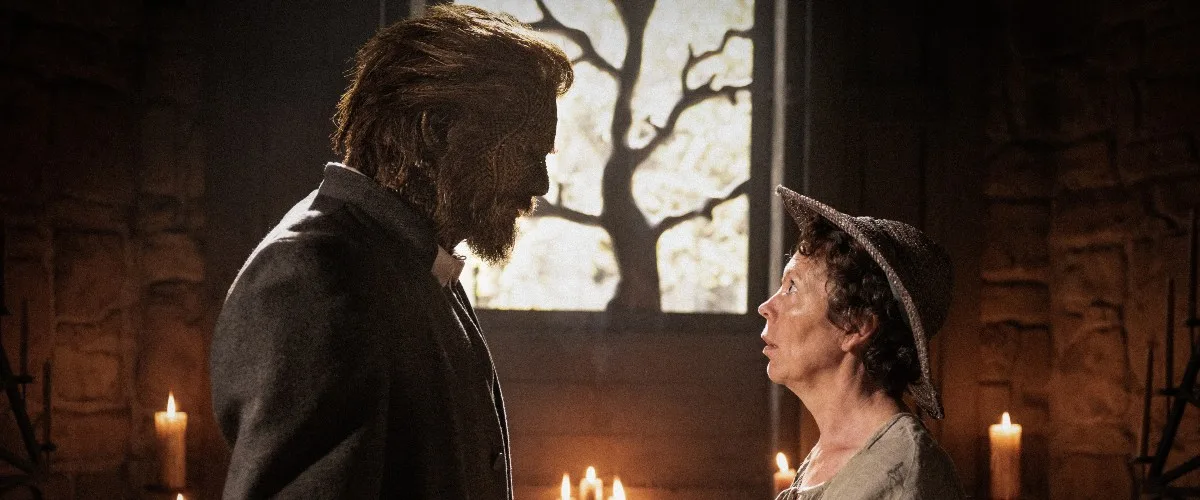
“Wicker” begins as a film about a lonely Fisherwoman (Olivia Colman) whose foul odor, disheveled appearance, and fierce independence make her the object of derision in her small medieval farming village. Marriage is a significant ceremony, one that gives every woman their worth. And despite the Fisherman finding the institution a burden worth mocking with raunchy, frank humor, the Fisherwoman makes a wish to the Basket Weaver (Peter Dinklage) for a husband composed of wicker in a fun-loving romantic fairytale.
What’s most surprising about the Fisherwoman’s request isn’t that she thinks it’s possible, but that the Basket Weaver assuredly takes the job. Alone in his cottage, he recalls that the Fisherman’s life has been “marred by tragedy,” an orphaned girl forced to fend for herself by learning a trade. He tells her to be at the chapel in a month; her husband will be awaiting her. “Mother nature provides. I merely augment,” says the Basket Weaver.
The Wicker Husband, played with incredible sincerity and shocking realism by Alexander Skarsgård, and the Fisherwoman are also augmenting what the village folks believe is the natural order of things. Not solely through the materiality of their bodies but also through their rejection of convention: The Fisherwoman doesn’t don a ceremonial metallic collar, and the Wicker Husband doesn’t ask to snap it on her during their wedding.
Alex Huston Fischer and Eleanor Wilson’s film proposes more startling ideas to these provincial villagers: What if sex was pleasurable instead of perfunctory? What if a man and a woman saw each other as equals and even came to love one another?
“Wicker,” based on Ursula Wills’ story “The Wicker Husband,” is Fischer and Wilson’s second feature following their apocalyptic parenthood comedy “Save Yourself!” But unlike that film, which spoiled its intriguing premise with little development, this rip-roaring comedy remains exciting precisely because the story doesn’t survive on belief alone. Its richly drawn characters, inspired narrative turns, and endearing whimsy recall a kind of crowd-pleasing cinema, which includes “The Princess Bride” and “Willow,” that we don’t often get anymore.
Its charm arises from how the Fisherwoman and the Wicker Husband’s happiness reveals each villager’s dissatisfaction within their own marriage. The young Bottlewasher (Gustav Lindh) becomes aware that he can’t sexually please his wife (Marli Siu). The Baker (Ben Ashenden) and his wife (Ella Bruccoleri) want a child, but unlike the Bottlewasher, they’re not even having bad sex; they’re having none at all. The Tailor’s Wife (Elizabeth Debicki), meanwhile, wishes she and her husband, The Tailor (Nabhaan Rizwan), were equals in business and at home, but she hates being judged only for her beauty. Or as her husband says, “a shining example to us all.”
Jealousy is the root of all evil in this village: vicious rumors about the devoted Wicker Husband being unfaithful to the Fisherwoman make the insecure woman question his loyalty, sparking a fit of rage that upends their seemingly idyllic partnership.
A few other amusing people surround the couple’s momentary break-up. Richard E. Grant plays an ineffectual drunkard doctor, and Kiell Smith-Bynoe plays a terse innkeeper who dispenses plenty of judgy facial expressions. Dinklage adds a dry wit that smartly accentuates the film’s playful tenor, including mischievous jokes, a jestful score, and lively costume and production design that combine for simple yet refined period recreations.
While “Wicker” mostly interrogates the limited self-worth imposed on its women characters as caregivers, it also turns its lens on the Fisherwoman. Does a man who’s been created to love you have free will? “Wicker” takes the easy way out by conjuring an all-too-neat explanation for their shared devotion, side-stepping a far thornier path than one would expect it to naturally take.
Colman and Skarsgård keep the film honest even when Fischer and Wilson wiggle out of their own conceit, conjuring deeply felt emotion out of the promise of love. The two also share wonderful chemistry, signaling their shared trust through sincere tenderness. “Wicker” offers many lessons in happiness, but its surest comes from a broad humor that leaves few safe from its delightful ire.