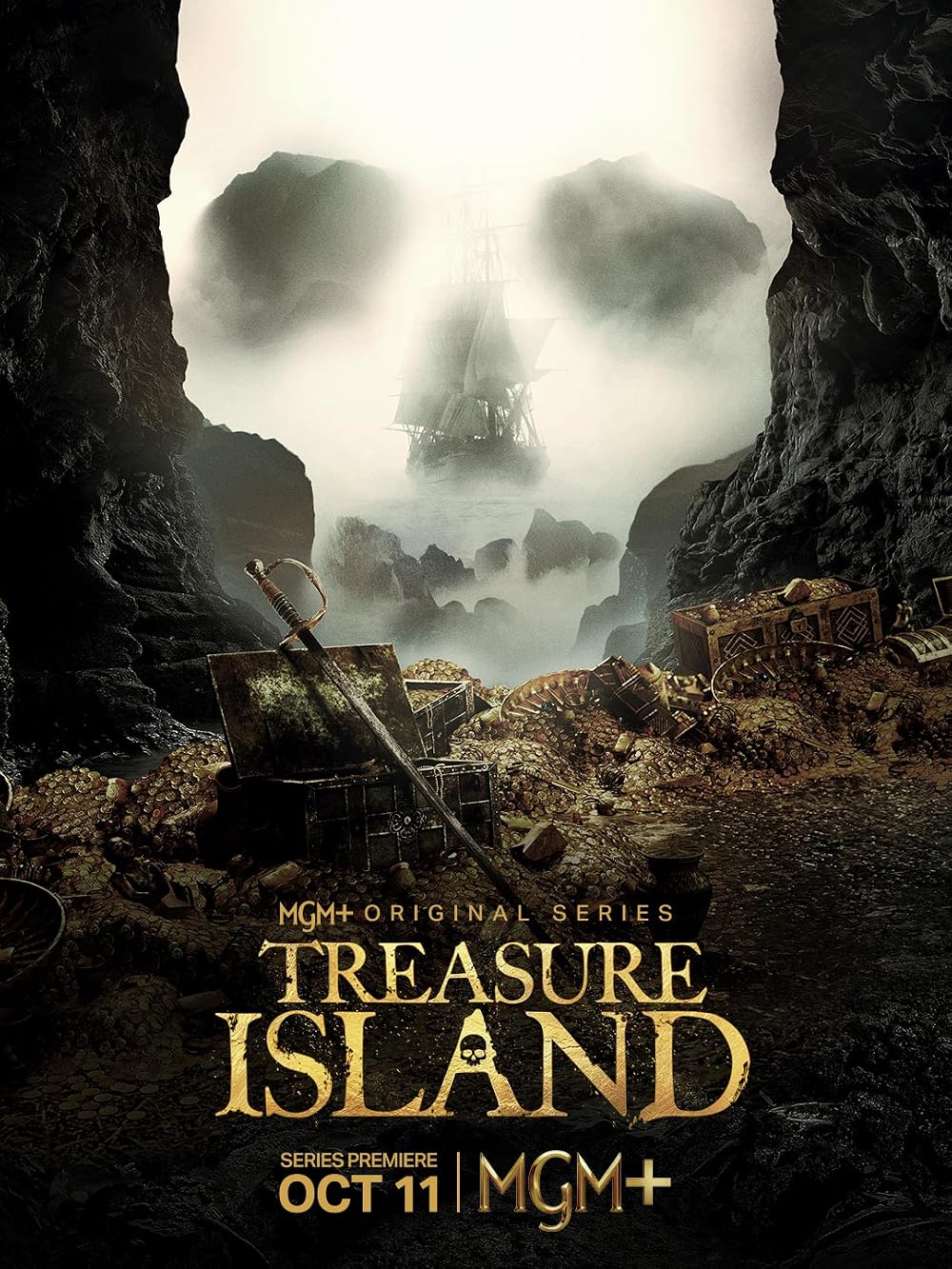


One has never read Robert Louis Stevenson’s “Treasure Island” and thought, “Perhaps Jim Hawkins’ arc would’ve been more enticing if his widowed mom was on Captain Smollett’s ship with him.” Nor thought a story involving Skeleton Island would’ve been better if it adhered to late-18th-century historical accuracy, or wanted the adventurous soulfulness replaced by an overly gritty tone that obnoxiously proclaims, “This isn’t your grandad’s ‘Treasure Island,’” stretched to a six-hour adaptation. Yet the MGM+ series does all of the above, creating an alienating, dull, washed‑up‑on‑arrival adaptation that never seems to justify its existence.
Everyone and their mother knows “Treasure Island,” but the “reinvention” from showrunner Robert Murphy throws widow Bess Hawkins (Hayley Atwell) into the forefront. In their run-down inn, she and her son Jim (Tom Sweet) exploit his superhuman photographic memory for profit, bidding patrons to go up against him and recite Bible scriptures verbatim in 10 seconds. Frenchman pirate Billy Bones (Tomer Capone, not dropping his “The Boys” French accent) washes up at their front door with Captain Flint’s map, and while Bess rehabilitates him, they share a heated romantic moment.
Peg-legged, parrot-wielding Jamaican pirate Long John Silver (David Oyelowo, in a thick accent) shows up in Cornwall himself. The three characters meet, and he kills Bones while searching for the treasure to avoid British custody.
With Flint’s map memorized in Jim’s noggin, Bess and Jim leave the inn and board Captain Smollett’s ship (Tristan Sturrock) bound for Bristol. The mother-son duo finds Silver back on the crew, both keeping the secret to themselves. However, a new adversary (and, for Bess, a new love interest) emerges in the dashing Aaron Graham (Jack Huston), a successful British spy and widower on a mission to locate the map.
As a reimagining, “Treasure Island” lacks creativity, starting with an unjustifiable reason for Bess’ inclusion. Atwell plays to her strengths, leaning into her spirited charisma, but the show shows little interest in Bess beyond her headstrong personality.
The show’s first half, which plays out the worst of Emerald Fennell’s writing instincts, focuses on her starting anew at sea. She engages in swashbuckling action as she duels Spanish pirates and finds new romance at sea. By contrast, the story “Treasure Island” gets pushed to the back seat.
While Bess is getting her groove back—as if Murphy is singing, “Jim Hawkins’ mom has got it going on. Jimmy, can’t you see you’re not Treasure Island to me?”—poor young Hawkins is relegated to being a non-character. He is nothing more than a MacGuffin, if not a Mama’s boy with little personality. For such a short miniseries, the sense of seafaring adventure barely leaves harbor. Even the handful of action sequences, pushed to their grittiest lengths, are dull, sloppily crafted, and shot, with awful CG blood spurts that cheapen the already drab production quality.
But don’t get me wrong: a bait-and-switch midpoint turn finally lets Jim breathe, and, in lieu of that, “Treasure Island” finally feels honest to its source and slightly engaging. It lays the groundwork for Young Hawkins’ gradual ascent to self-actualization and confidence, and Tom Sweet’s portrayal of his transformation is commendable.
Given the focus on the real-world historical ramifications, the complex relationship between him and Silver, Mr. Graham’s discovery of a new life for them, and his liberation through the treasure all carry nuance. Even in her absence, Bess still significantly influences his coming-of-age arc. Jim’s emotional attachment to her erodes his arc, though it also establishes his distrust of both Graham and Silver. Murphy does little to characterize Jim before his ability (everyone says, “He’s Jim Hawkins; he knows everything”), and when it does, it hinges on you recognizing the “Treasure Island” narrative and then putting in the work to emotionally gravitate toward him.
Oyelowo’s performance is what holds the ship together, though. Proving there’s never been a bad Silver portrayal, Oyelowo deploys his formidable charisma and thunderous voice to serve as an intimidating wild card. His expressive Jamaican accent, which occasionally gets laid thick, shows Silver’s depth, particularly in his relationship and charming chemistry with Sweet’s Hawkins.
The miniseries draws on real historical events from the Jamaican slave trade and the French Revolution, but it paints them in broad strokes, more as window dressing than as investigation, and forces them into the story instead of weaving them in naturally. If you were to make Long John Silver a Black man, then do more than have their white characters acknowledge his pursuit of freedom in proximity to their privilege. Silver is the granddaddy of pirates who pillage and steal for the love of the game, and that’s why he’s so fun. There’s no real enjoyment in seeing Silver racially targeted throughout any wrongdoings on the ship given his race.
Unlike “Muppet Treasure Island,” “Treasure Planet,” or “Black Sails,” MGM’s “Treasure Island” fails to balance innovation with respect for the beloved source for a clear demographic. By stretching the classic story as thin as a pirate’s blade and focusing on the wrong details—minimizing essential characters and adding contrivances—it isn’t enough to keep even the most devoted fans sailing along. Frankly, it misses the X that marks the spot.