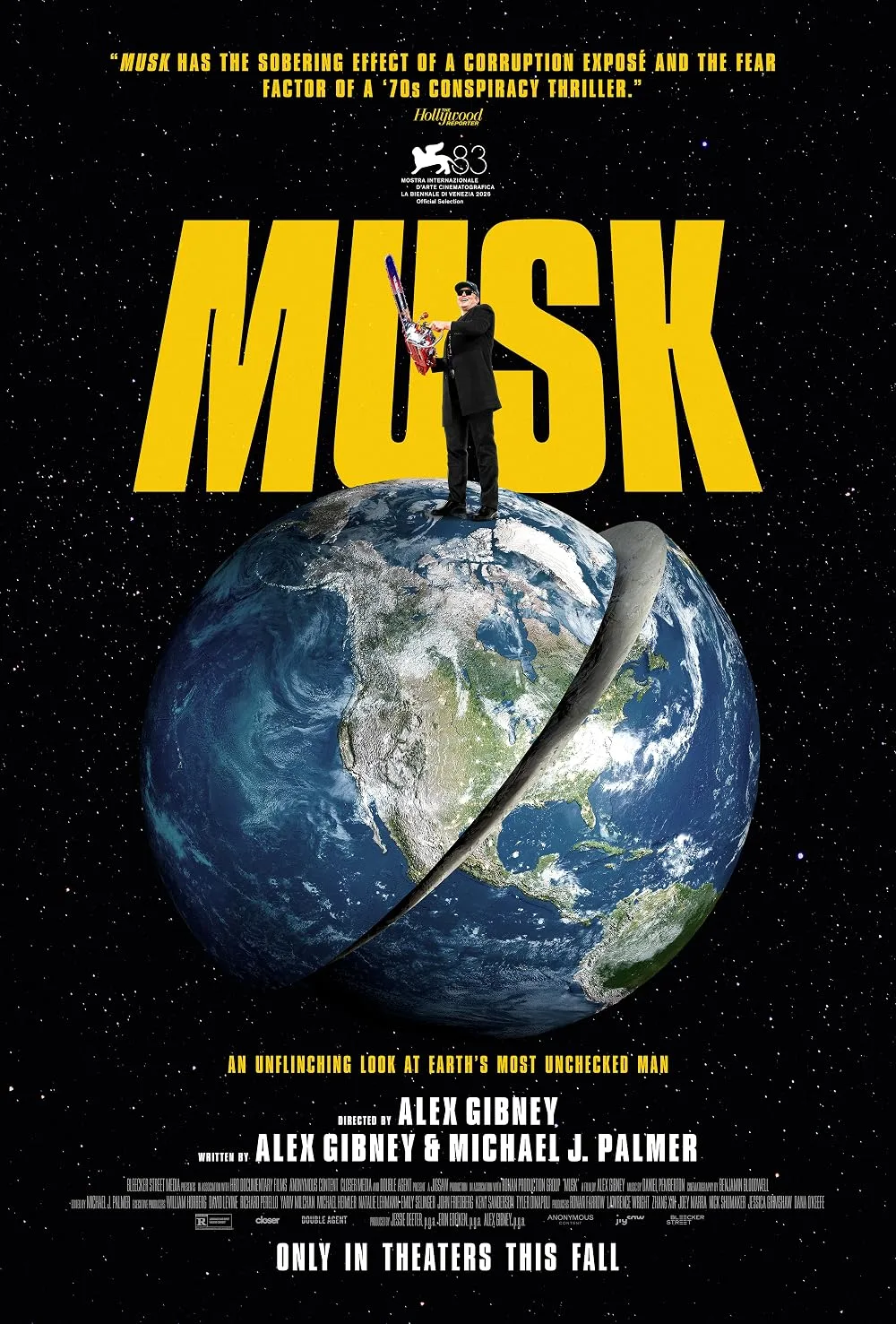

Oscar-winner Alex Gibney’s 4-hour documentary about Elon Musk may be the most important film of the year. After the first two hours, audiences will learn that he is better at engineering everything around him to suit his ego and his bank account than he is at engineering his many products. We see the damage he has inflicted, including horrific dash-cam footage of fatal accidents involving self-driving cars. Many who watch it will be rattled but consider it as remote if they don’t buy a Tesla or have stock in SpaceX.
The second two hours are when it gets really scary, because that is when audiences learn how he affects every one of our lives, in the United States and throughout the world. Gibney asks, “How could Musk assume so much power and why had we given it to him?”
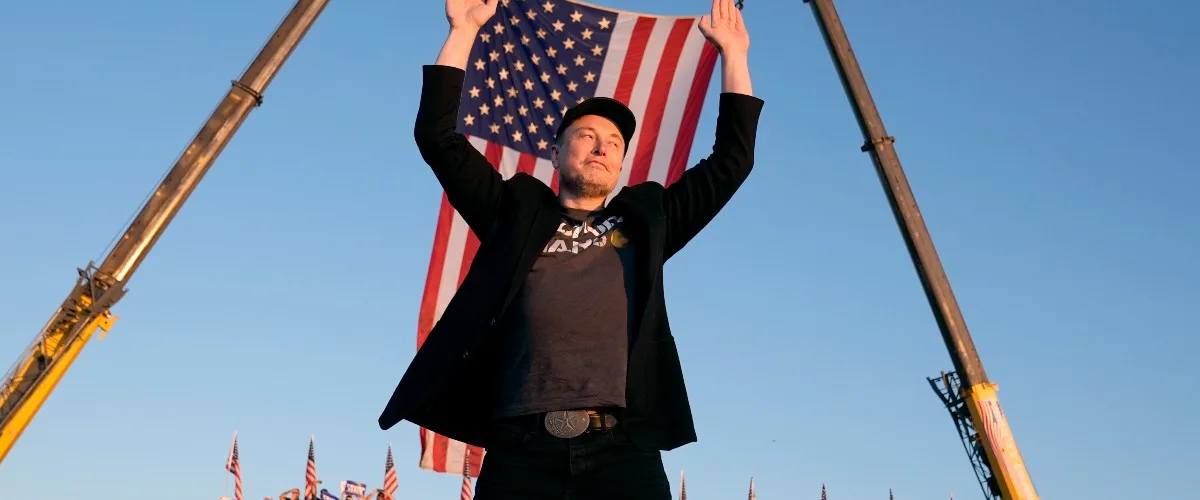
Probably the film’s most controversial choice is Gibney’s use of a digital avatar for the title character. Musk declined to be interviewed, so Gibney created an AI image to “speak” words from Musk’s actual statements and interviews. Perhaps intentionally, the avatar is on the edge of the uncanny valley, the head a bit large, the movements a bit stiff, fitting for someone who speculates on the “very high probability” that we may all be in some sort of “Matrix”-like simulation of reality or that he could “bend the laws of reality.” As we watch the archival footage, the artificial version increasingly blends in.
The archival footage is skillfully assembled, with telling juxtapositions and illuminating patterns. The most chilling is the footage of Musk’s South African father, who coolly tells the story of the time he shot and killed three Black intruders, describing the different shades of red in the blood that streamed out of them.
The new interviews with people who know Musk well provide significant context, with especially valuable contributions from tech expert Kara Swisher, columnist Cory Doctorow, and WIRED editor Katie Drummond. Former US Ambassador to the UN Samantha Power adds heart-wrenching details about the impact of the DOGE shutdown of USAID.
We hear about Musk’s early years in business, with his first success a software-turned-early internet business founded in 1995. Musk invested $2,000, and the business was sold in 1999, netting him $22 million. We get a sense of his family life from his first wife, Justine, who says she learned the term “gaslighting” from being married to him. Justine is the mother of six of Musk’s children. In 2002, their first child, Nevada, died in infancy. Twenty years later, Musk tweeted in reference to banning Alex Jones, “My firstborn child died in my arms. I felt his last heartbeat. I have no mercy for anyone who would use the deaths of children for gain, politics or fame.”
Yet in this very statement, he was using the death of his own child to make a point. Justine responded to Musk about Nevada’s death, also on Twitter: “not that it matters to anyone except me, because it is one of the most sacred and defining moments of my life, but I was the one who was holding him.” What we might call “stolen valor,” insisting on credit he did not earn, is shown repeatedly through the documentary.
Justine is also the mother of Musk’s daughter Vivian Wilson, who cut ties with her father because he refused to accept her gender transition. Viewers of this film may consider Nevada’s death and Vivian’s transition as significant factors in their father’s radicalization. More recent information is from the estranged mother of one of his more recent children, influencer Ashley St. Clair, who he met by reaching out on then-named Twitter.
We see him carting a toddler, named (like his social media site) X, around Trump campaign and transition events, barely interacting with him and showing no special concern about how the child feels being carried around so many meetings. This is his son with pop star Grimes, who shared her frustration—on X—about not being told ahead of time that their child was going to the White House.
We see harrowing footage of fatal accidents caused by Tesla self-driving cars, and even more harrowing comments from Tesla staff about faking the cars’ performance in a widely circulated promotional video. (For more on this, see Hubris Maximus: The Shattering of Elon Musk by Faiz Siddiqui.) Aside from a NASA representative, who acknowledges SpaceX’s failed launch but insists they saved the agency millions of dollars, the people in the documentary who worked with and for Musk say he over-promises and under-delivers.
We hear from Martin Eberhard, the founder and first CEO of Tesla. Musk became an investor and then took over. Eberhard tells us that it wasn’t enough for Musk to become CEO; he insisted on rewriting history to dub himself the founder. Similarly, we learn that Musk wanted to “look like an engineer.” He is not an engineer, but he is an effective shaper of his own reputation, bank account, and bio-dynasty (now at least 14 children with four mothers, many living on a compound he built).
In the second half of the documentary, we see how extensively Musk has engineered his way into every aspect of American and almost every aspect of global affairs. When he changed the domicile of Tesla from Delaware to Texas following two adverse court decisions from the almost-always “let CEOs do whatever they want” second-smallest state to Texas, one expert notes, “he didn’t move to Texas; he colonized it.” He got Texas to change its laws to make Tesla almost impenetrable to market or government oversight. And Musk’s various companies are so interconnected with each other and the technology so embedded throughout the world that it is almost impossible to monitor, much less control them.
And then, “Trump had the power to keep Musk in money, and Musk had the money to keep Trump in power.” Most people know about Musk’s stewardship of the DOGE project (named after his favorite cyber-coin) in the first few months of the second Trump administration. Some may know it promised to save the government $2 trillion, but it claimed only $215 billion in savings, and independent external audits have challenged that number, finding that the DOGE cuts actually cost more than they saved.
What may be new to audiences is the connection between the specific government departments DOGE targeted and pending government investigations into Musk companies. Musk was able to thwart them all through DOGE cuts. He also used DOGE to access information on individuals via the IRS and other agencies (see Blockers: Rebels in the Deep State by Michael Lewis).
The devastating throughline that dominates every chapter of this story is Musk engineering whatever benefits his ego and his net worth, not just intertwined but essentially the same thing. Musk’s operations are also intertwined with just about every aspect of our lives. The Pentagon is now using Musk’s Grok as its AI, and Musk is one of three advisors overseeing its “future of warfare” initiative. Maybe Musk is joking when he says we’re probably in a simulation. Or maybe it’s just what he tells himself to justify his inability to care about the damage he inflicts on others.