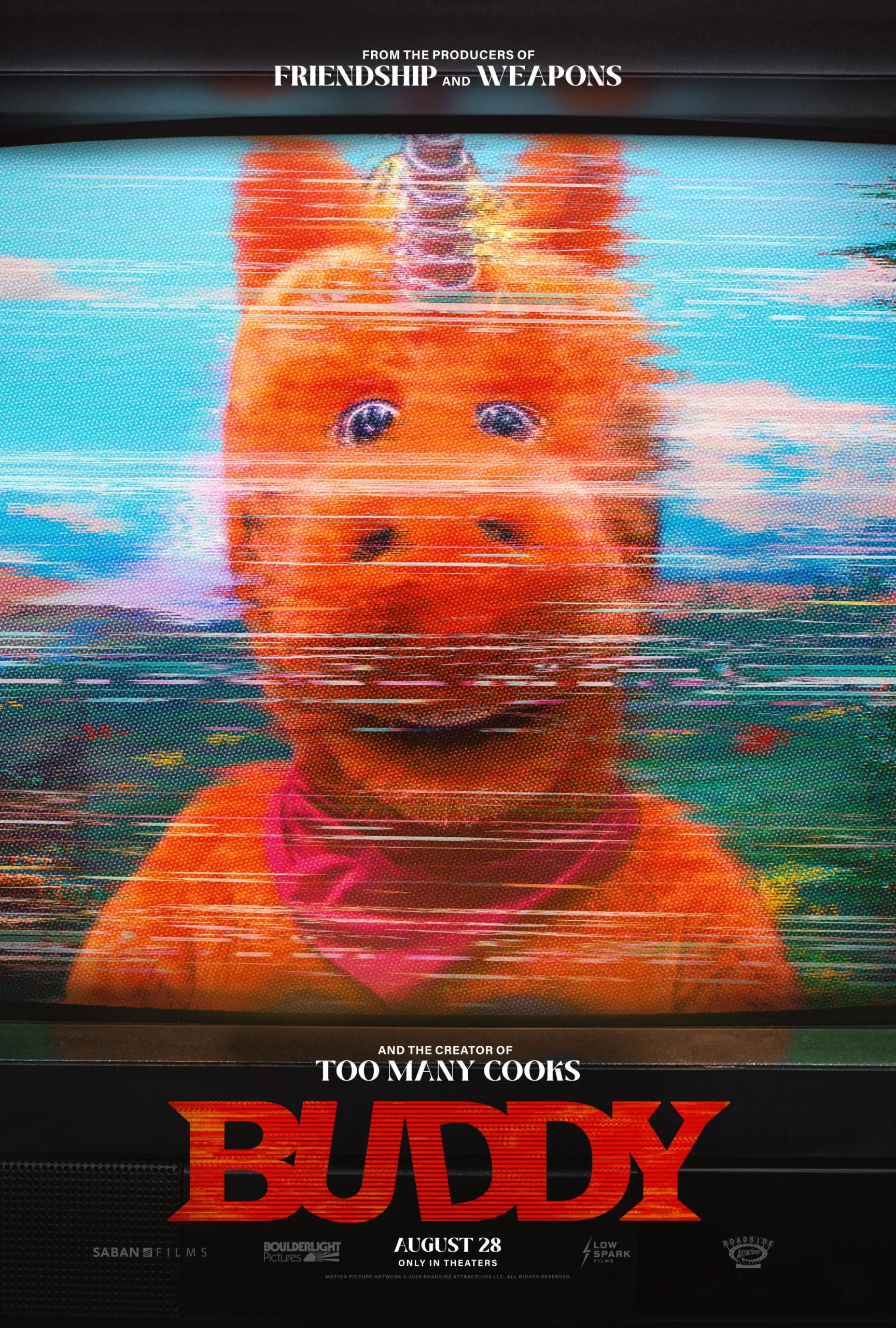
Most people growing up and coming of age across the ‘80s and ‘90s have probably crossed paths with one of those oppressively happy children’s TV programs with plush animals, various cheery side characters, and a group of kids harmonizing and doing daily chores with a smile. Indeed, I’m chiefly talking about “Barney & Friends” and its purple dinosaur, and perhaps a little bit about “Sesame Street,” too. These are the shows that not only used to be daily staples of our after-school lives, but are also at the heart of the ingenious and sometimes laugh-out-loud funny horror-comedy “Buddy,” that gleefully spoofs them to brilliantly dark, blood-splattered ends.
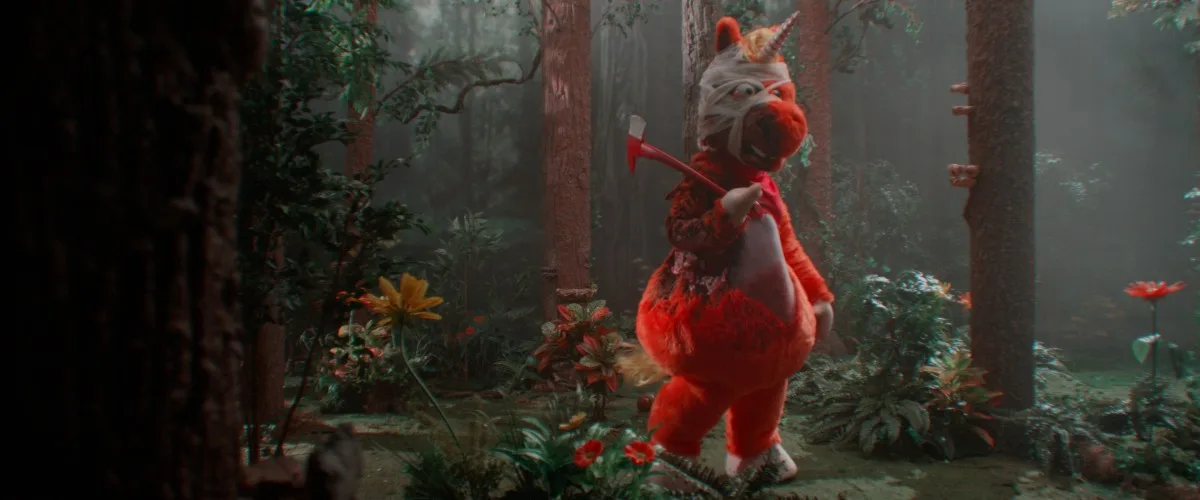
Trust Casper Kelly, the ingenious creator of the sensational “Too Many Cooks,” to see right through the uncanniness lurking underneath the inorganically happy sheen of these TV creations. In some ways, that is exactly what he did with “Too Many Cooks,” which was essentially an elongated spoof-intro modeled after the TV sitcoms of yore, where all characters are introduced in succession against an upbeat jingle, greeting the camera and viewers while they were pretend-caught in the middle of an awkward chore or moment. As “Too Many Cooks” went on and on, it turned darker and darker. That same logic very much applies to “Buddy”—thankfully, neither Kelly nor his co-writer Jamie King are concerned with whether they’re pushing the insensitivity envelope a bit too much, or offending anyone with the mounting dose of gore on the screen. Their Buddy (with suit-wearing and voice duties shared by Sergey Zhuravsky and Keegan-Michael Key), the orange unicorn star of the Buddy show, is bloody annoying, even tyrannical. And he must be brought down by any means necessary.
At first, though, you are supposed to just love Buddy, as the show’s jingle with the lyrics “You love Buddy, yes you do!” sang to the tune of “Twinkle, Twinkle, Little Star,” would like to remind you. (Yes, that is as hilariously creepy as it sounds.) And the kids, the mailbox, the mailman, the nurse, the train, and so on of the show are supposed to love him too, if how often they recite these lyrics and others in unison is any indication. The children are played by Delaney Quinn, Caleb Williams, Luke Speakman, Madison Skyy Polan, and Tristan Borders, all of whom are excellent. Other characters include the voices of Bennie Taylor, Patton Oswalt, Phuong Kubacki, Jimmica Collins, and Cedwan Hooks.
With enough late-twentieth-century TV grain, a truly believable set design in vivid colors, and an accurate aspect ratio for the era, Kelly first shows us the day-to-day of the Buddy show, running smoothly as everyone listens to Buddy’s shallow wisdom and overbearing instructions. He delivers them so politely that he often sounds like a grotesque white-collar corporate boss who seems genuinely happy about power-tripping through the lame job that he has. It’s of course all fun and games when Buddy gets it his way. But when one of the kids, the poor Josh (Speakman), says he doesn’t feel like joining in, oh boy!
This first “Squid Games”-style elimination doesn’t happen on camera, but be warned that Josh’s unfortunate fate will be shared amongst whoever dares to challenge Buddy’s unreasonable demands. It can’t be overstated how accomplished the child actors are, especially once their characters start to suspect Buddy’s true colors beneath his ugly orange fur. (One wonders whether orange was an intentionally political color choice here to portray a totalitarian monster with some real-world reference.)
The young cast act at an impossible intersection of a TV show that demands artificial emotions and real-life fears such as death, abandonment, and loneliness. Their suspicions soon send them off on a “Wizard of Oz”-adjacent journey across an enchanted forest where they have to find a way out and fend for their lives.
Elsewhere, we meet a family in the real world (the parents, Ben and Grace, are played by Topher Grace and Cristin Milioti), and they seem to be missing a child that they don’t remember. But Grace has a suspicion, an inkling that they once had another child in their home. Could it be Buddy who stole her during an occurrence that wouldn’t be out of place in “Poltergeist”?
It all comes together more seamlessly than you can imagine, while “Buddy” remains committed to its outrageous bit by dialing up the violence and carnage to both squeamish and uproarious effect across Buddy’s monstrous transformations and painful injuries. It’s a trippy, ballsy, and genuinely entertaining package that shouldn’t work at all. But it does, and I can’t believe it exists.