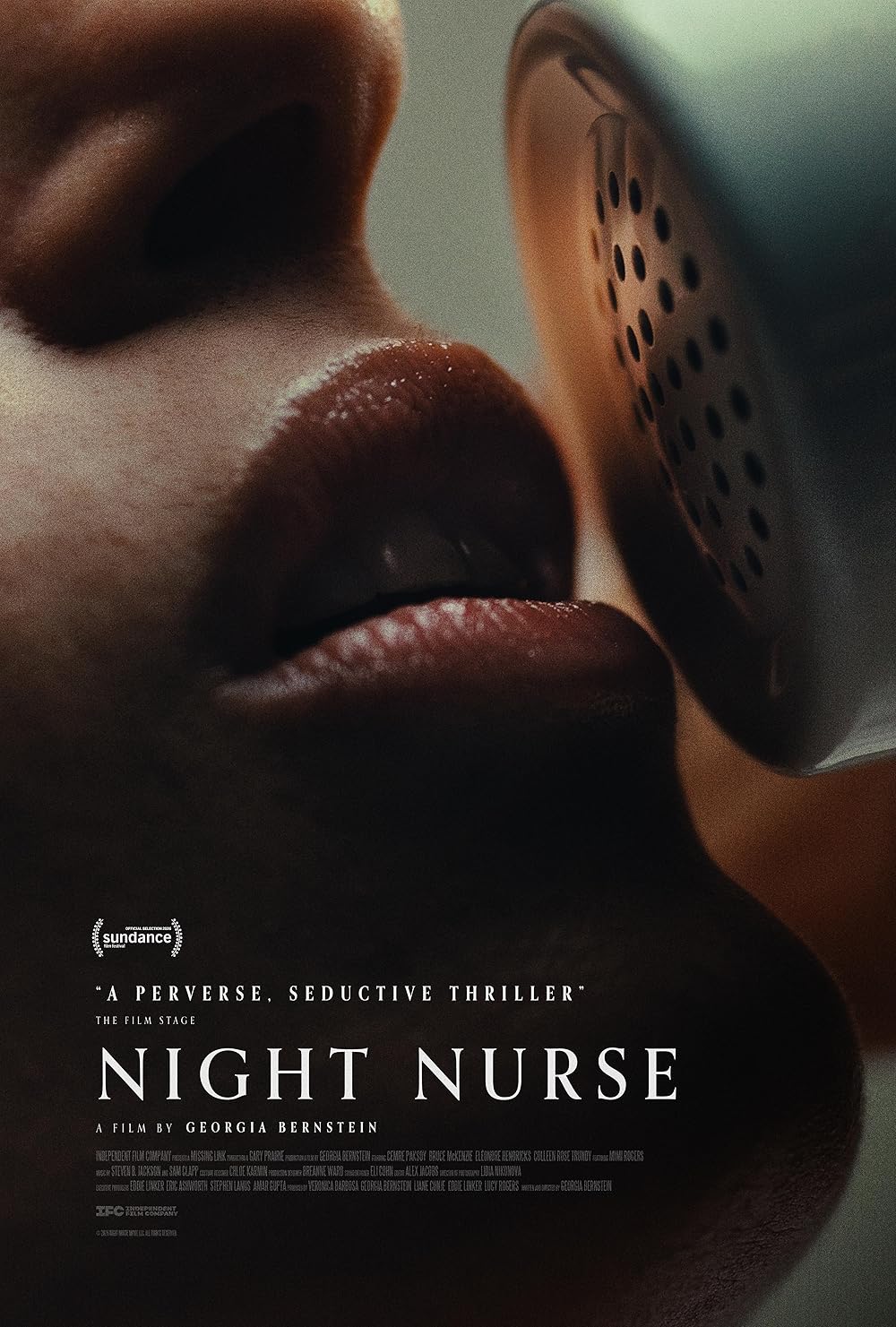
“Night Nurse,” about a senior citizen in a luxury elder-care facility and the nurses he enlists in a scam, is a dreamy, sinister, yet strangely tender movie. Its style is part film noir, part super-stylish arthouse psychological drama (picture something along the lines of “sex, lies, and videotape”). Written and directed by Georgia Bernstein, it takes its sweet time telling a slight story. The slightness doesn’t seem to bother the actors or filmmakers even a little bit, and Bernstein often gives herself permission to luxuriate in a moment or image rather than push the plot along.
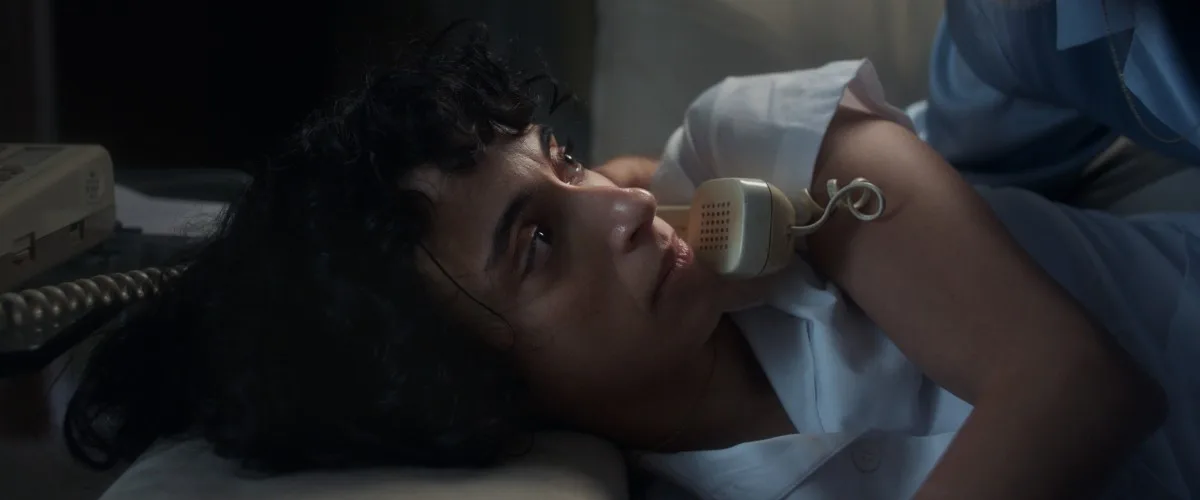
“Night Nurse” jumps into its premise immediately, introducing the heroine, Eleni Sadik (Cemre Paksoy) as she participates in a phone scam in which the scammer calls senior citizens pretending to be a grandchild in trouble with the police, and begs them to wire money to pay a nonexistent bail bond. While credits appear and fade, the camera crawls all over Elini’s body, following the path of a spirally, absurdly long phone cord wrapped around her like a string of lights on a Christmas tree. An older man is wrapped around Elini. We can’t see his face, but we can hear his voice. He softly speaks every line in the scam’s script, then Eleni repeats it into the phone receiver. They are as close as lovers in a post-coital embrace, but fully clothed and vertical.
Then we follow Eleni on her first day as a nurse at the elder care facility. The sequence starts with nurses in bathing suits escorting seniors around the shallow end of a swimming pool as Eleni watches from a glassed-in observation area. One of the seniors is a scruffy but handsome man wearing sunglasses and smoking a cigarette, not normal behavior at an indoor pool. (Details like the landlines, the absence of cell phones, and the plentiful indoor cigarette smoking suggest that “Night Nurse” is set in a nonspecific past.) Bernstein and cinematographer Lidia Nikonova concentrate on bodies and avoid faces. The men are well past retirement age. The nurses are decades younger. They suggest elderly sugar daddies and the mistresses they’ll marry when their divorce is final.
Paksoy is a slim, wide-eyed, twenty-something woman with long, dark, wavy hair, and a face that Johannes Vermeer would have loved to paint. The way she plays Eleni makes the character seem intensely alert and empathetic but also withdrawn and skittish. Elini’s guide on her first day is Mona (Eleonore Hendricks), an experienced nurse who will become a key player in the story. She’s older, wiser, and tougher than Eleni. If this were a black-and-white film made a century earlier, she’d be a wisecracking dame who chewed gum all the time.
Mona has a special bond with the man who looked up at Elini from the pool. His name is Douglas (Bruce McKenzie). He was also the man we heard in the opening scene. He was preemptively committed after his chaotic behavior at home suggested he had early stage Alzheimer’s, but he hasn’t been officially diagnosed. He is shown taking a cognitive impairment test early in the story and (mostly) passing it. But the way McKenzie plays him, we aren’t sure how bad his condition is, or if he even has it.
What follows is a psychosexual character study with noir in its veins. The main plot might be new to cinema. We’ve seen lots of older characters getting scammed by much younger ones, but not a senior exploiting other seniors. Douglas is charismatic and, to some younger women, sexy, despite the age gap. He’s one of those men who can make others feel like he’s in charge even when he’s not. And he’s a silver-tongued devil. The character is performing all the time, playing many versions of himself. McKenzie handles the gradations so subtly that you don’t think about how hard it is for an actor to do this and not get caught acting.
In the wee hours of the morning, Douglas makes a move on Eleni in one of the facility’s kitchens. He strolls in with relaxed entitlement, as if he and Eleni are a couple sharing a flat. Then he puts her against a wall and talks to her as if she’s his plaything. Eleni doesn’t object. In fact, she’s thrilled, like a danger-seeker breaking a taboo she’s broken many times before. We may wonder whether she has what are colloquially referred to as “daddy issues,” and that’s why she wanted to work at a place full of daddies. She might also be a sexual abuse survivor. There are hints of all this and more. But they remain hints.
One thing’s for sure: Douglas knows how to get inside certain women’s minds. The wry, knowing way Douglas and Mona speak to each other suggests she’s doing more for him than delivering meals and medicine. In time, Douglas pulls more nurses into his web of deceit. This makes Eleni jealous, but not jealous enough to quit. There’s a tour-de-force scene where Douglas entertains a roomful of nurses with an activity I won’t mention here because it’s so clever yet logical. The dynamics in the room feel cult-like, with Douglas as the patriarchal figurehead and the nurses as his harem. (Is Douglas named after Michael Douglas, who became a star playing ruthless, lustful, ethically challenged men?)
Bernstein directs her actors to knockout performances, and guides her crew into perfecting a clean, minimalist, hypnotic style. The use of picture, sound, and music creates a vibe that evokes film noir in color and those jagged, sexually explicit French dramas from the ’90s and early aughts—the kind where the director parked the camera on characters descending to the lower depths of life and stayed on them until the scene started to feel like pornography of one kind or another.
“Night Nurse” is an indie with a tiny budget. The only performer of note is Mimi Rogers, who has a small role as the director of the home. But it feels big because the actors are confident and the production is ingenious. Bernstein faked an elder care facility inside and outside of her grandmother’s house. There’s a scene in a hospital room that’s one static shot, with no establishing shot of the hospital’s exterior or even a glimpse of the hallway outside. For all we know, we could be looking at a rented hospital bed and medical equipment arranged against a sickly green wall, yet our brain reads the setting as “hospital room.” I’m not sure if a police car that shows up at the facility is an actual police car or if Bernstein conveyed the idea of “a police car” by showing the vehicle in fragmented closeups lit by flashing blue and red lights. The jazz score by Steven Jackson and Sam Clapp adds so much to the movie that it should be considered the final draft of the script. It complements Elina’s pliability and Douglas’ unknowability and adds layers of elegance and decadence. Parts of it recall neo-noir classics like “The Long Goodbye” and “Body Heat.”
If I were teaching a class on how to make a small film seem big, this would be on the syllabus. The camera never shows you anything except that which is essential to the story. You get just enough in the way of characterization and a sense of place to complete the movie in your mind. The dreamy tone and anywhere-yet-nowhere setting help in this regard. “Night Nurse” could be a dream of things that happened long ago.
The only major problem is that “Night Nurse” is told in a way that favors atmosphere and implied psychology over plot no matter what’s happening onscreen. This sometimes results in scenes that are compelling but not dazzling enough to justify their length. There are times when the movie seems like it’s vamping to hold your attention until something important happens. Late in the film, the hands of fate close into fists and break this world apart, but “Night Nurse” maintains its opium-den vibe, and continues to drift when it ought to be speeding up. There are two, maybe three moments that would have made for a satisfying ending, but the movie drifts past them. Nevertheless, “Night Nurse” is worth seeing and savoring, not just for its achievements, but for the many bright futures it contains.