

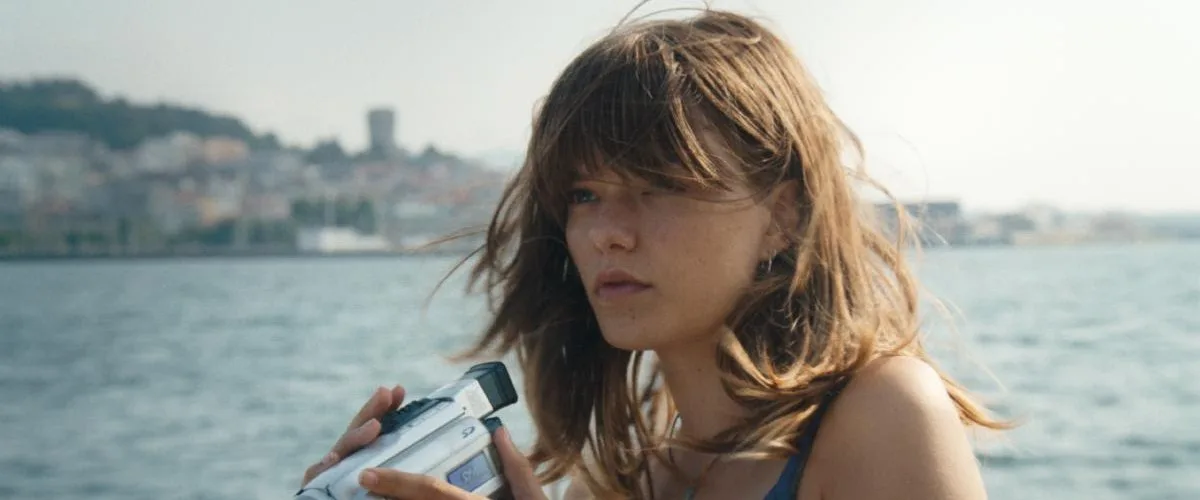
I have to confess that I am new to the work of director Carla Simón, so I haven’t seen her first feature, “Summer 1993,” which, like her new “Romería,” is a fictionalized autobiographical narrative. While “Summer” was from the perspective of a young girl, “Romería” deals with adolescence, a time when learning is, to a certain degree, displaced by yearning. (Simón’s second feature, “Alcarràs,” took a turn away from the strictly personal, taking a family of Catalonian farmers as its subject, and Simón learned the Catalan dialect to make the film, using non-actors.) In the case of Marina, the 18-year-old played by Llúcia Garcia, the yearning is for identity. Raised by her aunt and uncle for reasons somewhat obscure to her, Marina has made a pilgrimage to the Spanish port city of Vigo in search of answers about her biological parents.
She has an uncle in the vicinity, Lois, who spends much of his time with his own family on a grand houseboat, and he invites Marina to stay with him there. He is an open-hearted sort, and he parcels out information about her parents to her. That information is contradicted by other relatives living on the land. And the confusion deepens as her inquiries are met with suspicion and hostility. Aunt Olalla sews a beautiful red dress for Marina, but then apparently tells other family members to keep their distance from her because of something like bad blood. One of her hipper uncles, with the intriguing name of Iago, is more overtly sympathetic. Eventually, Marina learns that her father did not die when she was just a baby, as she had thought, but rather passed away when she was five. This rattles her; why does she have no memories of him? Why did he avoid her, seemingly?
As she continues to ponder and prod, Marina spends more and more time with Nuno, one of Lois’s sons. And she begins to rebel. Put off by her grandfather’s pushing of an envelope full of cash toward her, she tosses a bag full of leaves into their swimming pool. The movie takes on a magical-realist direction when Marina follows a stray cat to a particular doorway, then to the pier, where she finds a rowboat, gets in, and starts rowing out into the sea. When it becomes daylight, Marina rows to the side of a big ship, climbs its rope ladder up to the deck, and learns a great deal about who she is and where she came from.
Simón’s directorial confidence and facility are such that the viewer believes every turn that the story takes, and so what’s real, what’s imagined, what’s hallucinated all have an equal weight—all the pieces of Marina’s life that she has been aching to learn come together in these different forms, all of which are crucial to her understanding and her ability to forgive.
By the end of this splendid, sometimes languorous, sometimes heartbreaking picture, we learn that Marina’s search has not just a purpose of the heart but a pragmatic side. With definitive verification of her lineage, she may now apply for the university grants she’s seeking. The near-indignation with which she rejected her grandfather’s envelope full of cash makes more sense now; she recognized it as a kind of bribe, a payoff that might compel her to give up her investigations. The movie’s title, “Romería,” means “pilgrimage,” specifically a religious or spiritual one; Simón is suggesting that the search for self can indeed fall into that category. In any event, this is a pilgrimage well worth taking for film lovers.