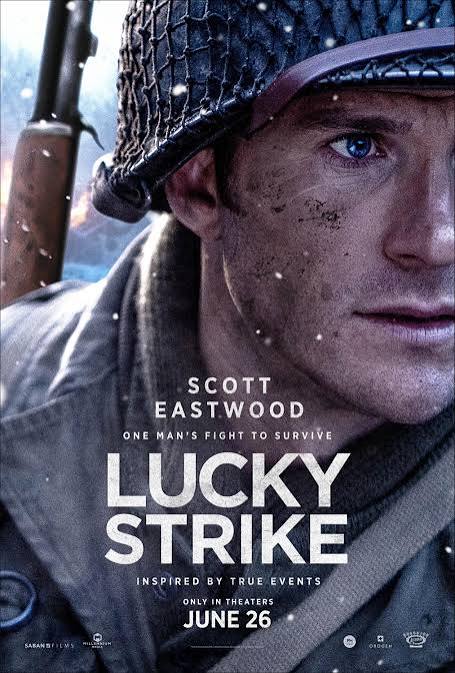


“Lucky Strike,” a mind-numbingly inert, hyper-patriotic war film, makes little sense and gives even less reason for its existence. It begins, oddly, in greyscale, following a group of Black soldiers driving a truck through the Ardennes Forest in December 1944, in the midst of the Battle of the Bulge. Evans (Reomy D. Mpeho) and his First Sergeant (Kwame Patterson), two Black soldiers in the truck’s front seats, share their angst about the seemingly endless conflict. Lest we think this film will concern their story, however, German soldiers show up to gun them down. The film just as abruptly re-centers on Colonel John Castle (Scott Eastwood), a white man working for Galvin Industries, who appears at Mrs. Caldwell’s (Aunjanue Ellis-Taylor) door to discuss her unpaid benefits.
Normally, you would assume that I just explained to you what “Lucky Strike” is actually about. You’d be wrong. This film loves to pull the rug out from under you. Except the rug it’s taking away is often significantly more intriguing than the one it leaves behind. Because once you think “Lucky Strike” will directly follow Mrs. Caldwell—it concerns her in the most nauseatingly propagandist yet tangential way—we fade back into 1944 at the Charlie Company headquarters for the 324th Engineering Battalion in Krinkelt, Belgium. This time, we’re in color (somebody will have to explain why the Black soldiers at the beginning needed to be in grey scale), and Castle is a Captain. He and his unit are being dispatched by Colonel Neale (Colin Hanks) to bomb a road that’s being heavily used by the 1st SS Panzer Division.
“Lucky Strike,” which is inspired by a true story, carries out the mission in a predictable manner: Castle’s entire unit is wiped out, leaving him alone behind enemy lines to make his way to a rendezvous point to be rescued. His wanderings across a murky, desolate landscape—vistas that are rendered as flatly as cold dew—lack momentum, interest, and curiosity. Instead, director Rod Davis Lurie—the filmmaker behind “The Last Castle” and “The Outpost”—offers a lackluster, creaky propaganda picture that recalls several 1940s B-movies used to inspire people to buy war bonds.
Lurie’s cause isn’t helped by having an uncharismatic Eastwood as his “everyman” lead. The Hollywood scion previously starred in the director’s Afghanistan War film “The Outpost,” with greater success, mostly because he had other actors (Orlando Bloom and Caleb Landry Jones) there to shoulder the load. Here, as the true lead, he struggles to give an underwritten character so much-needed definition. We only learn a few basic facts about Castle: he’s a father and husband with an engineering background who can be quite resourceful when the situation demands it—and that’s about it. Certainly, an “everyman” should be a person common enough to be relatable to all viewers. But it doesn’t mean they should lack specificity (show me a James Stewart movie where you don’t know everything about his character).
The same can be said about the film’s many lifeless set pieces. Each moment, from Castle taking shelter with farmers to playing dead under the feet of Nazis, does little to advance the story or one’s perception of Castle. Instead, they appear to be an excuse to rack up a grisly body count and to act as landmarks on Castle’s road to home. Worst of all, these sequences aren’t intriguingly shot; they’re weighed down by blurred CGI bullets, uncommitted POVs, and loud blocking and editing. There isn’t a single killing you don’t see coming from a mile away or a single death that incites a reaction on the part of the viewer. Outside of frustration, Castle shows almost no emotion. And the people he meets along the way rarely stick around long enough to inspire any further personal revelations from him. We’re instead stuck watching Castle on an endless loop of mowing down Germans—who are merely violent and tricky—and receiving flippant calls on his trusty radio.
That last component, a portable radio named “Lassie,” which serves as Castle’s lifeline, has larger implications in this movie. But those reasons arrive so late, with Lurie pulling another rug out from under us, that they miss their symbolic mark. One ultimately wonders why “Lucky Strike” wasn’t actually about the topic in question. Instead, Lurie ends with a hacky final shot that transitions into a slideshow featuring photos of real World War II soldiers set to the song “Show Mercy to the Hero.” The tune, performed by Calman Hart, is such a sappy, hyper-patriotic track that the credits might as well have ended with information about how to sign up for the army—a course you can certainly pursue without enduring “Lucky Strike.”