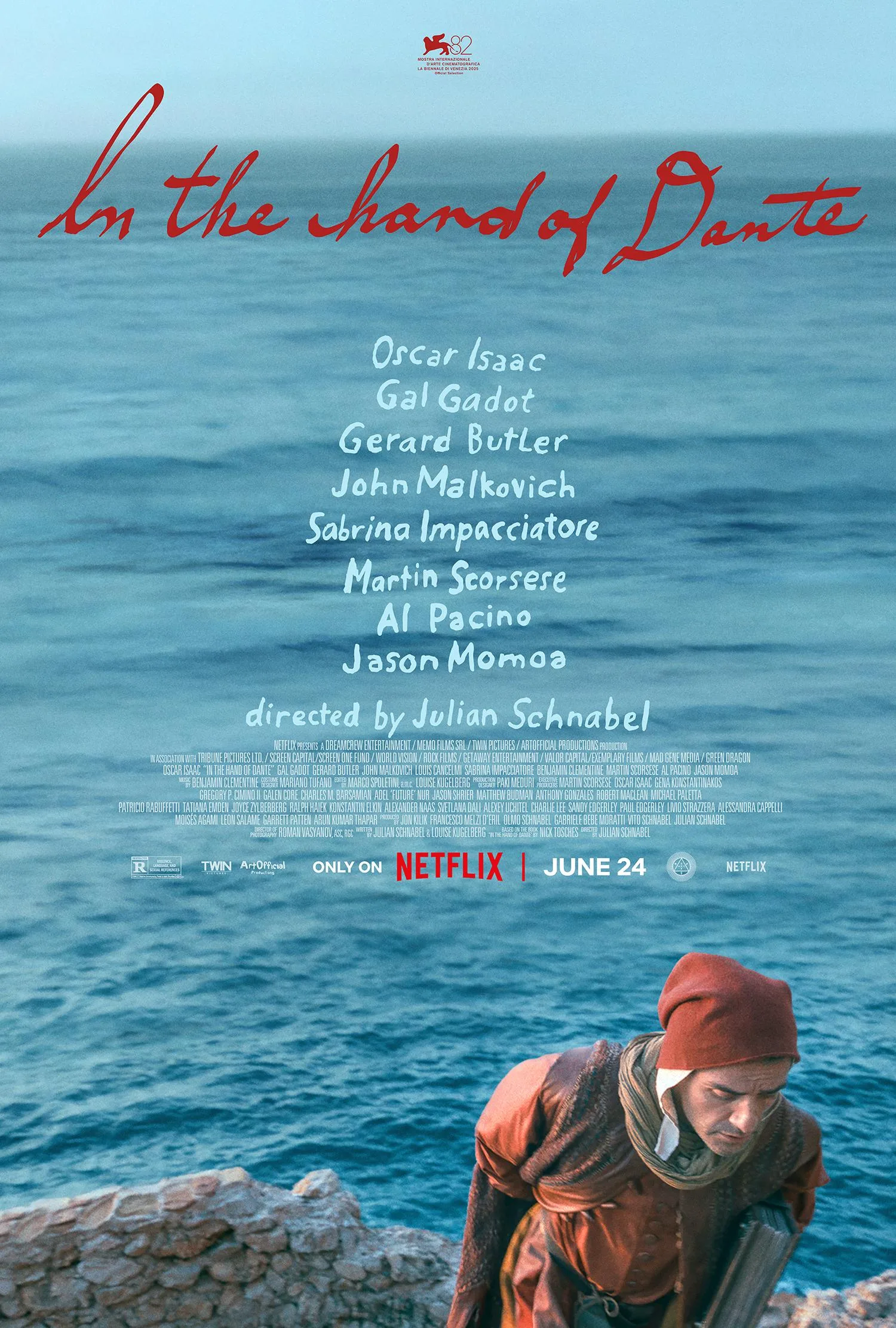

Reports out of Venice last year called Julian Schnabel’s “In the Hand of Dante,” this year’s “Megalopolis.” Much like Francis Ford Coppola’s divisive epic, this movie feels like it sprang from the pretentious id of its creator, the undeniably impressive director of works like “Basquiat” and “The Diving Bell and the Butterfly.” And much like “Megalopolis,” there’s the sense that only the filmmaker fully understands what in Dante’s fiery Hell all of this is supposed to mean.
Alternately riveting and dull as dirt, “In the Hand of Dante” has an insane ensemble—there’s a familiar face around every corner—but it’s a near certainty that most of them couldn’t explain it either, with the possible exception of the always-nimble Oscar Isaac. Schnabel’s vision starts with incredible promise—and gorgeous cinematography—before coming apart at its well-tailored seams, meandering through its many ideas with a near-refusal to connect them as it approaches a violent climax that centers on its worst, least-interesting characters. Still, if someone told me they loved this ambitious nonsense, I’d get it. It’s that kind of movie.
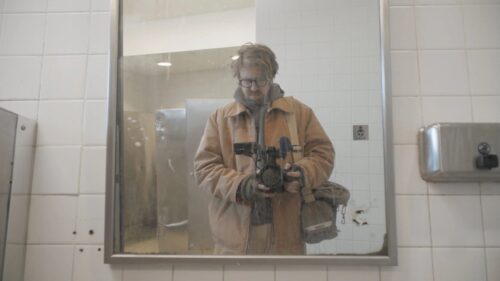
Based on the 2002 novel of the same name by Nick Tosches, “In the Hand of Dante” follows two tracks. In a black-and-white time period closer to today, Tosches himself (Isaac) ends up under the thumb of a vicious mobster named Louie (Gerard Butler) and his boss Joe Black (John Malkovich) when he’s tasked with confirming that a very valuable edition of Dante’s The Divine Comedy is genuine. In widescreen black-and-white, Tosches and Louie travel through a bizarre underground in New York before meeting with experts in Italy, eventually trying to retrieve the manuscript from the Vatican itself, while others try to beat them to it.
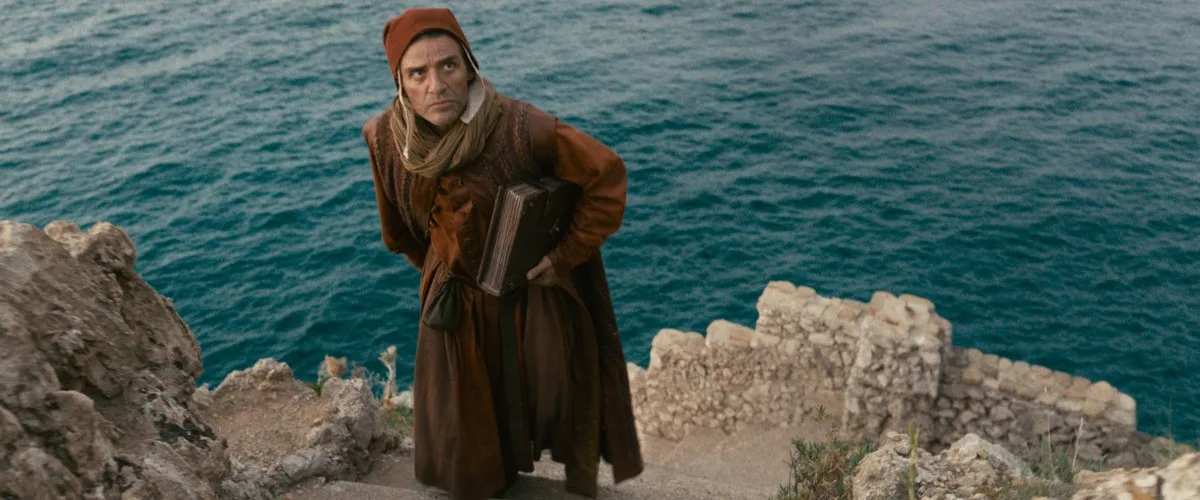
Meanwhile, Schnabel and co-writer Louise Kugelberg jump back in time to the 1400s, assigning the excellent cinematographer Roman Vasyanov (“Fury”) to bring Dante’s (also Isaac) quest for reason to life in vibrant color. As Tosches pushes through his own kind of inferno, one that also involves a past love named Giulietta (Gal Gadot) and a ridiculous caricature of a tough guy named Rosario (Jason Momoa), the film regularly shifts gears into a more poetic telling of the actual Dante’s quest, one that includes philosophical counsel from none other than Martin Scorsese as Dante’s mentor, Isaiah. Butler also plays Pope Boniface VIII, and Al Pacino cameos as Tosches’ uncle in an early flashback. Yeah, it’s both weird and impressive at the same time.
That sense of dueling eccentricity and pretension exists throughout “In the Hand of Dante,” giving the overlong film too many passages that could politely be called self-indulgent. In one scene, Butler’s Louie gets a long treatise about how he hates it when pretty women have to pick up the shit of their dogs. It’s followed by a punchline about how close the guy has gotten to necrophilia. There’s a fine line between character detail and something that should have been a deleted scene. “In the Hand of Dante” crosses that line way too many times before arriving at its multiple, graphic deaths that remind one that Schnabel and Tosches are trying to do their own thematic riff on both Divine Comedy and Inferno.
Despite its undeniable flaws, “In the Hand of Dante” admittedly asks and answers some interesting questions that could be enough for casual Netflix subscribers. Why is Dante’s time in color but Tosches in black and white? It’s likely a commentary on how the vibrance of the past gave way to the greed of the present. What is Schnabel saying about the intersecting forces of art, violence, and faith? After all, the film explicitly intertwines those two quintessential Italian institutions, the Vatican and the Mafia. It’s just one of its many half-baked ideas. Schnabel has a habit of pushing his project down interesting avenues only to take sharp right turns down distracting alleys. Finally, why is Gal Gadot still getting parts? There’s no real answer here, but the “Wonder Woman” star’s miscasting becomes one of the project’s most notable weaknesses. That is, until Momoa and an awful Sabrina Impacciatore try to one-up her in the awkward line-reading department.
While “In the Hand of Dante” never finds the consistency that eludes it, it is a film that sparks in individual beats. Scorsese’s turn as a world-wise mentor is a reminder that he could have been a fascinating actor if he had chosen to be. Butler chews the scenery in a very captivating way, as if he stepped off a “Den of Thieves” set into a period piece about “the veil of the inexpressible.” It’s intentionally incongruent in a way that can be captivating. And then there’s Oscar Isaac, an actor who’s always good and often great. He gives two lead performances in “Dante,” reminding viewers of his range and talent.
I said in my review of “Megalopolis” that readers should ignore the star rating and see it to make up their minds about what is undeniably a unique film-watching experience. I wouldn’t say that “In the Hand of Dante” is as essential as Coppola’s folly. But it has a similar WTF vibe, even if Schnabel likely didn’t have to spend as much of his own money as Francis. It’s another case of an artist swinging wildly through a sprawling vision that no one understands but him. Well, Scorsese probably gets it, too.