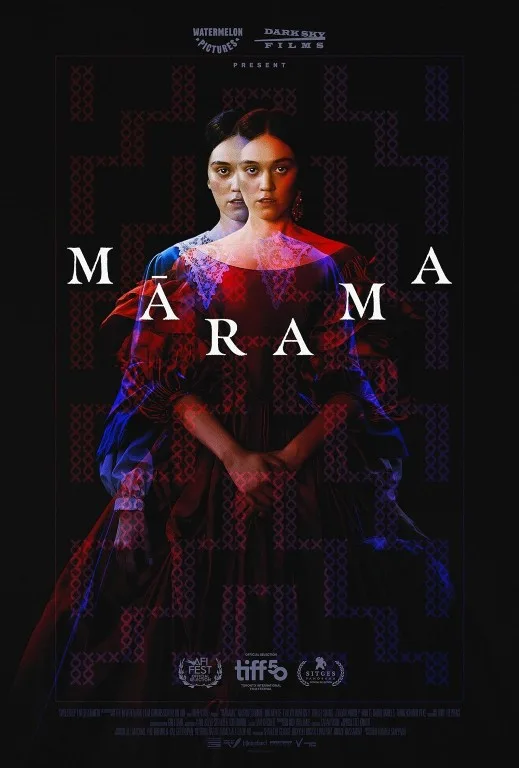

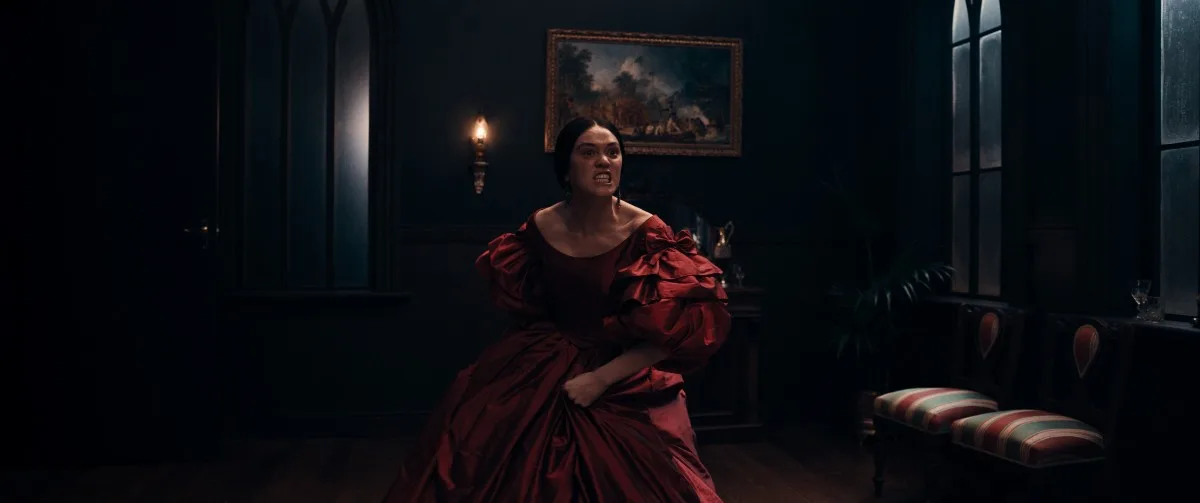
Under a crimson ballgown, typical of the Victorian era in style, Mary (Ariana Osborne) tries to conceal her rage and play along with the pageantry of the English aristocracy in 1859. The intensely colored garment, however, doesn’t cover the frame of a European woman, but a Māori body burning to rid itself of the lies she’s been fed. Mary is the central figure in the New Zealand gothic horror “Mārama,” the first feature from writer-director Taratoa Stappard, himself of Māori origin, which bargains in a tense atmosphere and a scorching lead performance. Stappard introduces Mary at the end of an arduous journey from Wellington in her home country to the English countryside. A letter from a man claiming to know the details of her troubled past compelled her to travel for weeks across the globe.
From the outset, the filmmaker offers glimpses of the horrors that Mary will slowly unveil. There’s an image of a bloodied woman, who looks just like Mary, trapped in what could be a prison cell or a hospital room. Is this her future? Her past? Something else? Nathaniel Cole (Toby Stephens), a wealthy man with an alarming obsession for Māori culture, welcomes her with open arms, insisting she become a governess for Anne (Evelyn Towersey), his 9-year-old granddaughter. It’s only when he reveals that the man who summoned her has passed away that May agrees to stay in hopes of learning more about her biological family’s history.
The horror doesn’t manifest in calculated jump scares nor malicious entities lurking in the dark crevices of Nathaniel’s large home, but as flash visions that possess Mary whenever she comes into contact with objects that carry the sorrows of the family members she never met or when she looks into an old mirror that once saw the reflection of her twin sister, Emilie (also Osborne), when she inhabited these same rooms.
At times, the recurrent flashbacks to the violence that, as Mary learns, other women in her lineage experienced feel repetitive, but the inclusion of traditional songs enriches the picture with an evocative, even unnerving spirituality. As Mary spends time with the young girl, Nathaniel’s twisted appropriation of Māori life is revealed through the artifacts he’s procured, the most outrageous of all being a full-size wharenui, a traditional communal home, which he had shipped from New Zealand to England as an inhabitable materialization of his fetishizing interest. The image of the wharenui placed on grass in a secret garden carries potent symbolism: a colonizer has not only extracted resources and inflicted horrors on the Māori flesh, but he’s gone as far as to steal the very home where their lives were once lived.
The film is missing a sense of who Mary was back in New Zealand, though, as well as a richer exploration of her own relationship to her Māori ancestry as someone adopted by Europeans. A line of dialogue clarifies she still knows the Māori language because her adoptive father traded with the Indigenous people, yet her connection to the identity she was forcefully cut off from when her biological parents died for her entire life before this crossroads thousands of miles away remains unknown. Details about Mary’s upbringing and the alienation she likely felt could have significantly improved our comprehension of the trauma the heroine is grappling with in the present. Longer sacred visions place Mary in front of her mother in a liminal space by the ocean, communicating that her ties to the Māori exist subconsciously within her, which in turn makes one wonder if the implication is that she had never seen these images before arriving in England.
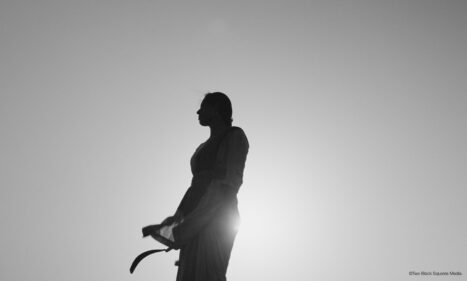
The fury of Osborne’s performance, nonetheless, keeps “Mārama” a worthy anti-colonialist statement that harnesses the symbolic virtues of genre cinema for its understandably virulent tone. The actress’s most astonishing scene comes after Mary witnesses Nathaniel’s right-hand man, Jack (Erroll Shand), an older and sly Māori man, perform a vulgar spectacle in front of a large number of guests that disrespects their people’s memory. In that moment, Mary, still in her ostentatious dress, transforms into a warrioress whose words and movements respond aggressively to such transgressions. Her body physically fights back.
Unfortunately, Stappard doesn’t engage with Jack’s position as a traitor to his people who desecrates their symbols and traditions for the amusement of the English oppressors. What trajectory of events led Jack to become a lackey to Nathaniel? If survival and comfort were his motivation (which is likely), does he feel any remorse? He still speaks his native tongue and has taught it to Anne; thus, perhaps there are shades of him that still respect his ancestors and long to keep their language and worldview alive. A conversation between Jack and Mary, outside of Nathaniel’s watchful eye, could have offered an extra layer of complexity—perhaps not absolving Jack but painting him in a grayer light.
Near the end, Mary, now fully embracing her true self and name (Mārama), surrenders to brutality to pursue justice. Shockingly gory instances and more horrifying revelations about Nathaniel’s identity and his crimes culminate in bloody catharsis. And though the ordeal wraps up without considering the consequences her actions might have had for a woman like her at the time, “Mārama” provokes a satisfying sense of retribution.