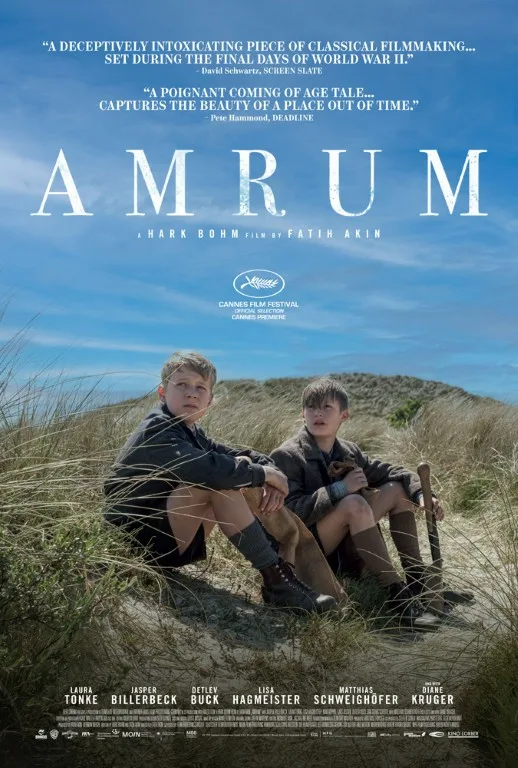
While the WWII coming-of-age fable “Amrum” is technically (and proficiently) directed by Fatih Akin, the eye behind “In the Fade” and “The Golden Glove,” its opening credits style it as “A Hark Bohm film by Fatih Akin.” This feels like a crucial distinction, a way for Akin to honor his mentor, whose childhood story this explores (and who passed a mere two months after this film screened at the Toronto International Film Festival).
In fact, Bohm was initially set to direct this himself, before age and declining health led him to pass it off to Akin, with whom he’d worked on “In the Fade.” It’s a compelling bit of stewardship, a mentor trusting an acolyte to tell the story of their early years; the results are respectful, if often a bit too airy to feel corporeal.
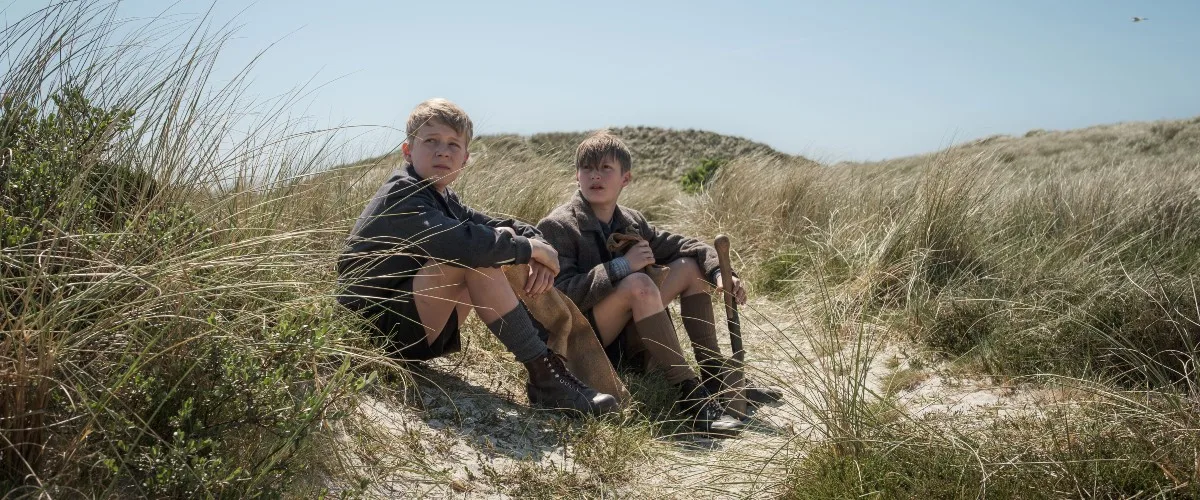
The title refers to the northern German island of the film’s setting, a bucolic if besieged little community populated by Nazis who breathlessly follow the final days of the war in 1945. But we see this story through the eyes of Nanning (Jasper Billerbeck)—a stand-in for Bohm as a child—an apple-cheeked innocent who understands little of the war unfolding around him and is just trying to fit into this new environment (where they’ve fled after the Allies bombed Hamburg). While he’s mostly a Hitler Youth out of social inertia, his pregnant mother Hille (Laura Tonke) is a diehard Nazi, and his SS officer father is away at war.
It’s in his refuge at Amrum that Nanning starts to open his eyes to the cruelty of the world. The native Amrummer children bully him for being from the mainland, and we learn that some villagers have divided loyalties about the Reich, even sneaking away to listen to jazz music on a clandestine radio. Meanwhile, his mother’s devotion to Hitler and his cause has devastating effects on her mental health and her pregnancy, as the Allies keep winning; in the film’s most histrionic scene, the news of Hitler’s death on April 30th, 1945, sends her into a fit of hysterics that also forces her into labor.
Apart from moments like these, however, “Amrum” is content to keep its rhythms dreamlike and gossamer, playing out Nanning’s gradual growth beyond his family’s politics and the values with which he was raised. As distant as Amrum is from the horrors of war, little peeks come out here or there of the cruelty of the world: The opening shot sees him and his little brother (Kian Köppke) watching bombers rain hell on the beaches, saying they’re just “clearing ballast.” He happens across a decayed, roting corpse of an ejected fighter pilot on the beach, its eyes gouged out by birds. Local boys encourage him to learn how to kill and butcher a rabbit, and the sounds will haunt you to the closing credits.
Even so, the impact of these episodic moments often fails to coalesce into something more tangible, weaving through Nanning’s life so passively that attention is easy to drift. And when the script gets more literal and pointed, these moments ring false, too; at one point, a character practically spells the Ahab-as-Hitler metaphor of Nanning’s fascination with Moby Dick, when we could have been trusted to connect those dots ourselves. It’s a film whose tranquility and humility sometimes work against it, even in those moments where it overcorrects with didacticism.
Granted, cinematographer Karl Walter Lindenlaub gives us plenty of beauty to behold when our attention wanders, from the crashing waves at the beach to the expansive fields and textured brick homes where the Amrummers reside. And the performances are simple and effortless in ways that speak volumes even when little dialogue is spoken; Diane Kruger appears as a rebellious villager who offers a more principled role model for Nannig, while Matthias Schweighöfer pops up in a dream as Nanning’s Uncle Theo, one of the few men he can genuinely look up to.
Curiously enough, the film feels in conversation with, of all things, Taika Waititi’s “JoJo Rabbit“; both are coming-of-age stories about little Nazi boys in the waning days of the Reich, coming to terms with both their lost innocence and the chance to break away from the fascistic instincts of the adults around them. But of course, Akin’s film is more delicate and mannered than that, trading dick jokes and hallucinated Hitlers for Malickian shots of waving seas of grass and crashing waves at golden hour. It’s an approach I’m grateful for, even as Akin tilts so far from Waititi’s satirical braying that the same issues come out as a whisper.