
The works of Christian Petzold, one of Germany’s most exciting contemporary filmmakers, are often quiet, contemplative stories that dabble in the mythic, tackling notions of identity and memory (both personal and political). “Phoenix” and “Transit” were broader, more sweeping tales about people trapped in the gears of fascism at various times in Germany’s past; his more recent output includes smaller, more personal and metaphorical stories like “Undine” and “Afire.” “Miroirs No. 3,” Petzold’s latest, follows in that latter mode, a four-person chamber piece whose rhythms are a bit more guileful. But it shares the same concerns he’s followed throughout his career, especially that of spiritual death, resurrection, and rebirth.
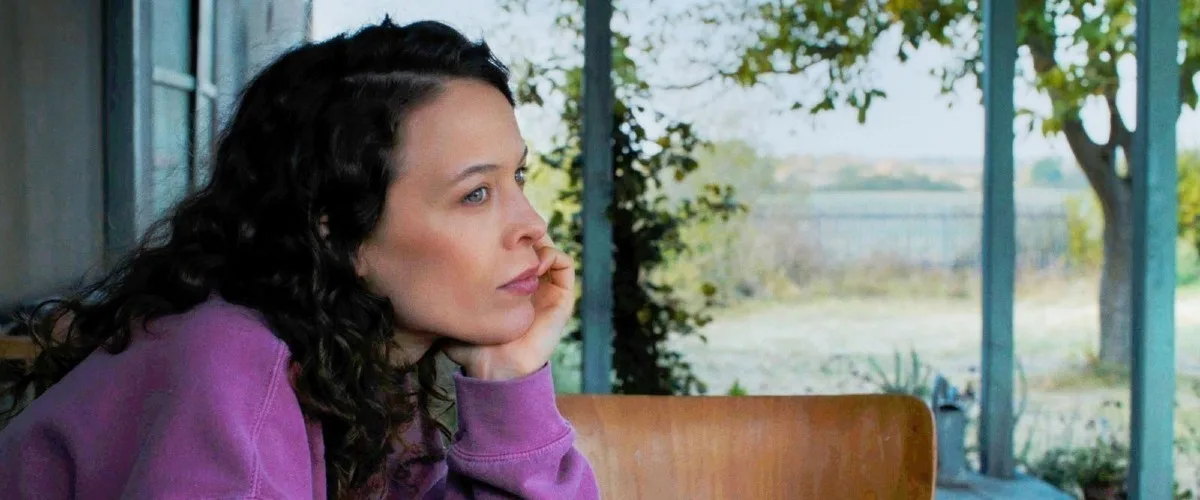
Here, Paula Beer (Petzold’s current muse, who’s appeared in his last four films) plays a depressed piano student named Laura, whom we can tell in the opening minutes has an antic disposition. She feels nervous from the jump, especially when she rides along with her boyfriend, Jakob (???), to a planned excursion with a couple of other friends. After changing her mind at the last minute about going, she makes him drive her back home. Next thing we know, their car is overturned, Jakob is dead, and Laura is flung from the vehicle into the grass, one shoe missing like she’s Cinderella. Dazed, she wanders to the nearby home of Betty (Barbara Auer), a kind, middle-aged woman who takes a sudden interest in Laura’s well-being after a single glance at her; curiously, Laura also decides to stay and recover at Betty’s house.
In keeping with Petzold’s withdrawn, minimalist style, we don’t quite clock exactly what draws these two women together for some time. The pair settle into an uncannily cozy dynamic, as if they’ve always known each other; Betty is mourning the loss of a daughter, and lets Laura wear her clothes, sleep in her bed, and play her piano. (Sidenote: The film is named after a movement in Maurice Ravel’s titular piano suite, and of course comes into play in the closing minutes.) For a time, this seems healing for the both of them—each fills a kind of hole the other feels, whether it’s for family or home. But that equilibrium is thrown into chaos with the arrival of Betty’s ex-husband, Richard (Matthias Brandt), and their son, Max (Enno Trebs), who wonder about this mysterious girl with the uncanny resemblance and her effect on Betty’s emotional well-being. But they, too, are curiously drawn to and resistant to Laura, feeling themselves drawn to the missing piece of their family suddenly reappearing on their door.
In this respect, “Miroirs No. 3” feels positively Hitchcockian, a recurring preoccupation of Petzold’s oeuvre; shades of “Vertigo” abound as characters attempt to replace what’s missing in their lives with doppelgangers willing to fill that role. There’s also something of the psychological tete-a-tete of Bergman’s “Persona” here, with two women dancing around what they can do for each other psychologically. Early on, Betty regales Laura with the story of Tom Sawyer painting the fence (a task echoed in them literally painting the fence around Betty’s home); it’s a story of the power of suggestion and motivation, where altering one’s perspective strongly enough can turn a wish into truth. That’s what feels like is happening in this surreal domestic drama, as Betty/Laura struggles to maintain a bubble that Richard and Max both see through but daren’t burst.
Hans Fromm, Petzold’s house cinematographer, keeps his characters framed in hazy, breezy compositions, capturing the grass, dirt, and texture of the idyllic, desolate world they’ve created for themselves. Most of the film’s action is confined to Betty’s cozy, lived-in domicile, with all its creaking wooden stairs and layers of white paint over concrete basement walls and window sills; still, everything plays out in our actors’ faces, their expressions conveying heaps of confusion and yearning and emotional pain in between Petzold’s sparse dialogue. It has to, because the film’s concerns are so very human. What do you do with a scenario that, false as it is, might just heal the pain of everyone involved? And what if it’s just a thinly veiled fantasy that will just prolong pain? We can guess what Betty gets out of this arrangement (something resembling the return of her dead daughter), but how does it benefit Laura? When Max asks her whether she’s sad that her boyfriend died in that accident, she replies, “I’m not really. I know I should be, but… I’m just not.” Perhaps the pressures of school, or an unsatisfying relationship, left her yearning for the security of a home she no longer had.
These questions are never answered with great clarity by Petzold, nor should they be; like the Italian neorealists before him, he’s much more concerned with training his camera on his characters and letting them unfurl in the situations they’ve been presented with. In this respect, “Miroirs No. 3” is hardly the splashiest film in his body of work. But it feels in conversation with his other works in a way that informs, rather than atomizes, our understanding of his filmmaking. These are wounded people, dealing with real or spiritual or interpersonal death, finding funny, tragic ways to move through that loss.