
“Mother of Flies,” about a father and daughter who get tangled up with a faith healer in a remote woodland area, is a family movie, but not in the way the phrase is usually used. It’s a nightmare parable about mortality, grief, faith, and the fragility of the flesh, made by one of the most fascinating filmmaking teams in American cinema, the Adams-Poser family.
The operation consists of four people: the father, John Adams, and the Mother, Toby Poser, both actors, and their daughters, Lulu and Zelda Adams. They direct, write, edit, and shoot as a team while they’re performing on camera. I have only seen a couple of their many films, “The Deeper You Dig” and “Hellbender.” Both struck me more or less as this one did: not quite my jam, for reasons that might not matter to other people, but clearly the product of talented people who’ve formed a hive-mind.
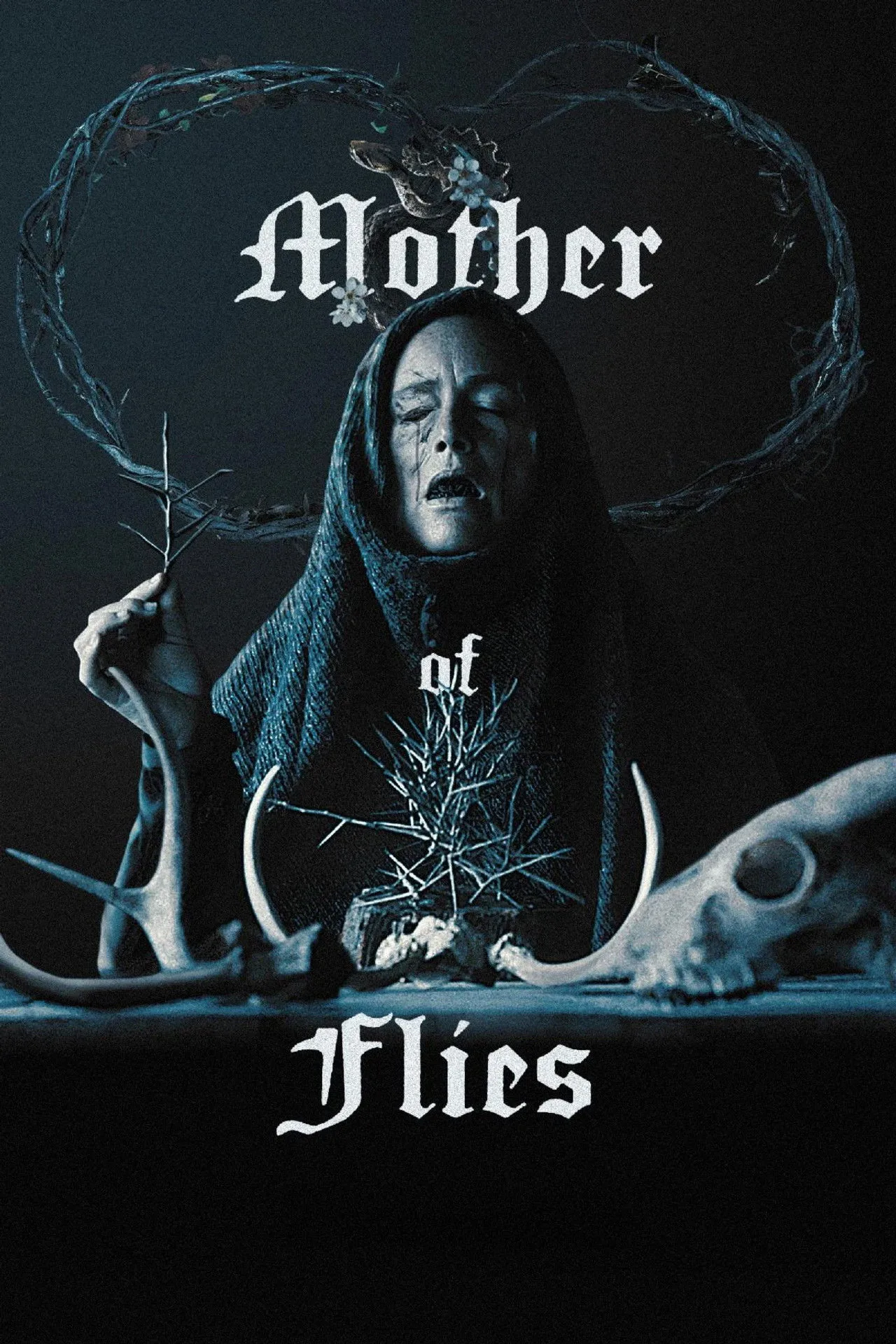
“Mother of Flies” has an opening credits sequence that’s both sensual and vile. That you can’t quite tell what’s going on makes it more effective. There’s blood, viscera, mud, slime, perhaps some other recognizable fluids. The ground is gnarled and irregular, suggestive of the roots of an ancient, old tree and a pile of corpses in a war zone. A naked person’s gore-slathered back is seen from above, raising and lowering itself, or thrusting at something beneath it. Tightly framed shots of a woman moaning and writhing evoke sexual ecstasy, the final stretch of labor before childbirth, and a body reacting to either the first hit of a powerful narcotic or an agonizing withdrawal from it. Aficionados of oil paintings from earlier centuries may be reminded of Hieronymus Bosch, Francisco Goya, Jusepe de Rivera, and other artists know for their depictions of Hell.
You won’t understand the point of those images until you’re deep into the story, which is about a young woman named Mickey (Zelda Adams) who travels with her father, Jake (John Adams), to a remote woodland house to meet a healer named Solvieg (Tony Poser). Solvieg is plainly defined for the audience as some kind of mystic — a witch or sorceress — before the father and daughter have even met her. The duo hopes that Solvieg can heal Mickey, a terminal cancer patient who has exhausted all the treatment options offered by modern medicine.
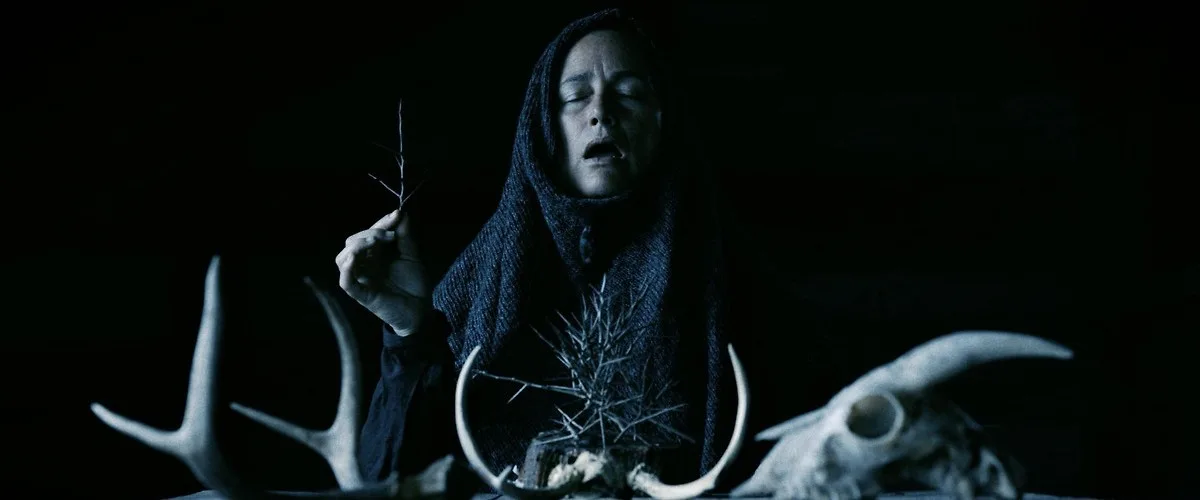
Solvieg speaks in everything but straightforward sentences. She monologues and recites scripture or incantations. Often she’ll launch into what sounds like a parody (intentional or non-) of the “greatest hits” of 19th-century English poetry featured in textbooks. Sometimes you can barely understand what she’s saying or why she’s saying it that way. Yoda would ask her to bring it down a notch.
But she’s confident in her powers and demands that the father and daughter submit completely to her process, which is pre-technological. Their diet consists of mushrooms and leaves. There are no bathrooms in the house, so they have to take care of business as their forager ancestors did. It’s as if we’re seeing an account of life in a cult with one leader and just two members.
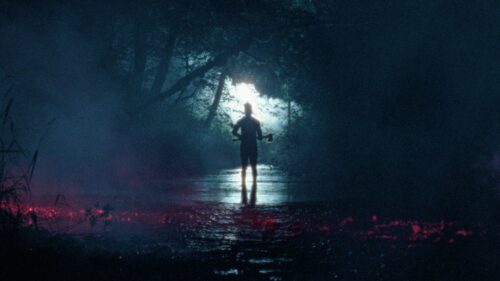
The movie serves up striking visuals. Solvieg’s house is covered by thick layers of vines. There’s so much vegetation encrusting the property that it’s impossible to tell where the vines end and the house begins. Solvieg is incapable of a non-dramatic entrance. She’s often silhouetted or glimpsed in half-light, framed by doorways or tree trunks. Mickey immediately begins experiencing visions—maybe hallucinations, maybe supernatural events; we can’t be sure at first. Lying in bed, she looks up at the ceiling and sees a pulpy, fleshy thing manifest itself and open up. It’s an orifice, but you can’t decide what kind because it keeps evolving.
And yes, as the title suggests, there are flies. Lots and lots of flies. If you tried to make a definitive list of movies with swarms of flies in them, you’d need to include this movie, which is up there with “Exorcist II: The Heretic” and the original “The Amityville Horror.” As the movie goes on, there are more sequences of intense violence, including one reminiscent of the over-the-top stories that circulated during the 1980s and ’90s hysteria over day care centers in the United States: ritual abuse, disfigurement, and torture, babies hacked out of their mothers’ bellies.
There isn’t a shot that isn’t meticulously created, lovingly fussed over, and suitable for framing. In an era of often slovenly filmmaking in which the camera is treated mainly as a device to record actors saying dialogue, this is welcome. But there are times when the images are lingered on too lovingly, and you may start to feel as if the component parts of the movie are preventing it from holistic excellence.
There are pacing and rhythm problems too, I think. It’s not that the movie is slow-paced, with a lot of lead-up to important moments and some sequences of abstractly framed shots that are more artful than useful; it’s that the slowness lives awkwardly in that zone between “too slow” and “not slow enough,” and it makes the totality feel disjointed. Lots of horror films are objectively slower than “Mother of Flies” but still mesmerize from start to finish. This one is fascinating and often horrifically gorgeous, but not hypnotic. It’s like a book of horrifying artwork that you can close at any time and return to later, rather than a nightmare that won’t let you wake up.
But there are so many compensations that it’s very much worth seeing for anyone who loves horror—especially the atmospheric and gory, dread-based type, rather than the kind that is single-mindedly obsessed with staging jump-scares. The central performances are all special. They’re not studied. They feel natural, even though every other aspect of the film is unreal and uncanny. And the woods are lovely, dark and deep.