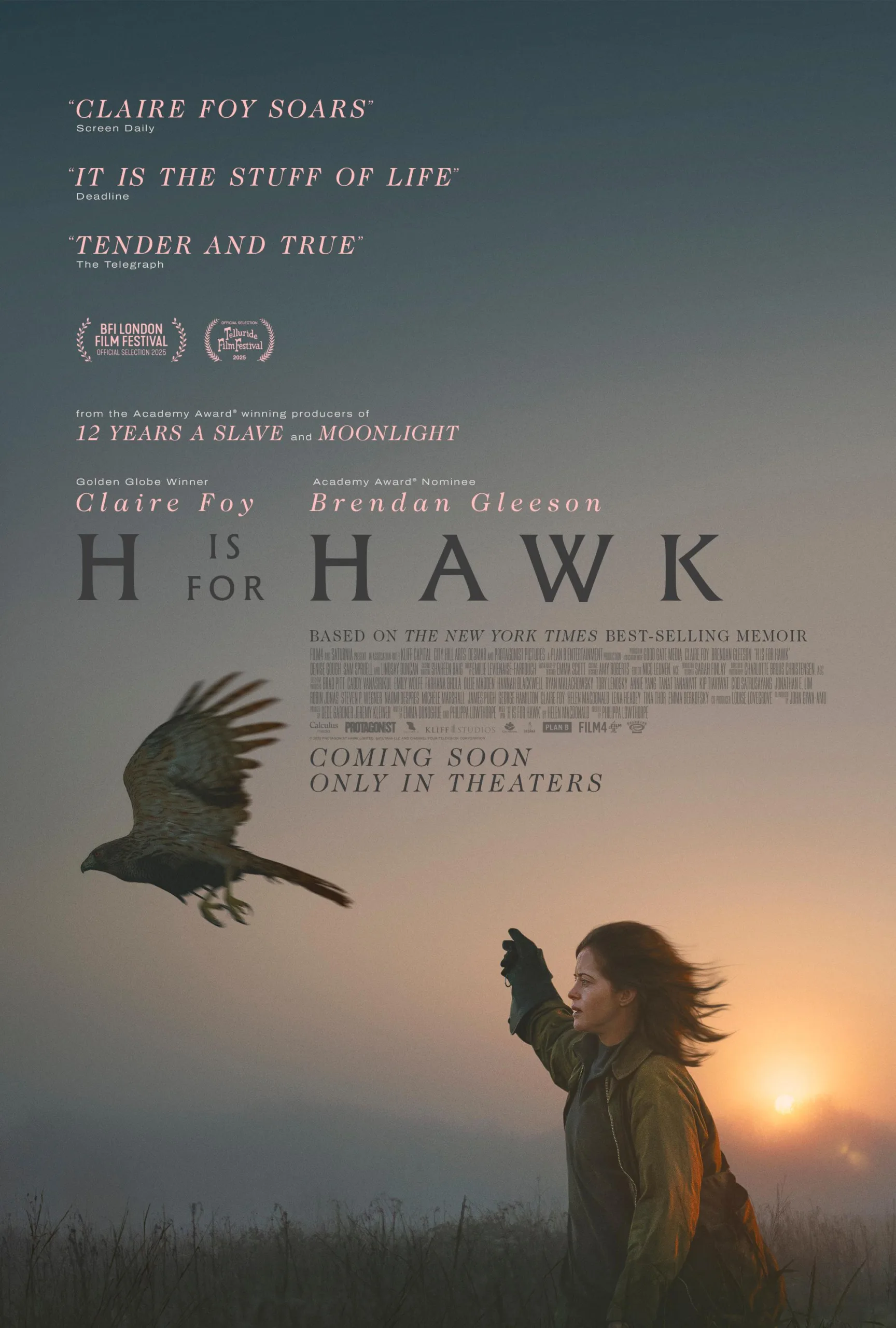

In the wake of her father’s sudden death in 2007, the English academic Helen Macdonald turned to training a goshawk, attempting to stave off depression by subsuming her grief in a relationship with a bird of prey—not just any bird but one considered notoriously difficult to train, even for trained falconers. But the goshawk’s fierce, unpredictable nature spoke to something wild in Macdonald’s own temperament, to her impulsive and perhaps self-destructive desire to withdraw from civilization, taking solace in the natural world and its primordial ways.
“The hawk was everything I wanted to be: solitary, self-possessed, free from grief, and numb to the hurts of human life,” Macdonald wrote in H Is For Hawk, her prize-winning 2014 memoir about the year she spent rearing this goshawk, whom she named Mabel, even as the rest of her life—from professional obligations to close friendships and basic personal hygiene—fell into disrepair. For all the time and energy Macdonald poured into every last training flight with Mabel, as her memoir made clear in one elegantly agonized passage after another, the mounting intensity of this animal-human connection also signified an obsessive emotional attachment, one that deeper healing—and her inevitable return to society—demanded she shed.
If the memoir’s alliterative title was read as quaint eccentricity by some of the countless critics who otherwise sang its praises, this could have been because they failed to grasp Macdonald’s meaning: that “H” stood for “hawk” at a time when she couldn’t bear to let it stand, as it always had, for “Helen.” For all its appeal to ornithologists, this was an account of a woman’s most intimate struggle to survive a tragedy that blotted out her sense of self—a story about the way grief perches in the soul.
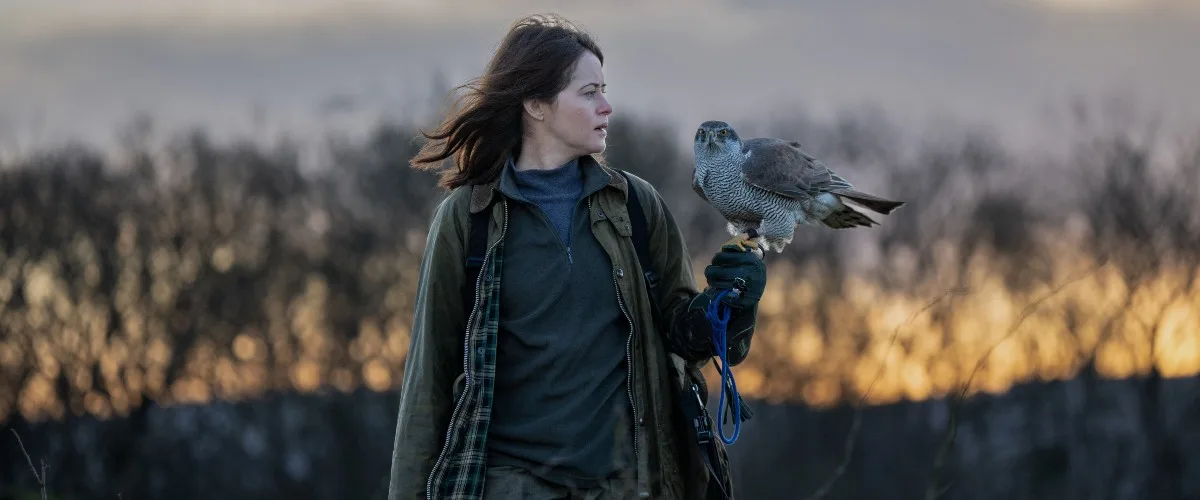
With Claire Foy starring in “H Is for Hawk,” there can be no such misinterpretation. The British actress, best known for playing a young Queen Elizabeth on the Netflix series “The Crown,” is heartbreaking in this adaptation’s main role: steely and stoic in the stiff-upper-lip tradition yet thoroughly conscious of her sorrow, which smarts beneath all the poised expressions like the inner wound it is. Foy has always been a fastidious performer, one skilled at surfacing her characters’ emotional states without troubling their carefully controlled exteriors, but there’s a raw fragility to Foy’s work in “H Is For Hawk” that (for as little as she actually cries on screen) honors the strange and unknowable enormity of Helen’s loss.
The scenes where Foy practices falconry, sharing the screen with a feathered co-star, are afforded an idyllic splendor by director Philippa Lowthorpe, who treats the British countryside like a quilted tapestry of open fields and rolling hills, shot through with golden light. But the film is seldom more mesmerizing than during one early sequence, in the cramped darkness of Helen’s apartment, where she struggles to establish an initial bond with Mabel. Concerned that the bird won’t eat, Helen is first perturbed, then panicked, until a friend arrives and provides the distraction necessary for the goshawk to pounce on a meal. Helen grows closer to Mabel as the bird acclimatizes, eventually settling into cohabitation herself. What Foy reveals to the audience in these scenes, Helen’s fight-or-flight responses easing into a quietly watchful posture, is a woman finding a delicate, instinctual peace in wildness. Hers is a performance both civilized and passionate, delivered in such a direct and honest manner that it distills Macdonald’s prose.
If only Lowthorpe’s film (the screenplay for which was co-written with Emma Donoghue, author of Room and its Oscar-nominated adaptation) had as much range in its 115-minute runtime as its lead actress displays in such lovely little moments. Having excised some of the memoir’s less cinematic aspects, like the spiritual kinship that Macdonald came to feel with children’s author T.H. White (whose early-career work The Goshawk also charted a writer’s efforts to tame a bird of prey), their adaptation is straightforwardly focused on dramatizing Helen’s downward spiral, enough so that it ends up saddling Foy with histrionic heavy lifting in the latter half.
Appearing largely in flashback as Helen’s late father, who fostered her love of birding, Brendan Gleeson marshals his craggy features and wry wit toward a performance of soulful immediacy. One not only mourns his character’s passing but also senses his presence lingering over scenes in which Helen unconsciously mirrors her father’s mannerisms, even as she follows in his footsteps. Supporting performances by Lindsey Duncan, as Helen’s mother, and Denise Gough, as her friend, can’t help but bring less to the picture, while later scenes that exist to emphasize Helen’s fraying emotional state—one finds her sleeping in a cardboard box beside Mabel—strike the same wretchedly unhappy note until it mostly just sounds repetitive.
Macdonald’s memoir was deeply interior, and the strain of externalizing it begins to show in overwritten scenes that return Helen from the countryside to Cambridge, where her dynamic with Mabel is derided by unsympathetic onlookers. The film’s strengths lie squarely with Foy, whose performance is restrained where it should be and revelatory at some moments you don’t expect. For all the majesty Lowthorpe evokes in outdoor sequences that follow hawks swooping and soaring over the woodland, what poet Emily Dickinson referred to as “the thing with feathers” can be glimpsed more fully from the ground. As her weary eyes widen, watching birds in flight, Foy’s features flood first with fear, then wonder, then hope.
“H Is For Hawk” opens nationwide in theaters Jan. 23, via Roadside Attractions.