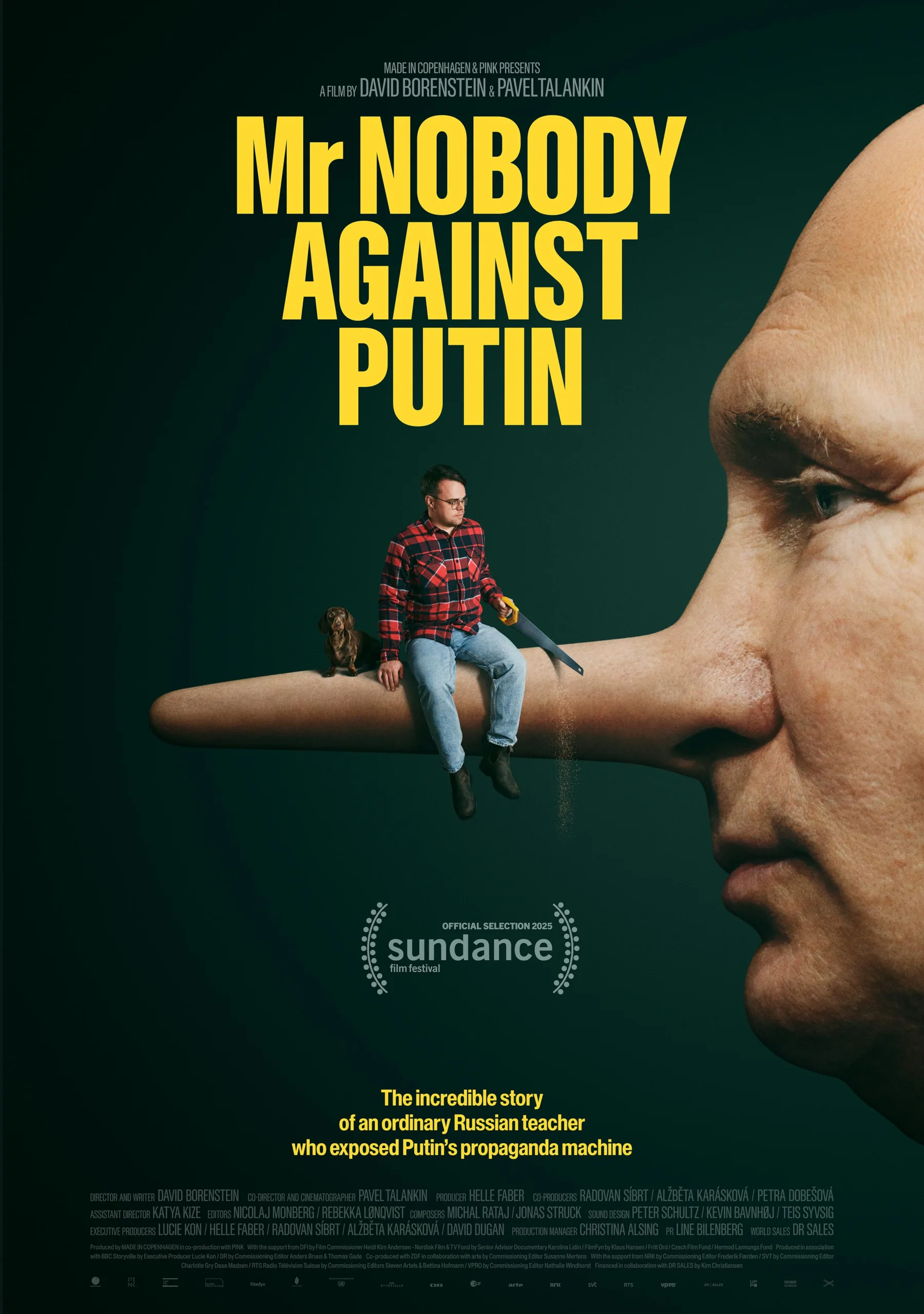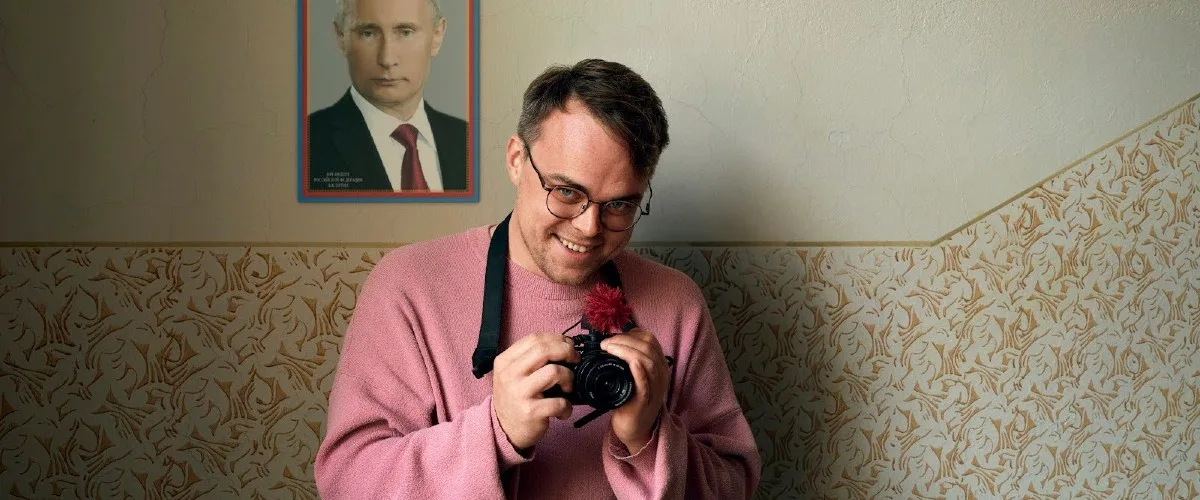
The unfortunately ever-growing archive of films about societies succumbing to war fever gains a memorable new entry with “Mr. Nobody Against Putin.” It’s about the experiences of filmmaker “Pasha” Talankin, the videographer and events coordinator for a primary school in Karabash, a petrol refinery town of about 10,000 located in the Ural Mountains. Most of Talankin’s days are spent recording events at the school. In 2022, Russian Premier Vladimir Putin sent troops into Ukraine, sparking the bloodiest European conflict since World War II. Talankin found himself behind a camera at a time when his school’s curriculum was being remade by the Russian government, mostly to propagandize young people into docile tools of the state who believe their motherland can do no wrong.
There’s a lot to recommend this movie, which was shot by Talankin over a two-year timespan, smuggled out of Russia and into Denmark, and put together in Copenhagen by Talankin’s co-director, David Borenstein. But one of its more quietly revelatory qualities is how it captures the way authoritarianism accelerates in wartime. One day, students, faculty, and administrators are going about their business, and the next, the fax machine in the principal’s office is spitting out an announcement of the New Federal Education Policy. Time that Talankin used to spend teaching and mentoring is reallocated so he can record endless hours of video of teachers reading state-written materials in classrooms, then upload the footage “to some mysterious government database.”
This outrages alarms Talankin, an antiwar progressive who hung a pro-democracy flag in his office and enjoys arguing politics with more right-wing colleagues. As the story unfolds, the war kills students he was close with and shatters their families. Talankin feels increasingly guilty watching TV coverage of protesters barely older than his students getting clubbed and arrested by police. He feels like he’s doing nothing, and that doing nothing makes him complicit. So he resigns.
But upon reflection, he realizes he made an impulsive, wrong choice. He could have used his position to collect material for a movie documenting a Russian school’s transformation into one tiny cog in a vast war machine that requires constant demonstrations of loyalty to the state. The de facto military takeover of schools crowds out real education. Almost nobody in Russia actually wanted it or is happy about it. They only participate because if they refuse, they’ll be marked as enemies of the state.
A movie illuminating this process won’t stop a war, but it could demolish the motherland’s claims that the Russian people have unanimously rallied behind it. The challenge for Tamalkin is how to make such a movie without getting beaten, tortured, jailed, or worse. (A 2023 law decreed that any Russian who opposed the Ukraine occupation was guilty of treason, a capital offense.)
Sheer luck must account for a lot of Talankin’s success, because he doesn’t try very hard to keep low profile. After an sequence recounting all-hands-on-deck teacher’s meeting to discuss the school’s rising rate of students failing classes, there’s a cut to Talankin and a couple of colleagues decompressing in his office afterward; we hear him off-camera suggesting that “the reason they are failing is all the bullshit…’Go, Russia! Hooray for nuclear weapons!’ is all we have here now.” Talankin even removes a row of K’s taped across the panes of a row of picture windows—the Cyrillic letter of the Russian alphabet adopted by pro-war forces, meaning a pobedu (“for victory”) or zapad (“west”)—and replaces them with X’s.
It’s fascinating to watch this man’s internal struggle become externalized in the filmmaking. It’s obvious that a lot of his story has been massaged in the editing to create a more “movie-like” rhythm and an upbeat feeling, to the point where you may start to imagine a Hollywood remake, probably starring Bill Skarsgard. The score, credited to Michal Rataj and Jonas Struck, runs the gamut from just right to too much. And there are a few moments where the shots of Talankin seeming to react to something that just happened in the story feel posed and inorganic. Talankin, the leading man, is a natural on camera, charming and often heartbreakingly vulnerable, but it’s clear, even in this inaugural effort, that Talankin the filmmaker needs to keep him on a short leash.
These are minor objections to a major effort, though. Talankin, with Borenstein’s mighty assist, has made a movie that combines a passionate heart and a generosity of spirit with what, in the United States, we’d call counterculture humor. Think of the kind showcased in mid-century fiction and cinema, like “Catch-22” or “Apocalypse Now,” where the only people questioning the mindlessness and corruption of their culture are smart enough to identify what’s defective but powerless to do anything beyond making hardboiled jokes.
Talankin has a gift for letting ridiculous people look ridiculous with hardly any prompting, as when he asks the school’s history teacher and official Kremlin representative—a dull man and godawful communicator whose face suggests a gangrenous James Woods—which historical figures he’d most like to have met. He replies with a list of sadistic madmen and genocide enablers, including Lavrentiy Pavlovich Beria, chief of police under Josef Stalin, who designed the gulag system. But Talankin gives him the gift of humanization anyway: during a graduation sequence, there’s a cut to the toady wiping a tear from his eye, proud as any parent.
Purely on a craft level, “Mr. Nobody Against Putin” is skillful and engrossing, never more so than when it captures wrenchingly painful moments in people’s lives with a detachment that keeps the focus on the subjects rather than shifting to Talankin. The strongest is a funeral for a student who was drafted and died in Ukraine. Talankin explains that he didn’t get video because, with Russia dug deep into the occupation, it might’ve caused a hostile reaction, so he recorded audio only. Hearing the dead soldier’s mother wailing inconsolably while staring at a black screen puts the experience in perspective in a way that the most eloquent narration never could.
It’s also fascinating to see the shooting style evolve as Talankin stops being a mere record-keeper and begins using the camera expressively. The shots become more varied and dynamic, the use of streetlamps and sunlight more painterly. The arrangement of faces and bodies within frames becomes more elegant. But there are also times, even in the more emotional later scenes, when the movie lets images speak for themselves. Notice, for instance, how the boys’ haircuts get collectively shorter as the story goes on, and how they start wearing camouflage outerwear, and how the school hallways seem to grow longer and colder. In the movie’s opening section, Talankin says he knows that if he’s to rise to the level of the era he’s chronicling, he’ll have to stop being a videographer and become a director. And he did.
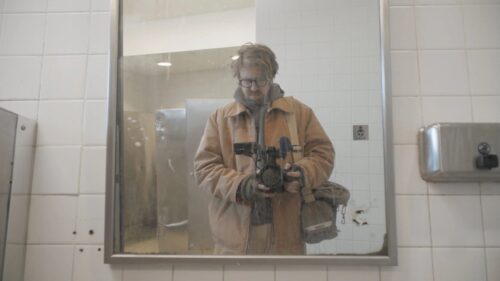
A side note: Talankin says early in the movie that as his duties expanded, the school hired a second videographer to assist him. This explains all the shots of Talankin operating his own camera, talking to faculty while being observed through a zoom lens, walking up and down stairwells, and so on. The credits list the two main camerapersons as “Pavel Talankin” and “Anonymous.” As much as I wish I could find out who this person is and write them a fan letter, there are cases where it’s better not to know, and this is one of them. Anonymous, if you’re reading this: great work, and stay strong.