“Skyfall” is a theatrical film in the same way that its director, Sam Mendes, is a theatrical filmmaker. That is, its approach to organizing space for an audience (the camera lens) is noticeably stagey. I mean that in a “value-neutral” way. I just mean the frame is frequently used as a proscenium and the images are action-tableaux deployed for a crowd — whether it’s the designated audience surrogates in the movie (bystanders or designated dramatis personae), or the viewers in the seats with the cup-holders. That’s not to say it’s uncinematic (it’s photographed by the great Roger Deakins!), but many of the set-pieces in “Skyfall” are conceived and presented as staged performance pieces.


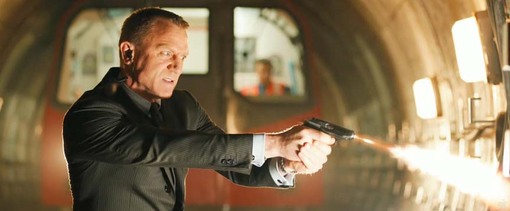
Not the opening one, so much, although it is constructed as a Bondian blowout in Istanbul directed “live” from afar by M (Judi Dench) and MI-6 in London, and climaxes with a train-top fistfight (multiple moving platforms/stages, if you will). This pre-credits extravaganza, which involves vehicles in hot pursuit through the streets, alleyways and the Grand Bazaar (obligatory in any chase sequence set in the Middle East or Asia, provoking involuntary under-the-breath exclamations of “Fruit cart!” from this viewer), motorcycles across the rooftops (see “The Bourne Ultimatum,” “The Bourne Legacy“), through a mosque (!) and onto the top of a moving train (countless movies, from “The General” to “Unstoppable“)… Later there’s a subway escalator chase that explicitly recalls David Fincher’s “The Girl with the Dragon Tattoo” (2011).


All of the above is self-aware spectacle, something to be expected from a Bond picture. But there’s an element of theatricality that runs through “Skyfall,” too. An assassination scene in a Shanghai skyscraper is staged and photographed like a shadow play, with layers of glass between us and the characters, who appear mostly as silhouettes against a gigantic animated billboard. It’s photographed head-on for the most part, with the glass windows and doors framed at right angles to the camera, which observes them straight-on as if from center-orchestra.

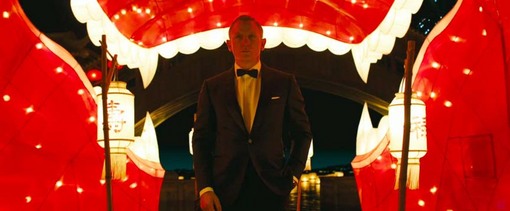
Bond (Daniel Craig) passes symmetrically through a proscenium arch (by gondola) to arrive at a Macau casino, which becomes a colosseum-like theater of death: Bond and some bad guys fight in a circular pit designed for the display of live Komodo dragons, watched by patrons from above. In scene after scene, there’s a behind-the-scenes intelligence directing the action, somebody who’s putting on a show designed for someone else to witness. And the villain, Silva (Javier Bardem), is introduced with a long shot in which he emerges from a pair of doors upstage and walks downstage toward the stationary camera while delivering a monologue — very much a stage entrance. One of his dramatic effects involves putting on a show in the London Tube — staged specifically for Mr. Bond. “I do hope that wasn’t for me,” Bond says of a small explosion. “No,” Silva laughs, delivering the payload on cue: “But that is.” (Boom!) Later, when Silva’s in custody at MI6, he’s kept in a brightly lit glass display case on a raised platform for some theater-in-the-round in which he commands the spotlight.


The big, blow-up finale involves rigging Bond’s dilapidated childhood Highland estate, known as Skyfall, with all manner of IEDs, setting the stage for a form of deadly performance in which most of the unknowing cast descends upon the set via helicopter with recorded music blaring (it’s a kind of overture, also recalling “Apocalypse Now,” of course) and then stepping onto a stage carefully prepared with practical effects.

I’m not much of a Bond aficionado (I’ve seen most of them, but enjoyed only one- Roger Moore: “Octopussy”), and I find that the credits sequences are often my favorite parts of the movies — which is definitely the case here (titles sequence by Danny Kleinman). Bond “dies” and plummets into the opening titles — into a river, over some falls and underwater, where there are blobs of red lava-lamp-like goo (like blood, like viscera, like nerve cells, like circuits) and Bond-girl mermaids swimming about in silhouette. You know, that kind of thing. I wondered how or if these images would manifest themselves in the larger movie… and they more or less did. These red shapes show up again as computer images, which morph into a map of the London tube system on a wall-sized computer screen manned by Q (Ben Whishaw).
Maybe I’m just free-associating, but it struck me that one motif that runs through the movie is something we’re all quite familiar with these days: aging technology… as an extension of aging biology. The movie’s MacGuffin is a hard drive (SSD, apparently) with the identities of secret agents and double agents stationed around the globe. (Yes, this is silly; why would anyone collate all that sort of information in one physical location? Then again, our former CIA director used Gmail — albeit the drafts folder — to clandestinely communicate with his mistress/biographer.)
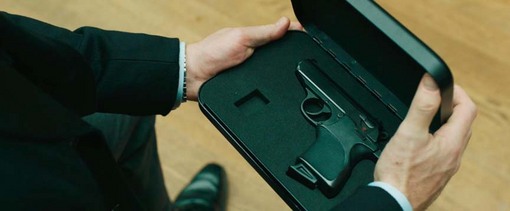
Near the start of the movie, Q gives Bond two crude tools: a handgun (with handprint ID) and a radio tracking receiver the size of an SD card — but with an inexplicably antiquated little pop-up antenna. (Maybe it’s just supposed to be retro for style reasons.) The former, then, is an extension of Bond’s — and only Bond’s — hand (“Less of a random killing machine and more of a personal statement,” Q says). Think of the flesh-gun in “Videodrome.” The latter is a teeny GPS tracker: A way for MI6 to keep tabs on Bond’s whereabouts. The only thing more personal than these would be devices implantable in Bond’s own flesh. (Silva has his own technological modification — false teeth to replace the ones he lost to cyanide poisoning.) And, of course, the purloined laptop hard drive is a metaphor for memory itself, all those agents who’ve taken on new identities and become embedded with terrorist organizations worldwide.
Bond has always been a vehicle for technological tricks and gimmicks, but this time most of the technology is old hat: motorcycles, trains, subways, hard drives… And the focus here (except for a gag involving the ejector seat of the classic tricked-out, Connery-era Aston Martin) is on Bond himself as a worn-out machine past its prime. (“Not bad, James, for a physical wreck,” Silva says. I hope he’s named after Henry Silva, by the way.) Bond fails the physical and psychological tests to go back to active duty as an MI6 agent, but M sends him back out into the field anyway, where he has to confront who he used to be (as a child at Skyfall; as a younger 007 with his Aston Martin — and a familiar vintage John Barry Monty Norman to go with it), and who he is now (older, battle-scarred — but still pretty darned spry, especially before his “death by credits sequence,” which doesn’t bother to show us any details about how he survived the fall into the water).
But Daniel Craig’s Bond does not appear to be worn out. And neither, evidently, given the record-setting opening weekend grosses, is this half-century-old franchise.