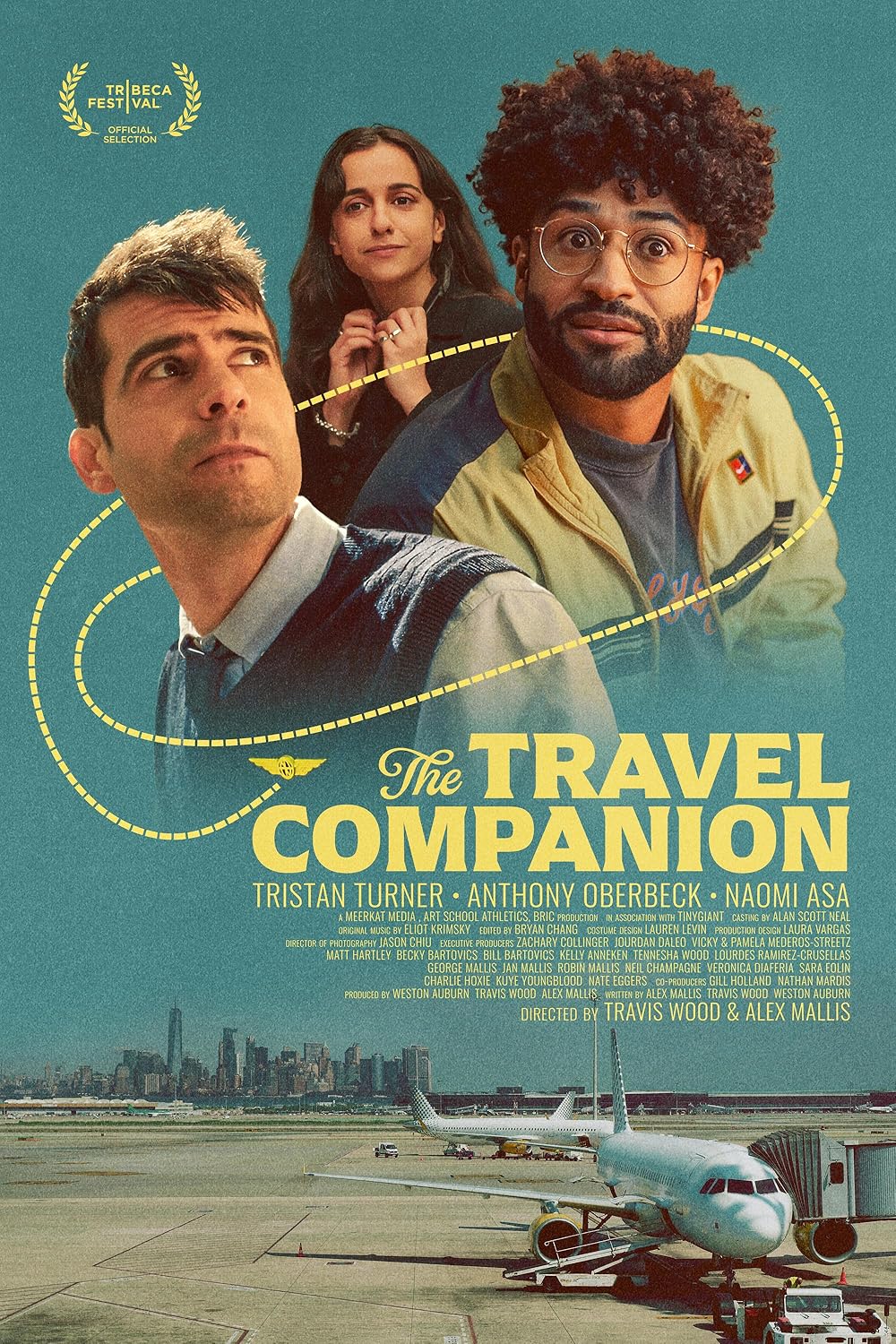
“The Travel Companion” is a remarkably assured first narrative feature from directors Alex Mallis and Travis Wood, who wrote the screenplay with Weston Auburn. It draws us in with acutely observed details and relatable characters that portray universal conflicts, all with nuance and good humor.
Simon (Tristan Turner) is a bit like the arrested-development characters Seth Rogen used to play: a little lost, a little self-involved, a little shlubby. We first see him on stage for the Q&A at a film festival, where the film he made as a student thesis project has just been shown. All the other filmmakers answer questions, but time runs out before Simon gets a chance to speak.
His best friend and roommate, Bruce (Anthony Oberbeck), is in the audience to support (and gently tease) him. A woman sitting behind Bruce congratulates Simon on the film, and they invite her to join them for a drink. Her name is Beatrice (Naomi Asa). She asks Simon what he is doing to follow up on his student film, and he tells her he is “marinating” an idea about “geography-based biases” with literal and metaphorical elements, but he wavers when he describes what he has shot so far in countries around the world as footage for the film or just “scouting.”
Those trips are courtesy of Bruce, who works for an airline and can designate one person each year as his “travel companion,” with unlimited free travel on a standby basis. Simon loves that status and the trips he has taken with Bruce. It helps him have something in his life beyond a dull day job shooting short films for taxis.
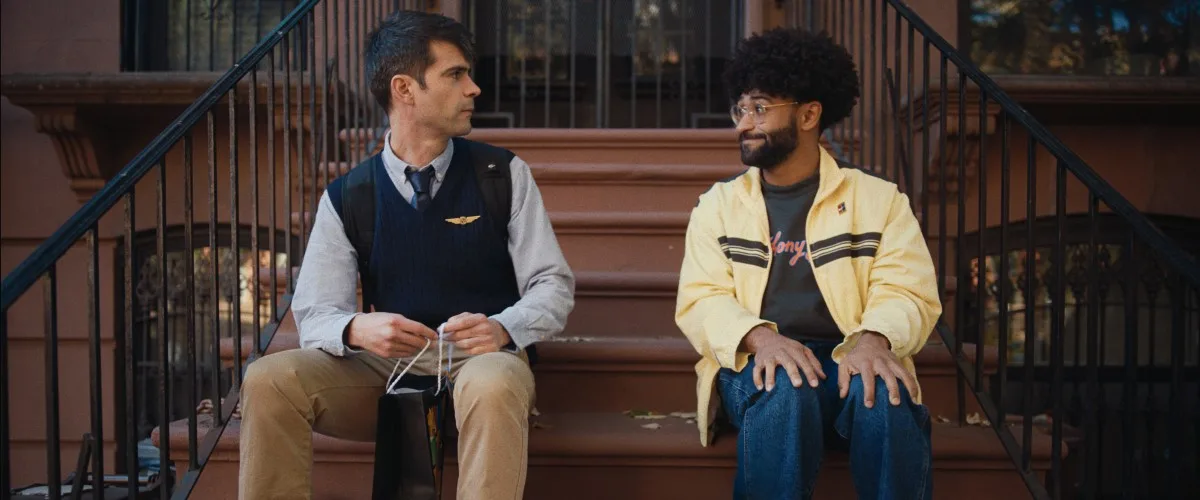
Simon and Bruce have been friends since third grade. Someone who sees a photo of them together describes them as “two dudes chillin’.” They have an easy comfort with each other when they work out or just sit on the front stoop of their building. But we can see the relationship is more about the ease and the history than the comfort. Simon is so caught up in his own issues he is not good at expressing genuine interest or picking up on signals. For example, when Bruce suggests that Simon take his “schvitz” (a zip-up steam room) privately, in his bedroom, Simon hauls it into the living room and cheerfully responds, “But then I couldn’t talk to you!” He tends to talk at Bruce rather than to him.
When Bruce starts to become involved with Beatrice, Simon gets anxious, less about losing the friendship but about losing the golden ticket to travel.
Simon’s focus on the travel companion perk serves as a metaphor for early adulthood—when the dreams of “someday” are suddenly up to you to deliver, and friendships based on convenience, history, and inertia can start to crumble. The film is especially skillful at exploring this specific story.
Simon sees Beatrice and other young filmmakers moving ahead while he still can’t decide whether the film he is shooting on his trips will turn into anything. He admits he’s been “milking” his thesis project, taking it to one festival after another instead of working on something else. He brags to a festival programmer that his next film is almost done (it has barely started) and is getting a good response at screenings (no one has seen any of it), and then has to back down when she reminds him that the festival insists on films that have not been shown. He is thoughtless, even boorish, and he does not listen to other people because he is too busy worrying if he is not doing as well as they are. It would be easy for us to lose sympathy for him, but Turner helps us see that his thoughtlessness comes from panic, not selfishness.
The film’s richness comes from some well-developed minor characters. Simon’s encounter with an entrepreneurial cab driver (Anil Joseph) is well-crafted, and we are glad to see that character turn up again near the end. And cinematographer Jason Chiu gives the visuals a more luxurious, immersive feel than we often see in lower-budget films, which is very apt for a movie with characters who talk knowledgably about lenses and film stock. An especially astute choice comes about a third of the way into the film when, for the first time, we see scenes of Bruce that do not include Simon.
It helps us recognize that Bruce has his own life and complexity; he’s not just there for Simon to react to. And a graceful ending shows us that losing the travel Simon loved so much helped him see where he really needed to go.