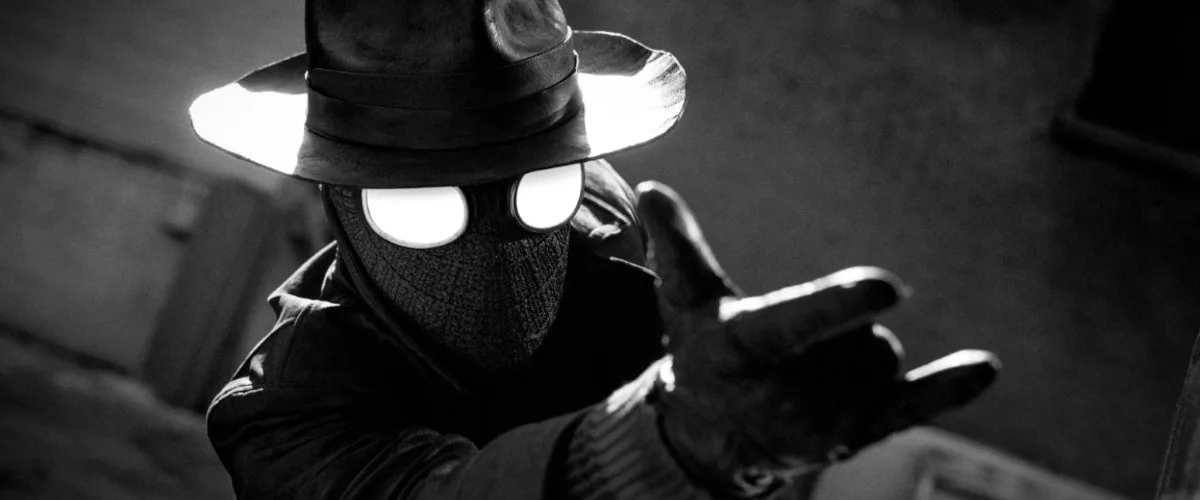
Nicolas Cage told Esquire magazine his character in “Spider-Noir” is “70 percent Bogart and 30 percent Bugs Bunny.” But even that Looney Tunes description doesn’t quite capture the inspired insanity of Cage’s performance in this uneven but visually popping and admirably bold film-noir comic-book tale. Cage switches gears about 147 times in “Spider-Noir”—affecting different accents and inflections, engaging in broad physical comedy, bursting into song when it’s least expected, laughing in moments that are deadly serious, offering commentary on events as they transpire, and going FULL BORE NICOLAS CAGE throughout.
At times, it feels as if we’re watching a particularly well-constructed “Saturday Night Live” sketch. Once in a while, we cringe at a big swing and a miss. Often, we’re reminded why Cage is one of the most electric, polarizing, and inspired actors of his generation.
Let’s take a beat in order to sift through the pop culture weeds of “Spider-Noir,” an eight-part series that premieres on the MGM+ linear broadcast channel on May 25, followed by a global release on Prime Video on May 27. I’m sure many of you recall or are aware of one of my favorite Roger Ebert features: “The Movie Answer Man,” a popular syndicated column that led to a 1997 book. Inspired by CompuServe chat discussions, Roger would take queries from readers – or in some cases, ask himself the questions. With a tip of the hat to “The Movie Answer Man,” here are some questions you might have about “Spider-Noir.”
Q: Is Nicolas Cage playing the same Spider-Man Noir character he voiced in “Into the Spider-Verse”?
A. Not really. While Cage voiced “Spider-Noir” in the 2018 Marvel movie, for his first major television role, he is playing one Ben Reilly, a hard-drinking, downtrodden, middle-aged private eye who hung up his crime-fighting persona “The Spider” years ago, after he was unable to prevent the tragic death of his beloved fiancée.
Q: When does “Spider-Noir” take place? Is Peter Parker part of the story?
A: The series takes place in shadowy, smoky, jazzy, and rain-soaked Depression-era Manhattan, where Peter Parker does not yet exist. “Someone once asked me what universe this was,” says Cage as Reilly in a voice-over that conjures up detectives of eras past such as Philip Marlowe and Sam Spade. “Strange question that stuck with me all these years later. All I can say for sure is that it was the only one that I knew of. And that was as true then as it is now.”
Okay. I think I’ve got it.
Q: Will “Spider-Noir” be in black-and-white or color?
A: Yes and yes. Each episode affords the viewer two distinct viewing options: “Authentic Black and White,” or “True Hue Full Color.” The black-and-white episodes lean heavily into the 1930s film noir style, while the color episodes are rich in saturated, vibrant tones. I alternated between the two styles from episode to episode, and while I preferred the gritty, moody black-and-white imagery, the color chapters featured gorgeously rendered costumes and meticulous production design in the vein of works by Edward Hopper and Lily Furedi.
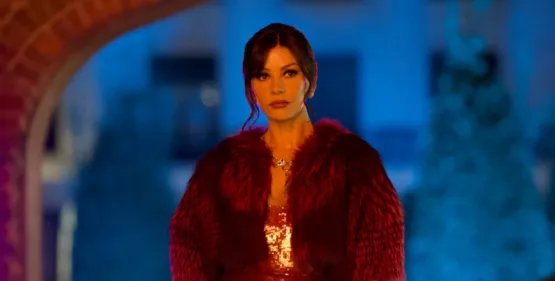
At the outset of “Spider-Noir,” Ben’s detective agency has fallen on hard times. The phone has been turned off, there’s virtually no foot traffic coming through the door, and Ben’s sassy assistant Janet (a scene-stealing Karen Rodriguez) is on the verge of quitting because she’s not getting paid. That all changes when Ben is hired—under false pretenses—to do surveillance on Li Jun Li’s Cat Hardy, a sultry nightclub singer who is essentially the prisoner of the mob kingpin known as Silvermane (Brendan Gleeson), who has been ruling the city unchecked since The Spider went into cobwebs (sorry) a half decade earlier.
Over the course of eight deliberately paced episodes (things drag a bit in the middle section), “Spider-Noir” introduces a tangled web (sorry again) of storylines. Jack Huston is outstanding as Silvermane’s muscle, Flint Marko, who is becoming trapped in his Sandman alter ego. Andrew Lewis Caldwell is spectacularly entertaining as Dirk Leydon/Megawatt, who quotes Shakespeare and fancies himself as the star of his own serial killer movie, while Abraham Popoola is a quietly powerful force as Lonnie Lincoln/Tombstone. All three of these troubled souls are mutating with alarming rapidity—but what’s the common thread?
The various and intertwining plot lines in “Spider-Noir” aren’t as gripping and visceral as, say, the recent “The Penguin” series. Much of my enjoyment stems from the consistent nods to the films of the period, from the music choices, e.g., “Dream a Little Dream of Me,” to the atmospheric cinematography, to tributes to films such as the pre-code “Below the Sea” (1933) starring Ralph Bellamy and Fay Wray, to the James Cagney vehicle “Great Guy” (1936). Ben knows the dialogue to the latter film by heart, and he’s such a movie buff that he references Tod Browning’s audacious and provocative 1932 film “Freaks.” He’s also a bit…strange, due to the traumas of his past and the recurring Spidey-sense migraines—and who better than Cage to hit those notes? Cage never makes a safe choice—at one point doing an Edward G. Robinson impersonation, because why not?
Whether in Authentic Black and White or True Hue Full Color, “Spider-Man” has earned a unique place in this particular universe.